An introduction to Chhow dance
Workshop and dance recital by Nrityanchal
Karim Waheed
The classical Indian dance forms -- Kathak, Orissi, Manipuri and Bharat-natyam -- are widely practiced in Bangladesh. Certain dance forms however, have remained underexposed. Among the ancient dance forms, "Chhow", is not familiar to Bangladeshis. Cultural organisation Nrityanchal recently held a two week-long workshop on Chhow dance; talented Indian Chhow dancer Swapan Majumder conducted the workshop. On June 18 Nrityanchal organised a dance recital at the Shishu Academy auditorium where students demonstrated different mudra (steps) of Chhow and performed compositions based on the dance form. Performances by Swapan and his wife Sucheta Majumder, a former student of Nrityanchal, were highlights of the programme. Prior to the performance, coordinator of Nrityanchal, Muhammad Jahangir said in his speech, "There was a Performing Arts Academy in the country. However, it was merged with Bangladesh Shilpakala Academy. Watching performances by visiting artistes from Korea, Russia or China, once can easily detect the level of advancement they have attained. One measly department in Shilpakala Academy can never achieve that standard. I'd like to request the Government to establish an independent performing arts centre that would provide our aspiring singers, dancers and instrumentalists with training as per international standards." Apart from the workshop on Chhow dance, Nrityanchal has previously held workshops on Gaudiya dance (conducted by Dr. Mahua Mukhapadhyay) in 2004, western contemporary dance forms (conducted by London-based Chinese artiste Mi Hi Chin), Kathak (conducted by Maalti Shyam) and Orissi (conducted by Kavita Trivedi) in 2002. Chief guest at the programme, Ramendu Majumder (chairman, ITI Bangladesh) said, "Nrityanchal always makes efforts to present something new -- both to aspiring dancers and the audience." Shamim Ara Neepa and Shibli Muhammed, on behalf of the organisation, also spoke on the occasion. Around 100 students who attended the workshop received certificates. It is difficult to determine the antiquity of Chhow. The three forms of Chhow are named after the regions where they are performed -- Purulia Chhow of West Bengal, Seraikella Chhow of Bihar and Mayurbhanj Chhow of Orissa. Ancient scriptures refer to the dance form's martial base and the derivation of the word by suggesting that the term "Chhow" is derived from the local dialect meaning an army camp. Apparently warriors, in their leisure, developed this dance form as an expression of jubilation or celebration. Often dealing with gods, goddesses and other mythic characters, Chhow dance features steps called "Chali" and "Dharan" (Mayurbhanj style) and is accompanied with shanai, dhol and dhamsha. During the first few performances, students in groups demonstrated different steps of Chhow. The movements and mudras are bold and at times raw, often using kicks and sweeps. The acrobatic fluidity seems to be the forte, reminding one of the Brazilian fight-dance "Capoeira". Swapan Majumder performed a composition, Nataraj. The dancer's authority on balance seemed to fascinate the audience, who lauded the performance repeatedly. The evening however belonged to a performance by Swapan and his wife Sucheta. The composition was a fusion of bold Chhow steps and lyrical agility of ballet. Dancers of Nrityanchal also staged a composition employing the Gaudiya style, based on Kazi Nazrul Islam's familiar poem, Chal Chal Chal. The evening ended with a charged performance highlighting the popular folk song Nao chhadiya de. Nrityanchal's endeavour to introduce unfamiliar and underexposed dance forms is commendable. These efforts will not only benefit dancers of the country but also introduce the audience to new, interesting art forms.
|
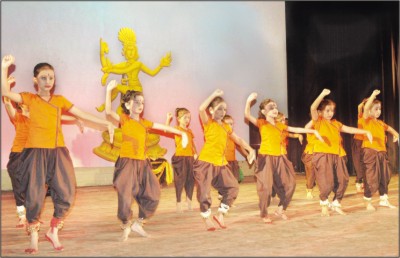
Students demonstrate different steps of Chhow dance at the programme. PHOTO: STAR |

