Land of refuge
Uttam Kumar Das
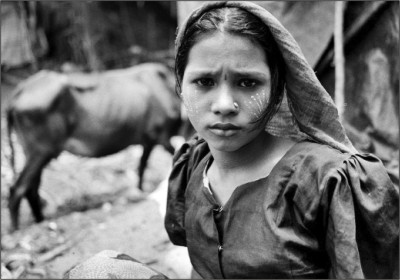
Bangladesh has been hosting thousands of Rohingya refugees from Myanmar for the last 16 years. According to the records of the government of Bangladesh and the UN refugee agency, UNHCR, there are now about 26,000 refugees living in two official camps in Cox's Bazar, a southern district bordering Myanmar. They are the remainder of some 258,000 Rohingyas who came to Bangladesh during 1991-92, after suffering gross violations of human rights at the hands of the military rulers of Myanmar. The government of Bangladesh registered this group of refugees, and extraordinarily (i.e. through an executive decision/order) recognized them as refugees. According to official claims, 237,000 Rohingyas have returned to Myanmar so far. However, local people believe that some of these refugees went to Myanmar to receive benefits from UNHCR and WFP, and later on came back to Bangladesh and mixed with the local population. There has been no repatriation since 2006. A total of 92 persons went back in 2005. On the other hand, there are an estimated 100,000 to 300,000 Rohingyas who are reportedly staying in Bangladesh without any status. Some of them even managed to migrate to different countries with Bangladeshi passports. A significant number of them have reportedly been enlisted in the voter rolls through various means, including patronization of a section of religion-based political parties. Indeed, Bangladesh is not a party to the UN Convention on the Status of Refugees, 1951, and it's Protocol of 1967. It also does not have any national legislation to deal with asylum or refugee issues. Though Article 31 of the Constitution guarantees equal protection of law for "every other person" staying in the country for the time being, however, there is a lack of judicial interpretation and common understanding of the clause. On the other side, Bangladesh has been a party to major international human rights instruments. It has also been a member of the UNHCR's Executive Committee since 1995. So, the state is already under obligation to extend protection to asylum seekers and refugees in the country. Empowerment through Law of the Common People (Elcop), a research and advocacy NGO, recently (05-07 May) organized a three-day residential training on Refugee Law at the Proshika Human Resource Development Center Trust at Koitta, Manikgonj. The United Nations High Commissioner for Refugees (UNHCR) sponsored it. Professor Dr. M. Shah Alam of the Department of Law, University of Chittagong, a former Member of the Bangladesh Law Commission said in the training that Bangladesh has been hosting refugees for years, and extending assistance and protection to them, although it has not signed the Refugee Convention. He observed that the government probably does not want to accept any legal obligation by being a party to the Convention. According to this expert on international law this is not the right stance. He observed that Bangladesh has already become a party to major international human rights instruments, which oblige it to protect refugees' rights anyway. So, no logic is valid here for not being a party to the Refugee Convention. Underscoring the need for a legal regime, and an institutional mechanism for refugee status determination (RSD) by the government of Bangladesh, Dr. Naim Ahmed, an advocate of the Supreme Court of Bangladesh and an expert on refugee law, said that accession would facilitate creation of an effective tool for the protection of refugees and identification of illegal immigrants in the country. Referring to the Rohingyas from Myanmar, he said that due to absence of a registration mechanism and status determination procedure, there is no authentic data on the Rohingyas and other foreigners staying in Bangladesh. A significant number of the Rohingyas have already got de facto citizenship here. In some villages in Bandarban district, bordering Myanmar, the Rohingya immigrants out-numbered the local Bangali population, Dr. Ahmed pointed out. The recommendations of different presentations during the three-day training included: - Bangladesh's accession to the Refugee Convention and it's Protocol.
- Adoption of a comprehensive national legal framework on refugees.
- Policy on the Rohingyas in Bangladesh.
- National judicial authority for refugee issues.
- Proper training for government officials and NGO workers dealing with refugees.
- Better and humane treatment for recognized refugees.
- Judicial and legal activism to set up a legal regime.
- Involvement of NGOs and civil society in refugee operations.
- Effective role of the international community and UN agencies to find a durable solution for the Rohingya problem.
- Initiatives of the government of Myanmar and Bangladesh.
- Continuous international support for care and maintenance of refugees in Bangladesh.
I am of the opinion that there should be thorough discussions and debates in the country on this issue, with participation of concerned experts, policy makers, representatives of development partners, and international and relevant UN agencies. The present government should pay serious attention to this. It has already decided to accede to two more UN Conventions (i.e. UN Convention against Corruption, and Convention on the Rights of Persons with Disabilities). So, immediate steps should be taken on the refugee issue, with a view to enacting a comprehensive policy and legal framework. Initiatives should be there for finding a solution to the plight of the Rohingya refugees as early as possible. The writer is a lawyer and researcher specializing on human rights and refugee law. Currently, he has been working as the National Protection Officer with UNHCR in Dhaka.
|