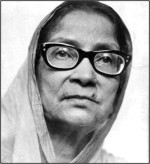
Sufia Kamal: The legend
Makhduma Nargis
Some years have passed since our dear Khalamma left us. But the legacy of this legendary figure remains. Based on my association with her for over three decades, what follows is my humble attempt to explore the relevance of the life and works of this great soul to the contemporary world.Sufia Kamal, during her seven decades of active life, had many faces: pioneer of women's liberation, fighter for democratic values, champion for the poor and disadvantaged the world over, and leading cultural and social activist. These were not separate issues to her. I would argue that all of them, to her, were an integral part of the struggle for a common humanitarian goal. I feel that her life-time achievements were the result of her intimate and comprehensive understanding of our society, forward looking approach, and her strength to take a moral stand on all emerging issues. Thus, this great lady in one life-time could achieve so much, and endear herself to all across the social and political divide. Unfortunately, in contemporary Bangladesh, such a multidimensional but highly focused approach is largely missing. Sufia Kamal was the president of the largest women's organization, Bangladesh Mahila Parishad, from its founding days till her death. Coming from a conservative Muslim family, she observed and nurtured women's emancipation to raise the status of women in the family, society and state. She realized the need for mainstreaming, empowerment and the slogan “Women right are human rights,” many years before these words entered the vocabulary of international women's movements. This was possible because the essential element in all her activities was to change the social attitude towards women. Even today, in this respect, women in Bangladesh have a long way to go, and it will be achievable only through perfect understanding of Bangladesh society at large, and its intrinsic strengths and limitations. Sufia Kamal was an ardent believer in democratic and secular values, and in women's rights as an integral part of the broader democratic rights, which had to be fought for by men and women together. She had been on the streets for democracy since the early 50's. All these years, she and Bangabandhu shared mutual respect. She, against all odds, fought against political and social distortions after Bangabandhu's death. Now, our country is passing through a critical time, trying to reinvent democratic practices and values. So, we need her presence more than ever. To her, democracy did not just mean election and power plays; to her, secularism did not mean only fair and equal rights for people of all religions; rather, religion has no role to play in influencing the decision making process of the government. I have rarely seen an individual so deeply religious, but still truly non-communal in letter and spirit. Thus, she embodies our motherland Bangladesh, whose people are deeply religious and generally non-communal. Over the last few years, religious extremists have been resorting to both constitutional and violent means to distort democratic values and sow the seeds of religious intolerance in public minds. She knew that these were the dark forces that try to push back all our achievements in democracy and women's rights. So we need, more than ever, a Sufia Kamal to fight back the trend. Sufia Kamal had the foresight and courage in taking principled and moral positions on all issues. It is not limited to the oft-quoted story of how she reacted to General Ayub Khan's remark that Banglees were animals. She had the courage to stand by the disadvantaged when others stepped back and dared not intervene. When greedy land grabbers evicted sex workers of Narayanganj, she was the sole voice to protest, and demand punishment for the clients and for those who brought these unfortunate girls to the flesh trade. She had the courage to fearlessly lead protest marches during the communal riotsHindu-Muslim or Banglee-Bihari. Still in captive Bangladesh, she had the courage to refuse to sign a statement favouring the Pakistani junta during the liberation war. More than ever today, we need such courageous social leaders. Sufia Kamal led cultural movements as part of her overall mission. She was president of Chhayanaut till her death. The songs of Tagore and Nazrul inspired her throughout her lifea believer in blend of nature and love for humanity. These two great Bangalees inspired her to achieve her singular mission to create a better and fairer Bangladesh. Sufia Kamal remains forever in our hearts. Dr. Makhduma Nargis is a freelance contributor to The Daily Star.
|