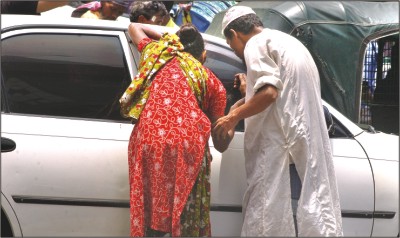
Organised gangs control begging business at traffic lights
City Correspondent
Physically challenged beggars of all ages, some with injuries and horrendous skin sores continue to create nuisance at almost every traffic signal of the city begging from commuters. Commuters in vehicles can have their day marred and psychologically scarred while responding to the gentle taps on their car windows and confronted with such public nuisance, standing there displaying the infected sores and begging for alms. Schedule 3, Item 57 and Section 150 of the Dhaka City Corporation Act 1983 clearly states that "begging unfortunately for alms or exposing or exhibiting with the object of exciting any deformity or disease or any offensive sore or wound" is a punishable offence. The offender may be fined a maximum penalty of Tk 5000 for the first offence. Thousands of other professional beggars crowd bus terminals, railway stations, market fronts, residential and commercial areas. According to commuters there are many beggars at busy intersections, who look perfectly healthy. Most of the city's traffic signals are also crowded by vendors selling items varying from fresh fruits, flowers to towels, maps, popcorns and pirated copies of bestsellers. Flow of traffic is often disrupted due to the presence of such a big working crowd shuttling between vehicles on major thoroughfares. According to several sources, at least three Dhaka based organised gangs control the traffic-signal-begging business. Generally each beggar is forced to hand over more than half of his day's earning to one of the gang members. A day's earning could range from Tk 150 to Tk 500, according to beggars. In turn the beggar is given accommodation, food and transportation. The stories of most of these physically challenged beggars start from the rural Bangladesh, where poverty, social prejudice and lack of rehabilitation facilities virtually outcast a person having physical disability. Exploiting the situation the gangs controlling begging in big cities pounce on the victims. At times the poor parents of such victims are promised a regular monetary allocation if they hand over their physically disadvantaged ward. The gangs take control of the person's food, shelter and transport in Dhaka and post the victims at different intersections. "I am glad my food and shelter are guaranteed by my boss, he also gives me new clothes during eid," said Physically challenged Morium Begum from Sirajganj begging at Farmgate intersection. Morium lost her legs to polio when she was a child. The police on the other hand are unable to control begging at traffic signals. Police officials said it has always been a mouse and cat game with the beggars. "When we try to catch them and send them to vagrant centre, we are told not to make the vagrant centre overcrowded, they are here at least making a living out of something while the society has rejected them," said a police sergeant at the Farmgate intersection.
|