Reminiscing exodus '71
Exhibition at Liberation War Museum
Karim Waheed
No one becomes a refugee by choice, yet currently there are around 10 million refugees worldwide. People become refugees when they are subjected to violence or persecution in their homelands. They see no other alternative and flee to a country they are often not familiar with, living in tents or slums, struggling for food, medication and education, most often being labelled as "unwanted elements" by the natives of that land.Bangladeshis are not unfamiliar with the concept. We do have our history of exodus. In 1971, during the Liberation War, around 10 million Bengalis from East Pakistan migrated to India, living as refugees in 829 camps all over West Bengal, Tripura, Meghalaya, Assam, Bihar and neighbouring areas. To observe World Refugee Day 2007 (June 20), Liberation War Museum has organised a photo exhibition at its premises. The exhibition was inaugurated by Pia Prytz Phiri, UNHCR representative in Bangladesh, on June 27. The exhibition is dedicated to the memories of Sufia Kamal and Jahanara Imam -- both of whom had made immense contribution to the Liberation War. Photographs and other memorabilia bring to light the plight of Bengali refugees cramped in camps as well as contributions of three women -- Mother Teresa, writer Maitreyi Devi and Anjali Lahiri -- who became "angels of mercy" to these distressed. Mofidul Haq, a trustee of the museum said, "Every year Liberation War Museum tries to mark the World Refugee Day through different programmes. This exhibition is an attempt to pay homage to the mothers who carried the dreams of a nation waiting to be liberated, with them to the refugee camps." Ziauddin Tariq Ali, another trustee of the museum said, "In 1971, 10 million refugees, living in inhuman conditions, gave the global conscience a wake-up call. Their cause mobilised campaigns around the world against the atrocities by the Pakistani junta." Ali recalled Sufia Kamal's involvement in the war and called her "the major inspiration for the Liberation Museum." According to him, "Sufia Kamal taught us how to be defiant in the face of repression without losing humility." Akku Chowdhury, also a trustee of the museum recalled an unfortunate period in the '90s when the nation "seemed to have forgotten its past." "Jahanara Imam led the Ghatak Dalal Nirmul Committee and voiced a demand to bring the razakars and other war criminals to justice," said Chowdhury. Saif Imam Jami, Jahanara Imam's son, said, "On June 24, I was privileged to open the Jahanara Imam Memorial Museum. I'll always remember three words my mother stressed on: Conviction, sacrifice and compromise. She used to say, 'Conviction is what drives us. We are Bengalis first and then, Muslims, Hindus, Buddhists and Christians. Without conviction one cannot make sacrifices. When you can't make sacrifices, you often find yourself making compromises.'" A photo taken at 'Khelaghar' shows smiling children, a stark contrast to the bleak images surrounding it. Maitreyi Devi, set up 'Khelaghar' for the children of refugees from East Pakistan. Photos feature Sufia Kamal speaking at a public procession before the war broke out. Family photos of Jahanara Imam show her with the son she lost to the war. Also on display is a poster of "Strings & Stars", a fundraising show for Bengali refugees, held in Mumbai in '71. Leading Indian moviestars including Raj Kapur, Dilip Kumar, Ashok Kumar, Sunil Dutt, Amitabh Bachchan, Dharmendra, Nargis, Saira Banu, Sharmila Tagore, Waheeda Rehman and several others, along with ace musicians took part in the show. A translation of noted Indian poet Kaifi Azmi's verses on the refugees pouring in from East Pakistan, makes its place among the memorabilia. One complaint of the visitors was that several photographs do not have captions. Filmmaker Jahanara Noori presented a documentary on Julian Francis and Sanghamitra Desai, both of whom had worked at the refugee camps in India during 1971. The exhibition will continue till July 3.
|
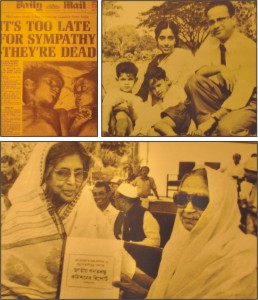
(Clockwise from top left) A news on Bengali refugees published in the June 7, 1971 issue of Daily Mail, Jahanara Imam seen with her family, Jahanara Imam (L) with Sufia Kamal |

