Molla Sagar and his three daring documentaries
Fayza Haq
Three of Molla Sagar's documentaries were recently screened at Alliance Francaise. These are interview-based films. Dudh-Koyla, a 22-minute film, took him nine months to complete. The film deals with the views of people, living in Fulbari, about the coal mine that was to be there. Over a lakh of people would have had to leave their homes and the film portrays their resentment.Another documentary by Sagar, Shironamheen 23 July, deals with the police brutality on the female students of Shamsunnahar Hall on the night of July 23. A successful movement followed and the film is a record of it. The students went on fast at the Shaheed Minar and demanded the resignation of the VC and proctor. There was a report on what actually took place but which is yet to be published. The film shows how and why the students were attacked. The reaction of the University authorities was also recorded. Sagar also captures other social events taking place alongside the student agitation, such as the dance programme at the National Museum, implying how life proceeded untouched by the tragic incident, even right next to the Dhaka University campus. The third documentary Cholo mon natok dekhte jai (“Lets go and watch a play”) deals with folks songs and the views of rural singers from remote corners of Bangladesh. Prior to these films Sagar made O Pakhi and O Pakhi reeti kotha, on the subject of bird hunting. Sagar started off as a student of fine arts but gradually moved to photography. He was keen on films from the outset. He is inspired by Ritwik Ghatak and Satyajit Ray. He finances his films through his photography.
|
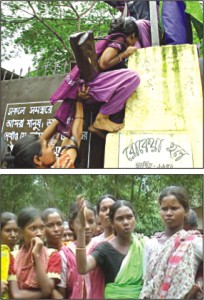
Stills from Shironamheen 23 July (Top) and Dudh-Koyla |

