TechSpotlight
CommunicAsia 2007
Opportunities for digital convergence
Hana Shams Ahmed and Nafid Imran Ahmed, back from Singapore
Like everything disciplined in Singapore, the thousands of attendees at CommunicAsia 2007, the 18th instalment of the region's information technology exhibition and conference, had a clear idea about the enormous business opportunities available there. The exhibition took place from the June 19 to 22 at the Singapore Expo, a 10-minute drive from Changi Airport with a total area of 69,000 square metres, and participated by over 2,400 exhibiting companies from 65 countries or regions. The display of new technology was indeed a feast for the eyes. Some of the key technology highlights were the following 3G/HSDPA; broadband wireless; DMB/DVB; embedded technology/RFID; enterprise networks and technologies; infrastructure solutions; IP technology; IPTV; Fixed-Mobile-Convergence (FMC); mobile and fixed wireless technologies; mobile communications, content and applications; Next Generation Networks (NGN); network equipment; satellite communications and technologies; security; smart cards; VoIP; Wi-Fi/WiMAX; and wireless devices. IPTV and IP Phone
IPTVs and IP Phones were the biggest consumer technology 'wow's at the expo because of the enormous possibilities and cost savings in case of IP phones for big corporations. Although IPTVs are yet to reach the mainstream market, multinational corporations and banks are already licking their lips at the prospect of the myriad of interactive services that would enable television to offer a lot more than just pure entertainment. More than just delivering content, IPTV is about enabling users to access all kinds of services at the click of a button sitting right in front of their televisions from monitoring their office CCTV, to gaming, to buying products and availing services, to video conferencing and availing banking services, the possibilities are endless. While only a handful of service providers are offering IPTV services across Asia, there are not many fully-scalable, advanced IPTV operations yet. Mobile Gaming
According to Informa Telecoms and Media, the worldwide market for mobile games will grow from $2.41 billion in 2006 to $7.22 billion by 2011. Other industry experts are more ambitious. Whoever maybe right about their projection, it is needless to say mobile gaming is a big market and with more and more young people latching on to advanced 3G handsets which provide new levels of quality and gaming experience for these huge groups of young people. And exhibitors in CommunicAsia 2007 were showing off all that is new and happening in this sector. VoIP
While in the rest of the world, VoIP technology has already moved into the telecom mainstream with broadband and other types of IP telephony, the Bangladesh government's indifference to open up this gold mine of a technology is nothing but a step back in time. CommunicAsia 2007 reveals how the revenue and profit opportunities within the VoIP wholesale market are boundless. A number of companies have developed VoIP strategies to take advantage of the business opportunities that this fantastic technology provides. According to CommunicAsia sources VoIP services have been growing in triple digits, both in terms of revenue and traffic. According to TeleGeography Research, international VoIP traffic grew from less than 10 million minutes in 1997 to 61.8 billion minutes in 2006. For a developing country like Bangladesh, a big percentage of whose GDP is generated from remittances sent by migrant workers, using cost effective VoIP services over standard PSTN is the only rational option to take. GSM providers in Singapore and most other countries already offer VoIP call options from their handsets. It's fast and reliable and licence costs are set at a bare minimum. Telecom experts believe that all voice will ultimately be carried through IP, completely replacing traditional PSTN/TDM switches.
India and Sri Lanka are already bearing the fruits of this technology to the fullest earning a huge amount of revenue for their countries making use of the great number of enthusiastic young people willing to work at minimum per hour rates, outsourcing taking place from countries like the US and UK where such rates are enormous. Call centres have thus become the next big thing after the readymade garments industry. Bangladesh has a pool of young, enthusiastic people just fit for this purpose. Mobile Entertainment
CommunicAsia 2007 has huge respect for the needs of the young cell-phone dependent generation and thus mobile entertainment was of great value to many exhibiting companies there. Many industry experts believe that mobile entertainment is the next wave of growth in the Asia-Pacific mobile industry. The Bangladesh market is no less different. Besides gaming services, messages, multimedia messages, wallpapers, photos, music, ringtones, callerback tones have all become extremely popular with the new generation. WiMax
WiMax, rumoured to be the newest big thing in wireless broadband technology, has finally come out of its planning box and is now operational. Since this is a backend technology consumers will not be able to directly see its advantages, although business corporations are fast latching onto this technology. Countries like Sri Lanka and Pakistan are pinning their hopes on WiMAX to provide service to underserved areas and Malaysia and Thailand hope this technology will help them provide broadband connectivity to rural and remote areas. NSN@CommunicAsia 2007
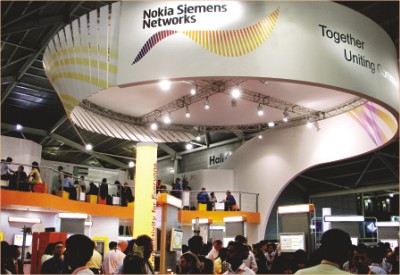
Following the big merger just a year back, for the first time, communication services provider Nokia Siemens Networks (NSN) participated at the CommunicAsia and showcased their latest solutions and technologies. NSN's key highlight at the event was their solution, Village Connection, which will help build rural connectivity village by village, enabling operators to extend their reach to remote villages and NSN are already in talks with major telecoms operators in this region for implementation of this new solution. "We have had lots of discussions with operators as well as regulators. The product will be made available in the second half of 2008 and the trials will start in the beginning of next year," Michael Murphy, head of technology, Asia Pacific, said in an exclusive interview during CommunicAsia. This new low-cost wireless communication solution could enable operators to provide mobile services for as low as $3 a month and offers to build rural connectivity on a franchise-based business model between an operator and local village entrepreneurs. The solution is likely to comprise GSM access points located in villages and regional access centres. A village would typically host one access point module comprising GSM radio, power and IT hardware and software components. “Our vision is to connect 5 billion people by the year 2015,” said Rajeev Suri, head of APAC, NSN, mentioning that India, Indonesia and Bangladesh are among the top three markets with enormous growth potentials in this region. When asked whether Bangladesh should move to 3G or WiMax, the officials mentioned that it's a decision that has to be taken by Bangladesh, but they are ready to deliver every kind of solution. They also mentioned that Spectrum allocation is a major issue in the Bangladesh market and has to be resolved in order to have a smooth mobile phone service. Suri also mentioned that as device evolution brings the mobile internet experience to the consumer mass market, total data traffic in mobile networks will rise remarkably. To offer these services efficiently, a continuous development of cellular networks, cost saving and enhanced user experience by simplified network architecture, such as I-HSPA and LTE (long term evolution) are required. NSN's HSPA (high speed packet access) solution and LTE were demonstrated at the event. To understand the capacity and importance of the show one only has to look at the names of the companies Singtel, Star Hub, Telecom Malaysia, British Telecom, Equinix, IDA, CNET etc. are just tips of the digital icebergs that made this show THE place to showcase the advancement and potential of the field. All the big players were there discussing and competitors are not seen as competitors, but potential for expansion and diversification. What was blatantly obvious was the almost non-attendance of any representation of Bangladeshi companies in CommunicAsia 2007. Despite big names in the telecom sector and an ever-increasing consumer base combined with overseas companies looking for investment opportunities in such consumer-concentrated market, this absence is distressing indeed. ITEL Billing, a billing company with customers all over the world was the sole representation of Bangladesh at the expo, which was a very encouraging mark. It is hoped that other companies will follow suit in the next such event and Bangladesh telecom companies will take advantage of the huge opportunity CommunicAsia provides.
|