Poetry from the Past
Where art thou, Feroz?
Rubana
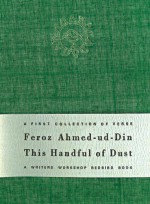
Feroz Ahmed-ud-din is not a familiar name in poetry circles in Dhaka. He studied English at Dhaka University in the late '60s and early '70s. I met Feroze when I was working in Thai Airways International a decade later. He was then very much the stern executive whose poetic sensibilities did not show. Therefore, when in October 2006 Professor Kaiser Haq handed a copy of his This Handful of Dust to me, I was pleasantly taken aback. Feroz has published only one collection of poems, that too way back in 1974, from Professor P. Lal's Writers Workshop in Kolkata. When I looked for it at' The Nook' (Writers Workshop's outlet in Lake Gardens), I found no unsold copies of the book. I ventured into the archive and eventually found the last two copies of Feroz's book. This Handful of Dust - ironically, was covered under layers of dust- had a sari-cloth bound cover and was neatly calligraphed by Professor Lal. Unlike other volumes, there was no introduction to the author. There was, however, a foreword from Professor A.G. Stock, a visiting British professor with a long association with the English department, University of 'Dacca'. A.G. Stock had wonderful words to offer about Feroz. She also mentioned meeting Feroz in 1972 and said that he was an improved poet in 1974. She wrote that "this first book has more than promise", and called his voice a "quiet" one that came from a young country "long submerged in bloodshed". Feroz's poetry volume has 28 poems, of which only two poems were published earlier and the rest were all freshly written and published by Professor Lal. Surprisingly, for a young mind, silence, darkness and death are the poet's favorite themes. Professor Stock mentions his father's demise, which partially explains his mood throughout his book. The beautiful prose poem that opens the book was also written shortly after his father's death and is the title poem of the volume. The image that this poem conveys is of the handful of earth that Muslims usually strew on the fresh graves of the loved ones: This handful of dust
scattered on the face of time
never blots out the sun
but deep inside
there is always an eclipse. Feroz also won the All-Pakistan Poetry Prize Contest early in 1971 with 'On My Twenty-Second Birthday' in which he refers to the devil always ready to hand death over to him on a platter. 'Blue Song: Bangla Desh 1971' is a poem that I would like to quote in its entirety: songs have gone out of fashion
in the deep trenches of war
here the lullaby
is a sudden bullet. The struggle to overcome the fear of the death and the gradual disintegration of the self complete this poet's world. With lines like: "Grass breaks like ice-cubes of desire", the poet gropes for a tool to battle: ...time's iron
enclosers in the dark, clasping
frightened
strangely beating hearts. Every poem in the volume has a final statement at the end. All the last two lines or three have a final voice in the poem. For example, in the poem 'Flowers', the poet describes the abundance of flowers but he slowly takes his readers' hands and leads them to the unbarred doors and cautions them against "the darkness inside" which: will creep towards you
engulf you
take the form of wolves
and
devour you. A 'September Morning', for Feroz, is also not above the "gray ash" that falls over the city from the previous night when the night's "burnt cinders" are "scattered by the sun". This poem too, ends with a clear statement: Inside each sunrise
frantically the morning
gropes for a day. 'The Day Death Was Born' evokes an image of death being visually connected to ...entangled
mess of overhead electric wires
and crows
that dance like memories
without sound. Death, in this poem is being towed and is born anew amidst an "anesthetic abortive silence". The poem 'Gypsy' has a young man in the poem who is a vent that the poet was looking for. He seems to carry an assurance of life that the poet was desperately trying to cling to. Knowing that his end is near, Feroz takes a good look at the newcomer and yet is not happy: At the end of a long journey
one has always illusions of a home. The most tragic poem in the collection is 'Poem Untitled' where Feroz handles a tragic theme with maturity that was extremely unusual and way beyond his youth: You ask me how we all committed suicide, it was
easy...
From then on our corpses have clung to each other
for the fear of straying away
...we kept our deaths out
of our family albums. The last poem, 'Cinderella' that I'd like to quote, once again can be categorized as a death poem. Here time seems to be slipping out with smoke filling lungs and cigarette ends writhing on the floor. Feroz ends brilliantly in this poem: Here when contracts end
no final handshakes
no grinned goodbyes.
Only moving carriages
that turn into pulp
and mice running through the night. While digging into the archives of Writers Workshop, I came across Feroz Ahmed-ud-din four times in different volumes of 'The Miscellany', the bi-monthly publication of the Writers Workshop. The first time was in the July-August 1976 issue, where he was discussed by Mary Ann Dasgupta, She compares Feroz's book with Nasima Aziz's One More and mentions that both the manuscripts had arrived in the post almost on the same day. Dasgupta mentions Feroz and Aziz as "fresh, authentic voices of poetry" and adds a quick note of gratitude to Prof P. Lal for publishing "untried talent." He was in Volume No. 64, July-August 1974. Feroz Ahmed-ud-din was published for the second time under the section reading 'A bunch of poems'. However only 19 were published out of the total of 28. Then I came across Lakshmi Kannan's write-up on Feroz in No. 72, November-December 1975. Here again Feroz is compared with Nasima Aziz. Lakshmi recollects a Workshop group that had "gathered for a poetry-reading session at the flat of Poppy Ayar, Regional Officer, USEFI." She adds, "It was a day of Nasima Aziz and Feroz Ahmed-ud-din, two Muslim poets who had brought out their first book of poems by WW." Lakshmi mentions Feroz being introduced by Prof Lal and says he had "an ornate Muslim" style. She refers to his poem "Mirrors" and praises its visual reversal of letters having the "collegiate touch to it." Stand face to ecaf
Communicate
Hand to dnah
Tongue to eugnot
sweet
to
bitter In the same piece, Lakshmi talks about P.N.Shastri being the first one to point out that as a Muslim poet, Feroz too has followed the tradition of not referring to any gods. He thought that this practice had offered a freshness to the poet's inspiration. Lal however had disagreed. He thought that the absence of gods in poems could be a negative factor as well. The last time I discovered Feroz was in Volume 88, July-August 1978. That particular issue had Feroz playing with transcreations of 15 Urdu poems. His attempt to work with poems of Mir Taqi Mir(18th century) is remarkable : Do not give length
and breadth to the nest, O bulbul.
For this handful of feathers
a handful of twigs will do. Publishers and poets are a tangled topic of discussion. . Many need to be chased in order to bloom. Publishers throughout the world are largely losing interest in poetry because a few Bob Dylans of the world sound better as poets than vocalists and because melody and beat add more sense to the words a poet utters. In the world that we live in, any thinking mind is a mind of poetry; any philosophy is best comprehended when coupled with the imagination of verse. Feroz is an outstanding example of this. A poet like Feroz Ahmed-ud-din would have never come my way had it not been because of a chance reference. The fact that he was published in India and not in Bangladesh is a surprise. The fact that he was discussed in India and not in his hometown is a disappointment. Where art thou now, Feroz? And will you please write more? Rubana is a poet currently pursuing higher studies in English at Jadavpur University.
|