|
|
Committed
to PEOPLE'S RIGHT TO KNOW |
|
 |
|
Vol. 5 Num 1095
|
Sat. June 30, 2007
| |
|
| |
|
Literature
|
Book Review
Farhad Ahmed
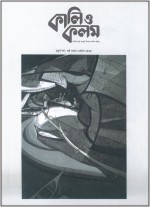
The latest issue of Kali O Kolom (July 2007, editor Abul Hasnat; published by IceMedia Limited of Bengal Group) underlines our abiding love affair with Rabindranath Tagore, with the opening article by Professor Anisuzzaman on the poet, titled appropriately enough, 'Takay Jana Furai Na'. It begins with an amusing anecdote: that on the poet's 80th birthday Gandhi sent him a congratulatory wire saying "Four score not enough. May you finish five score." To which Tagore replied back, "Four score impertinence, five score intolerable." After recounting which Professor Anisuzzaman launches into his dissertation by commenting that it is really not the length of one's life, but what one does with it. Next is Abedin Kader's discussion of Amartya Sen's continuing preoccupation with identity and the self, framed in the terms of the latter's book Identity and Violence. For those so inclined, there are also two well-researched essays -- one on Beckett by Amitav Choudhury, and the other on Foucault by Abul Hossain Bhuyian. For readers of short stories (one reader has written to say that since the short story form occupies a special place in Bengali literature, this section should be expanded in the journal), two are of special mention. One is 'Pagli' by Anowara Syed Haq (with illustrations by Qayyum Chowdhury), and the other is 'Tala Moricher Hoi-Choi' by Zia Hasan -- both seem to hum with an existential disquiet which reflects the tonalities of modern Bangladeshi life. In the art section Jahid Mostafa's 'Shilpi'r Chokhay Muktijuddho' is an informative look at the art inspired by our independence struggle in light of the exhibition held from 7-20 May at the Liberation War Museum, while Shahed Shojol discusses the pat paintings of Shambu Acharya. Amid all the other offerings on display in the journal (drama and book reviews, serialized fiction, poetry, essays, etc.) two are notable for being on opposite sides of the spectrum. One is Anisul Hoque's engrossing 'Ora Amar Mukh'er Bhasha Kaira Nitay Chai: Mahmuda Hamid'er Chithir Jobabay Ochilai', where the popular novelist/writer discusses his own writing and Bengali language in terms of two of his novels, displaying the considerable linguistic resources this writer brings to the practice of his craft. At the other end is a book review by A Z M Abdul Ali of Tahmima Anam's recently published A Golden Age. It is in fact, not much more than a lengthy plot summary of the book -- 7 pages and 20 columns -- that no doubt will ruin the reading of the actual novel for potential readers. While the review does note, and forgive, the 'factual' errors of the work, it fails to analyse the novel in terms of English writing by Bangladeshis, or South Asians, or even of fiction on 1971, and reductively treats it as if it were completely isolated from such a frame. One is forced to conclude that English language works should be reviewed in Bengali publications (and vice versa) by reviewers sufficiently at home in the imaginative works of both languages. Farhad Ahmed is a free-lance translator/reviewer.
|
|
|
|
|
