Special economic zone soon for organised industrialisation
Says industries adviser
Star Business Report
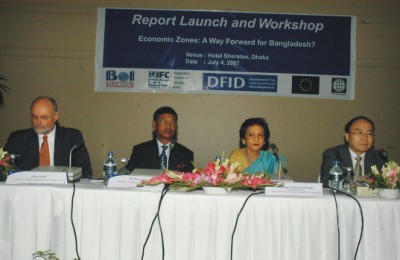
The government is mulling to set up a special economic zone (SEZ) shortly in order to give the growing unplanned industrialisation into an organised shape.The Board of Investment (BoI) already has started a feasibility study across the country to find out a suitable place for such a zone, aimed to attract huge local and foreign investment. Industries Adviser Geeteara Safiya Choudhury in a workshop yesterday hinted at setting up an SEZ saying, "We need a special economic zone due to prevent rapid growing of unplanned industrialisation". The workshop marking the release of the World Bank report 'Bangladesh: Piloting Reform through the Development and Management of Economic Zones' was jointly organised by Board of Investment, IFC Bangladesh Investment Climate Fund and World Bank at a city hotel. The adviser said, "We must be careful that zones do not end up benefiting big business with little positive effect on a greater community. That is why we must consider large-scale zones in order to have significant economic impact on the areas where they are established." The existing policies are not feasible for systematic industrialization, she admitted, also pointing it out that the present pace industrialisation is inadequate to create required employment generation. She said, "We would like to create a policy and regulatory framework that will allow public-private partnerships in zone development and management". The industries adviser said, "We have a rapidly growing work force that cannot be absorbed by agriculture. Bangladesh will need to provide jobs to an additional 100million people by 2015. Well-planned industrial growth is very vital to providing the number of jobs needed." Md Nazrul Islam, executive chairman of BoI, also reiterated the need for establishing a special economic zone in the country. "We have conducted a study in some parts of the country, including Sylhet and Chittagong, for a suitable place for SEZ," he said. He, however, said the process of establishment of this zone is now at primary stage. Speaking at the workshop, Zhu Xian, country director of the World Bank, said the success stories from international arena show that economic zones can catalyze a multiplier effect on the economy by attracting investments, both domestically and internationally. Citing an example of zones in the Dominican Republic, he said these zones have accounted for over 80percent of total exports of the country. And only one zone in China created jobs for 3million people, he added. "I do believe that the potential and opportunities presented by zones are profound and Bangladesh needs to consider how to strategically capitalise on such potential now," Zhu Xian said. "EPZs in Bangladesh have had success in attracting nearly $1.1 billion in total investment in 1983-2005, account for nearly 20 percent of annual exports and bring in 25 percent of total FDI, said James Crittle, head of IFC Bangladesh, the private sector development arm of the World Bank Group. "But there is greater potential, which has been tapped in other countries", he said. "This report is a beginning. We will continue to help government and the private sector to explore options for expanding zones to help promote an conducive investment climate," he said. Zaidi Sattar, senior economist of World Bank, and other officials of IFC Bangladesh and Board of Investment took part in the workshop.
|