Introduce secular edn system to ensure social justice
Speakers say at seminar
Staff Correspondent
A secular education system should be introduced in order to build a true democratic society and ensure social justice and communal harmony, experts on law, media and development said at a seminar yesterday."We require a secular democratic education system... and a government of the people and for the people," Justice Golam Rabbani said at the seminar on 'Relevance and impact of conscientisation and mobilisation as a development strategy in the 21st century'. Nijera Kori, an NGO, that is working to conscientise the poor and landless people, organised the seminar at Brac Centre Inn in the city where three studies on the impact of its activities since 1980 were presented. Prof Abul Barkat presented a study on 'Development as conscientisation: The case of Nijera Kori', Dr Naila Kabeer on 'Constructing citizenship from the grassroots: What difference does Nijera Kori make?', and AKM Masud Ali of Incidin-Bangladesh presented a study on 'Palm-print of identity: Impacts of the emerging identities of organised rural landless'. Justice Rabbani, who chaired the seminar, said religion is a private matter where a person builds communication with his creator. Education, therefore, should be secular in general, he said, referring to a High Court verdict in 2001 declaring all kinds of fatwas (religious edict) illegal and unconstitutional. Secular education through media and at educational institutions is needed to institutionalise democracy, which is a major instrument of development, said Nurul Kabir, editor of The New Age. Referring to the state of emergency, he said, "We want a political process, but we also saw that political parties were not following democratic principles." He also suggested expansion of the activities of Nijera Kori, which work to unite the poor and victims of exploitation and educate them about their rights and responsibilities, so that they can bring changes to themselves and society. Dr Atiur Rahman of Unnayan Samannay said economic efforts could be incorporated into the conscientisation process for long-term impact. Greater connectivity through radio, television, newspapers and internet should be built to make information accessible to more and more people, he said. On democratisation, he said the countrymen should be realistic in their expectations from the political parties. "Don't think Bangladesh will be a Switzerland in a day." Dr Naila Kabeer said Nijera Kori has made a significant difference at local levels by changing the attitude of local courts, leaders and journalists towards the poor and marginalised people. Nijera Kori Coordinator Khushi Kabir said, "When people are conscientised, they can realise the rights enshrined in the constitution, identify their own problems and solve them by themselves." Research Director of Bangladesh Institute of Development Studies Dr Simeen Mahmud also spoke.
|
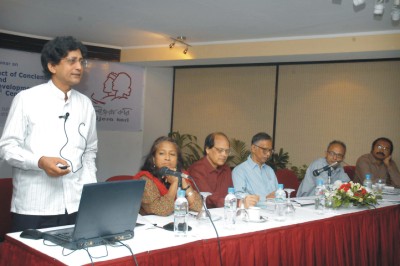
Prof Abul Barkat speaks at a seminar at Brac Centre Inn in the city yesterday. On his left are Dr Naila Kabeer, Dr Atiur Rahman, Justice Golam Rabbani, Nurul Kabir and A K M Masud Ali. PHOTO: STAR |

