Sense & Insensibility
Tajuddin Ahmad: The lonely warrior
Shahnoor Wahid
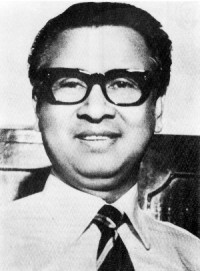
On Monday, the 82nd birth anniversary of Tajuddin Ahmed came and went by without making much of a noise. Can we expect a grand celebration of his birth anniversary one day? Does he not deserve one? Is his memory fading away from our collective minds? Will our next generation remember him at all? These are questions worth delving into, since laudable attempts are being made at the moment to recognise and restore the rightful place of great national leaders along with that of Bangabandhu Sheikh Mujibur Rahman, the chief architect of Bangladesh. In fact, the illustrious political career of Tajuddin and his contribution to the creation of Bangladesh will remain an inspiration for all freedom loving peoples of the world. But, unfortunately, the apathy and disrespect that has been shown to him since his assassination will go down as a nation's collective story of shame. And we must correct ourselves at the first available opportunity. With such thoughts clouding the mind, one tends to get pensive thinking about this man of substance -- a lonely warrior, a true patriot, a Bengali by heart, an architect of Bangladesh. He was a thinker politician, a philosopher and a visionary. And at the same time he was capable of undertaking colossal responsibility and delivering the goods too. Who does not know how he shouldered the responsibility of steering the liberation war in 1971 on behalf of Bangabandhu Sheikh Mujibur Rahman, and coming out victorious on December 16. Tajuddin Ahmed's association with Bangabandhu goes back to the fifties. He was the constant companion of Bangabandhu. The latter never took a decision without the approval of the former. In fact, Bangabandhu and Tajuddin were complementary to one another. They fought many a battle together to carry forward the ultimate agenda of obtaining the freedom of the Bengalees and creating a homeland for themselves. Tajuddin Ahmed took the cue from Bangabandhu's March 7th speech, and prepared himself for any eventuality. Accordingly, after the crackdown on March 25 he immediately started his ground works for launching the war of liberation against the occupation force. He knew that the period of talking was over. It was time to trade bullet for a bullet. The amazing story of his organising the liberation war with more enemies around than friends has taken a legendary proportion by now. And yet the new generations know so little about this freedom fighter. A short take on Tajuddin Ahmed from a biography
"Tajuddin Ahmad (1925 -- November 3, 1975) was a prominent leader of the Awami League. In 1971, he successfully headed the government at Mujibnagar and was instrumental in forming the first government of the Peoples' Republic of Bangladesh on April 10, 1971. Tajuddin Ahmad obtained a Bachelor of Arts degree with honours in Economics from Dhaka University in 1953. He also obtained a law degree. As a student he was moved by the inequalities in society and became an activist and a social reformer. Tajuddin Ahmad also became active in the Muslim League and the Pakistan movement, and later organised the student wing of the Awami Muslim League in 1949. At this point in life he associated himself with Hussain Shaheed Suhrawardy and Sheikh Mujibur Rahman. Tajuddin Ahmad became involved as an active organiser of protests and other activities during the Language Movement of 1952. He was arrested by the police and was imprisoned for several months. After his release, he was elected to the East Pakistan Provincial Assembly in 1954, but was arrested following the dismissal of the A. K. Fazlul Huq-led government. He was arrested again, following the imposition of martial law by Ayub Khan in 1958. Tajuddin Ahmed got deeply involved in the pro-democracy movements led by the Awami League and other political parties in the then East Pakistan. It was in 1966 that he organised protests against the arrest of Bangabandhu on charges of sedition. He also took part in the round table conference in Rawalpindi, convened by Ayub Khan to resolve the crisis between the government and the opposition parties. In 1970, Tajuddin Ahmed became a member of the National Assembly of Pakistan. But his greater role in our national history was yet to be played, and he did not have to wait long. It came in the month of March, 1971, following the arrest of Sheikh Mujibur Rahman by the Pakistan army, when the worst genocide in world history began on the soil of Bengal. Ahmad organised a government-in-exile, popularly known as the Mujibnagar government, to win his nation's freedom. Ahmad named the capital Mujibnagar, after Sheikh Mujibur Rahman. The oath-taking ceremony of the first government of Bangladesh took place on the soil of Bangladesh, in Meherpur, Kushtia, on April 17, 1971. As the first prime minister of Bangladesh he organised a guerrilla warfare with the active participation of Bengali civilians and armed forces. During this period, Ahmad had to face vehement intra-party strife led by Khandokar Mushtaq Ahmad, who conspired to harm the national struggle for independence through a failed attempt to form a confederacy with Pakistan. Among Ahmad's great diplomatic achievements were to win international support and recognition of Bangladesh as a sovereign nation by the government of India and Soviet Union. After the independence of Bangladesh, Tajuddin Ahmad returned to Dhaka on December 22, 1971. In the subsequent cabinet formed under Sheikh Mujibur Rahman, Ahmad was given charge of the ministries of finance and planning. He was also appointed member of the committee in charge of writing the Constitution of Bangladesh. His assassination
When Sheikh Mujibur Rahman assumed the title of president and banned other political parties in 1975, Ahmad opposed the forming of one party system known as Baksal. When Bangabandhu was assassinated on August 15, 1975, Ahmad was kept under house arrest on the very same day. Later, on August 22, he was arrested with other political leaders by the regime of the new president Khondaker Mustaq Ahmed and imprisoned at the Dhaka Central Jail. On November 3, in what became infamously known as the "Jail killings," Ahmad along with Syed Nazrul Islam, A. H. M. Qamaruzzaman and Muhammad Mansur Ali were killed on the direct instruction of Khondakar Mushtaq Ahmed. And, thus, a great son of the soil was smote down, and we say in the words of Shakespeare: "Woe to the hand that shed this costly blood." Shahnoor Wahid is a Senior Assistant Editor of The Daily Star.
|