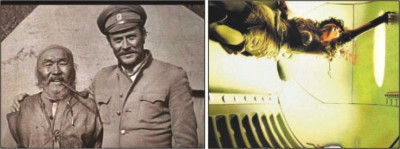
Three-day film screening session begins
Cultural Correspondent
As part of its monthly World Film Manifestation Programme (WFMP), Dhaka University Film Society (DUFS) has arranged a three-day film screening session at the Russian Science and Cultural Centre Auditorium. Beginning yesterday, the session titled "Contemporary Far Eastern Cinema" ends tomorrow. It is the 53rd session of WFMP organised by DUFS. Films included in the screening session are Not One Less (China), Good Morning (Japan), 2046 (Hong Kong), Dersu Uzala (Japan), Come and See (Russia) and Burnt by the Sun (Russia). Chinese film Not One Less (1999) directed by Zhang Yimou (China) is the winner of Venice Film Festival " Golden Lion" Award in 1999. Not One Less features the struggle of the Chinese to overcome poverty. Japanese film Good Morning (1959) by Yasujiro Ozu (Japan) is a comedy, which features Westernised suburban Japan in the late 50's. Portraying the disturbance created by two young boys for a TV set, it focuses mainly on the daily lives of a small community and the way its members interact. 2046 directed by Wong Kar Wai is a Sci-Fi movie. Made in Hong Kong made movie portrays a science fiction that may occur in 2046. Dersu Uzala (1975) directed by Akira Kurosawa (Japan) is the Oscar winner of 1976 under Best Foreign Language Film category. The film features a Russian army explorer who is rescued in Siberia by a rugged Asiatic hunter renews his friendship with the woodsman years later when he returns at the head of a larger expedition. Come and See (1985) directed by Elem Klimov (Russia) is a film on World War II. Set against Byelorussia Come and See features massacre created by the Nazis. The movie also portrays determination of the people of Byelorussia to resist the attack. Burnt by the Sun (1994) directed by Nikita Mikhalkov is the Grand Prize of the Jury winner of 1994 at the Cannes Film Festival. Set against Russia in 1936, Burnt by the Sun features a revolutionary hero named Colonel Kotov. Colonel Kotov impersonates a character very familiar to the Russian mentality: He is tall, strong, authoritarian, but at the same time-- protective, warm-hearted, charming and prone to jokes. He is about just as sympathetic as the gruff milkman with a heart of gold in "Fiddler on the Roof". Although he is a military, he is not the kind of guy you think as having blood on his hands. But of course Lenin and Stalin's aura over Russian people was also partly due to the fact that they represented strong and protective father figures.
|