India elects its first woman President
Mahmood Hasan
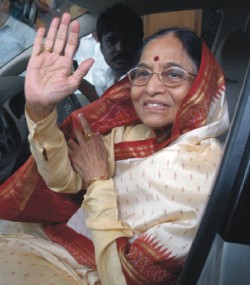
A presidential election for any country is an important national event, and if the country is large as is India it evokes keen interest among its neighbours. The president of India is head of state, supreme commander of the armed forces and the chief guardian of the Constitution. He also exercises immense power, can dissolve the parliament, call for fresh elections, and can even declare war on another country but all on the advice of the prime minister. It is, ostensibly, an immensely powerful post but is, in reality, a ceremonial sinecure. Indian lawmakers went to the polls on July 19 to elect their 13th president. Mrs. Pratibha Patil was declared elected on July 21, and will be sworn in on July 25 for a period of 5 years. The incumbent, President Dr. A.P.J. Abdul Kalam, shall complete his term on July 24. Unlike the Lok Shabha elections, which are based on universal adult franchisean Electoral College indirectly elects the president. The 4896 members of the Electoral College come from all the parliaments; Lok Sabha -- 543, Rajya Sabha -- 233, and the state assemblies -- 4120. As each of these Electoral College votes has weightage, the calculation procedure is complicated, but, generally, a candidate winning the majority of these votes is declared the winner. Dr. Kalam was not in the fray as the Left Parties were against giving a second term to him. At a function recently he remarked that he would leave Rashtrapati Bhawan with only two small suitcases. No president in India has done two terms except Rajendra Prasad (1950-1962). This year there were 84 candidates in the race. Only two candidates survived the scrutinyVice President Bhairon Singh Sekhawat (who was also Governor of Rajasthan) and Mrs. Pratibha Patil, the incumbent Governor of Rajasthan. Some of the well known names which were doing the rounds in Delhi for some time were Joyti Basu (former chief minister of West Bengal), Pranab Mukherjee (foreign minister), Dr. Karan Singh (son of Raja Hari Singh of Kashmir), Shivraj Patil (former speaker and home minister), Sushil Kumar Shinde, Somnath Chaterjee (incumbent speaker), and several others. Normally past presidential elections in India have been built on consensus. But this time the election for the first citizen of India had taken a rather unusual twist. Every party and alliance fielded a candidate. But since the Lok Sabha and several state assemblies are under the control of UPAnumber wiseCongress had the ultimate say. On June 14, the Congress-led United Progressive Alliance (UPA) announced Mrs. Pratibha Patil, the Governor of Rajasthan, as its candidate for the presidential post. The high-minded Left Parties, unwilling to see Bhairon Singh Sekhawat as head of state, quickly gave their consent to the UPA candidate. After all, do they not "support-UPA-from-outside?" From the manner in which Congress went about this nominationit looks like they wanted a loyal president at Raisina Hill, where the Rashtrapati Bhawan stands. The opposition National Democratic Alliance (NDA), led by the BJP, decided to support independent candidate Bhairon Singh Sekhawat. Congress knew well that the veteran Sekhawat would certainly not be a pliant ,resident. Farsighted Sonia Gandhi needed a loyal president, not only for the remaining term of the UPA government but also for the Lok Sabha elections of 2009. Given the political fragmentation of Indian polity, it is unlikely that any single party can win a majority at the hustings of 2009. The president shall play a crucial role in the formation of the government at that time. The 72 year-old lawyer Pratibha Patil, from Jalagaon in Maharashtra, was hardly known or seen in public life. She does not belong to the mainstream political culture of India. Congress leaders, let alone workers, hardly knew her name. She shot into fame because Sonia Gandhi had chosen her. She had never been in the central cabinet, never was chief minister of any state, or even a member of the Congress Working Committee. Her husband Devi Singh Shekhawat lives in Amravati, son Rajendra Singh in Mumbai, and daughter Jyoti Rathod in Pune. Vegetarian Pratibha Patil kept the expenses of the Jaipur Raj Bhawan to a minimum. There were no parties, dinners, or musical evenings at the Governor's House. As governor of Rajasthan, she lived alone and led an austere life. For her, the governorship was probably the highest point in her life. This time around, a divided NDA failed to collect the numbers for their candidate, Sekhawat. Shiv Sena of Bal Thackeray of Mumbai, a key ally of the BJP, broke ranks and voted for Pratibha Patil. Desperate, the Advani group within the BJP masterminded a vilification campaign against the UPA candidate. Acerbic BJP lawyer Arun Jaitley, assisted by the communal Arun Shourie, launched a website"knowpratibhapatil.com" which contained some very damnable accusations against the UPA candidate. Patil has been accused of financial irregularities, of being involved in protecting murderers, and of ignorance. Irregularities at "Pratibha Mahila Sahakari Bank," and her sugar factory at Jalagoan defaulting on Rs 20 crore, were posted on the web. Her remarks on the use of the veil by the women of Rajasthan, because of oppression during Moghul rule, confirmed her appalling ignorance of history and came under severe criticism. As the election date (July 19) drew near, Hindu astrologers predicted that she would win by a large margin, because "the planets were aligned in her favour," which substantiated her belief in superstition. All major newspapers in India had severely criticized the Congress and the UPA over their choice of the candidate, and rejected Pratibha Patil. AIADMK leader of Tamil Nadu, J. Jayalalitha, remarked "this is a big joke on the entire country." A non-resident Indian (NRI) commented: "India is ruled by corrupt politicians across the board, with the exception of the president. Pratibha as president would be a plum on the corrupt cake." There is no dearth of highly educated, well-known, accomplished women leaders in India. In almost all fieldssocial, cultural, scientific, corporate and public lifethere are outstanding leaders who are women. Anyone of them would have done India proud. Though UPA has touted that Pratibha's entering the Rashtrapati Bhawan would help in empowering the downtrodden women of India, there is great skepticism about that happening under her. Political culture in the largest democracy of the world has come to such a pass where it has failed to nominate and elect an eminent citizen as president. Congress failed to grow taller than its narrow party interest. Power politics determined everythingnot morals or ethics. Interestingly, when BJP was in power, despite accusations of being communal, it had shown courage and wisdom in nominating Dr. A. P. J. Abdul Kalam as president in 2002, soon after the Gujarat riots. It chose an eminent scientist, the father of India's nuclear program, for the post. Dr. Kalam had commanded wide respect across the spectrum as a non-partisan presidenthis queer hairstyle notwithstanding. However, BJP's vilification campaign against Pratibha Patil was certainly in bad tasteknowing fully well that she would be elected and that they would have to deal with her in the days to come. The smear campaign not only demeaned the office of the president, but also undermined BJP's own position as a responsible political party. Pratibha Patil is certainly not the worthy successor of the likes of Rajendra Prasad or Dr. Sarvepalli Radhakrishnan, or the recent incumbents of Rashtrapati BhawanDr. Shankar Dayal Sharma or K.R. Narayanan. A highly educated professional like Prime Minister Dr. Manmohan Singh reporting to Pratibha Patil will certainly look awkward. The only redeeming aspect of this bitter episode is that, on the 60th anniversary of independence, India has got a woman presidenta break in male chauvinist tradition. A post-independence-born leader as president would probably been more appropriate for an emerging India. In any case, Bangladesh congratulates the newly elected Pratibha Patil and wishes her "bon courage." Mahmood Hasan is a former Ambassador and Secretary.
|
|

