Grooming young talents in classical music
In conversation with Shipra Khan
Sadya Afreen Mallick
AT a recent workshop on classical music, two young disciples of Begum Shipra Khan -- known to her students as 'Guru ma' -- presented a collection of ragas to the assembled audience of music lovers. The younger of the two students, Shaveena Anam Preeti, presented raga Emon. After a short alaap or prelude, Preeti performed bilambit ektal in 48 beats and then moved on to the fast paced drut kheyal in ,teen taal interlaced by taan and sargam. She followed it up with a tarana with equal ease. Next, Nusrat Jahan Shathi, a barrister by profession, presented raga Ragesree. Shathi improvised on raga Ragesree based on sringaar raas (romantic tone), in bilambit and drut kheyal.When her students had completed their performances, Shipra Khan took to the stage and presented a thumree on misra kafi followed by a dadra in manjh khamaaj. She was accompanied by Siddiqui on the harmonium and Bimol Hawladar on the tabla. After the music session she spoke of her experience in training vocalists of Bangladesh and India for the last two decades. Shipra recalled the first time she had come to Bangladesh in 1987 with her mentor and husband, the illustrious sarengi maestro late Ustad Sagiruddin Khan. They had come to Bangladesh on invitation from Shadhana, an institution aimed at nurturing classical music in Bangladesh. What had struck her most at that time was the tremendous level of enthusiasm amongst the young learners eager to train in classical music. Throughout his career, Ustad Sagiruddin Khan had accompanied the master exponents of classical music in the subcontinent. After he retired from playing at live concerts he felt it an opportune time to devote himself to training the classical vocalists in both India and Bangladesh. "Artistes of repute -- Nilufar Yasmin, Sabina Yasmin, Subir Nandi, Khairul Anam Shakeel, Shaheen Samad, Dalia Nausheen and many more showed keen interest in joining the workshops under Ustadji," said Shipra. During their short visits to Dhaka, Shipra Khan took a deep interest in budding artistes and started training them. Shipra herself comes from a musical background. Influenced by her father Fonibhushan Datta Rai Chowdhury of Mymensingh, Shipra graduated from Rabindra Bharati. Born and brought up in Kolkata, she trained under Sagiruddin Khan for about 8 years, specialising in Delhi and Banaras gharana. In 2006 Shipra received the 'Best Guru Ma award' from Haldia Cultural Classical Academy. She is involved with West Bengal Cultural Academy and Salt lake Classical Academy to name a few. She has trained Anushey, Anirey, Nazia, Sadaaf, Paresha Zarmeen, Preeti, Shama and many others. "We noticed that the students' performances were enthusiastically received by the audiences as they presented classical songs and improvised on various ragas with alaap, taan, bol baat and sargam," said Shipra Khan. Since Sagiruddin's demise, Shipra Khan has been holding workshops for upcoming artistes in keeping with the musical style and tradition of her late husband. "Classical music is a pure performing art form. The more the artistes get to perform the more at ease they become in presenting the intricate styles of expressing a raga, since ragas bloom as you move on from alaap to its fast paced bandish, taan and sargam. This might be extremely difficult without regular practice," she says. "Through the guru sishsya parampara, singers seek advice on the process of rewaz, the different styles of presentation among the different schools of thought known as gharana, and the applications of different notes and grammar of classical music," explains Shipra. Although Shipra Khan is happy with the development of classical music among her students, she is far from impressed on the state of classical music in the country. "Classical music is purely devotional. Developing an emotional sense of expressing ragas develop with time. Patience, regularity and rigorous practice are its prerequisites. There are no short cuts," she stresses. "As proper training institutes to nurture this art form are far and few between in Bangladesh," she says, "young talents face an uphill task in honing their skills. In stark contrast to Bangladesh, in West Bengal, Mumbai, Chennai or New Delhi, classical music -- both vocal and instrumental -- is practiced religiously, and that too under direct government patronage. One is amazed at the rise of interest among disciples from all across Europe, US and the Far East to train in our rich eastern classical music," she adds. "It is up to us to continue to nurture such a rich vein of talent in this part of the world".
|
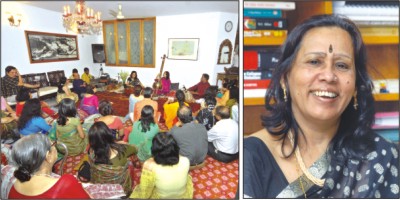
A performance featuring young artistes trained by Shipra Khan,(L) Shipra Khan(R). PHOTO: STAR |

