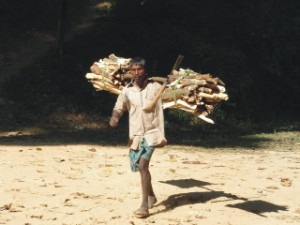
Forest crisis and the exclusion of the poor
On the 1.53m hectares of land under statutory authority of the Forest Department, current government policy restricts the role of the rural poor both in improving forests and in benefiting from them. Ishtiaq U. Ahmad and Philip J. DeCosse identify how simple policy reforms can stimulate greater involvement of poor households and communities in forest management while shifting the Forest Department's role from command-and-control towards poverty alleviation.For each of the past ten years, the Prime Minister opened the Forest Department's annual "Brikkho Mela" (Tree Fair) with a speech calling for a social movement to plant trees throughout the country. Households responded enthusiastically. But the success in tree awareness and planting has been limited primarily to homestead lands. On the vast tracts of once-forested land -- which account for 10 per cent of the country's surface area -- the Department has few options for systematic and large-scale involvement of the local poor in forest management in ways that benefit both the poor and the country. The primary impediment is the government's policy which says: any revenue generated from public lands must be collected by the relevant Department and forwarded in its entirety to the Treasury. This policy "elbows out" -- as economists like to say -- investments of time and energy that might be made by the millions of poor people living adjacent to these lands. Community forests
The poor can benefit from forests acting either as members of a household or of a community. In many countries, governments have recognised legal frameworks under which communities can benefit from sustainable forest management. Under such "Community Forestry" agreements, the community is granted rights to benefit from fodder, fuel wood, medicinal plants and, in special cases, timber, from a determined forest area. Nepal -- a world leader in community forestry -- codified such arrangements in a Community Forestry Act, passed in 1990. In Nepal, all of the revenue from these community forest lands goes to the communities -- none goes to the government's treasury. In many other parts of the world, governments have allocated public forest lands to communities under conditions managed by the forest department. Current policy in Bangladesh does not readily allow for community forestry. The only possible basis for it is the little-known "village forest" provision of the Forest Act 1927, and this provision has never been invoked, principally because it would require that government absolve itself of any responsibility for protecting the village forests. Thus in Bangladesh today, there exists no viable legal framework under which Forest Department staff can work with local poor communities to enable them to conserve, protect and benefit from adjacent forest lands. Household social forestry
Although community forestry has not progressed far in Bangladesh, the Forest Department has made important strides in helping poor households get access to forest lands under social forestry "Benefits Sharing Agreements". Under these Agreements, a beneficiary household can receive 45 per cent of the value of logs sold at year 10 from a one hectare plantation plot, with another 45 per cent of revenue going to the Treasury, and a final 10 per cent retained for re-planting. These benefits can be significant. On July 2nd, the Chief Adviser presented a check of Taka 2 lakh to one household as its share from a single hectare. Although this 45-45-10 formula can be successful when executed with direct government funding, the model effectively limits the capacity for social forestry as a generalised solution for reforestation of public forest lands. This is because the "one-size-fits-all" social forestry model, in which government grants 100 per cent of the financing, does not create sufficient incentives for those poor households that may be able to put up their own financing in "sweat-equity" or capital. And since the government cannot afford to pay for social forestry on more than a small part of forest lands, it needs the complementary investment and effort of small and poor rural households. In this context the percentage distribution of the benefit sharing mechanism should be modified to provide incentive to the beneficiaries. Carbon offsets
Forest-based carbon offsets provide another opportunity for rural poor to benefit from forest conservation. At retail prices in the range of $7/ton of CO2-equivalent, individuals and companies around the world are eager to offset their carbon emissions and are looking for opportunities to do so. Bangladesh is blessed with some of the world's most productive soils. The opportunity for rural communities to generate income from carbon offsets is thus both real and significant. At an average of 300 tons of CO2 equivalent per hectare of 10-year old forest, retail price for that carbon offset now ranges in the order of USD $2,100. While wholesale prices will be less, the potential for generating income for rural communities is nevertheless considerable. But again the problem arises: the government does not presently have a clear mechanism by which communities can benefit from forest protection and the resulting carbon offset payments. "Clean Development Mechanism (CDM)" projects are too complicated and time consuming for communities, dominated as the process is now by government actors. A way forward
The government can take steps today that would allow the Forest Department to shift its focus in a way that would favour both the poor and the forests. The Department should be given permission to develop trial protocols for testing both community forestry models and a more diverse set of models for social forestry, with the portion of revenue directed to the government reduced and that to the poor increased. Although households clamour for fast growing exotic species, the Department should be given authority to develop mixed species plantations, including those that allow a minimum number of native species to remain on the land at the end of the 10-year plantation period. A government Order may be issued to cover this wider variety of models on a trial basis. In the medium to long-term a revision of the Rules may be considered to allow this flexibility. Government might also form a "Community Forestry Working Group" to review experiences from other countries and propose a Bangladesh-appropriate community forestry model. For the past 20 years, more than 90 per cent of investment costs for forest plantations on public lands have come from the government through donor-financed projects. All of these projects are now completed, and no new such projects are on the horizon. The poor do not have large amounts of financial capital at their disposal, but they do have a willingness to invest time and energy, and they are sufficiently industrious to obtain financing when needed from willing agencies. The future of the public forest lands requires that the poor -- whether as households or communities -- be engaged as "entrepreneurs" in reforestation of the country. The new role of the Forest Department, indeed the government as a whole, should be to facilitate this role of the poor. Such an approach will help ensuring Forest Department to manage forest for the public good. Ishtiaq U. Ahmad is the Conservator of Forests for Wildlife at the Forest Department. Philip J. DeCosse is Chief-of-Party of the Forest Department's Nishorgo Support Project.
|