Nepal starts work on 'truth commission'
Afp, Kathmandu
Nepal said yesterday it had started work on a South Africa-style truth commission to deal with the rights abuses of a decade of civil war, but the UN voiced concern that offenders will go unpunished. The truth commission, which will allow those behind atrocities to confess without fear of punishment, was part of the deal between the central government and Maoist insurgents at the end of the war that killed around 13,000 people. "The government has already started work for selection of members in the commission," Peace and Reconstruction Minister Ram Chandra Poudel told the Kathmandu Post, an English language daily. He said officials were still sticking by the idea of not punishing the guilty, asserting that this was the best way of holding together a fragile peace process and power-sharing accord. "If we push forward the concept with a view to remind them about past antagonism and to take revenge, it may affect the peace process," Poudel warned. Both the Maoists and government security services committed serious human rights abuses during the war, including abduction, rape and torture. Of the 13,000 people killed during the decade-long conflict, around half were killed by the former rebels and half by the police and army. But the United Nations immediately repeated its deep reservations over the Himalayan country's plan on how to deal with its bloody past. "The Office of the (UN) High Commissioner for Human Rights (OHCHR) has serious concerns about a number of provisions in the Truth and Reconciliation Bill," Sandra Beidas, the officer in charge of OHCHR Nepal told AFP.
|
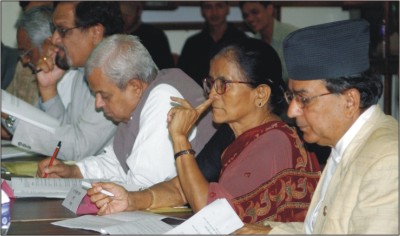
Nepal's Minister for Peace and Reconstruction Ram Chandra Poudel (R) reads through documents at a meeting in Nepal's Election Commission in Kathmandu on July 25. Nepal has started work on a South Africa-style truth and reconciliation committee, a key part of a peace deal that ended an often brutal 10-year civil war, an official was quoted as saying. PHOTO: AFP |

