Non-Fiction
Striped Lightning*
Tahawar Ali Khan
Question 1: How swift is a tiger's attack?
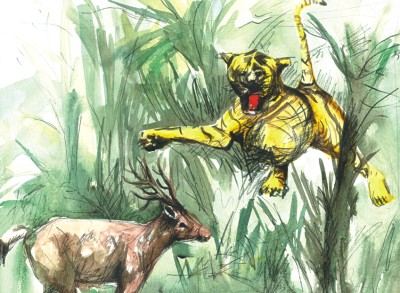
Question 2: How powerful is a tiger's blow?If I answer that a tiger attacks 'with lightning speed' or 'in the twinkling of an eye' or 'in a split second' you may think that I am employing a figure of speech and am referring to an event that actually extends over, say, three or four seconds. Similarly, if I tell you that a tiger can break the neck of a full grown cow or buffalo with a single blow, it will not give you a fair idea of his power because some celebrated 'strong men' have been known to perform this feat. While hunting in the Sunderbans, I witnessed a rare example of the incredible swiftness of a tiger's spring and the devastating strength behind his blow. Let me tell you the story so that you may understand what a 'split-second attack' really signifies, and and what is meant by the ancient phrase, 'strong as a tiger.' I was hunting on the western bank of the Malancha River in the vicinity of Mandarbaria Khal, when a keen shikari I had known for some time--a Forest Guard named Abdul Razzak--spotted me from his canoe as he was passing by on his patrol beat. He immediately came over and joined me on the beach with a warning to be careful as a couple of tigers had been seen several times on the previous evening in that area. We decided that the matter was worth looking into, and so we set off together on foot along the Mandarbaria Khal. We reached a creek running left from the Khal and saw a large herd of cheetal (spotted deer) crossing it about 400 yards away. The wind was blowing in the right direction and enabled us to get close to the herd by walking just inside the forest. We concealed ourselves behind a large tree and watched nearly two hundred animals cross over to the other side. The creek was flowing full and fast, and as cheetal do not normally cross water-courses till they are almost dry, we deduced that the large-scale evacuation was an amergency move forced on the deer by several tigers operating in the area. We continued along the bank of the creek for two hundred yards or so and then Razzak showed me fresh pug-marks of a tiger cub leading to a small depression in the ground. Here the animal had rested only a short while ago, as the grass, which had been flattened down by his body, had not sprung fully erect. No prints could be seen beyond the depression as the ground was very firm, and so we began to search around for the cub. After a little while Abdul Razzak said he would call up a full-grown tiger. I had seen the man call up a tiger before in a very unorthodox manner. In the Sunderbans, it is usually done by holding a round earthen vessel close to the mouth and sounding into it in imitation of a tigress calling to her mate. The hollow vessel gives a deep resonance to the call, which is immediately answered by the tiger who begins to move towards it. Call is answered by call in this manner, and the tiger is lured nearer and nearer till he comes within shooting distance of waiting guns. Razzak, however, did not imitate tiger calls. His method was to hide behind a bush and shake it violently with the barrel of his gun, while he seized his windpipe with the left hand and uttered loud distress calls closely resembling the strangled cries of a cheetal hind caught by the throat. The rustling bush gave the impression the 'victim' was threshing about in agony, and if a tiger was nearby, he usually came out to investigate whether a rival was poaching in his preserve. Telling me to be ready, Razzak went a few yards away and hid behind a screen of bushes which he began to agitate, giving at the same time a startling imitation of a deer's distress call. This was repeated at intervals and I looked about anxiously, waiting for the tiger to appear. Four or five minutes passed, when I heard a sudden frightened yell, and to my astonishment and alarm, saw Razzak leap straight up into the air with this gun as if he had been catapulted vertically from the ground. ...On his way down he fired a barrel wildly from his hip, and there some confused scrambling behind the bushes for a second or so. The next moment, a terrified tiger cub--about as big as a spaniel--shot out of the thicket, followed by Abdul Razzak, who was swearing fluently in Bengali. The cub scampered away into the forest and the disgusted guard fired his second barrel in its direction, more as a gesture than with the intention of hurting him... "After giving the distress call, sahib," Razzak explained, "I paused for a while and looked around. I couldn't see you from my position and when I heard a soft tread behind me I thought it was you. Then I felt two light taps on my body--one on my chest and the other on my back. Looking down, I saw the foreleg of a tiger across my chest and thought I was being hugged by a man-eater. The only way of escape was upwards through the encircling legs and so I jumped..." On our way back, as we were passing a large clearing by the side of the creek, we heard a great commotion in the trees ahead of us near the Khal. It seemed that every bird and monkey in the area had joined in to sound a general alarm, and there was a riot going on between the jungle folk. It was also clear that whatever was causing this disturbance was moving fast in our direction. Razzak thought it was a fight between two male tigers that would be worth watching. We broke off a thin branch, slung our guns from the projecting stump, and climbed quickly into a tree from which we could look down into the clearing. The farther end of it, about fifty yards away, was blocked by a large number of trees which had been cut down by woodcutters and left lying there for some reason. We had scarcely settled in the tree when a large cheetal stag rushed into the clearing from a point below and to the left of us. Horned stags cannot run fast through thickly wooded forests because of their spreading antlers and so this animal came at a medium trot, his ears twitching and flanks heaving with fear. Bounding along almost lazily on each side of him were two full-grown tigers who made no attempt to seize the deer but merely headed him off as he tried to escape to one side and then the other. This behaviour of the tigers was puzzling for a moment till the explanation arrived in the shape of two tiger cubs who entered the clearing a few yards behind the fleeing deer. They were both about the same size and, for all I know, one of them may have been the cub responsible for Razzak's recent discomfiture. I was deeply thrilled when I realized that we were watching the cubs being trained by their parents to hunt their traditional prey! The little ones pursued the stag dutifully like two schoolchildren trying to behave under the watchful eyes of Papa and Mama. Their quarry had put on a sudden burst of speed and come up against the dead end of the clearing, where he made frantic attempts to break through the thick rampart of felled timber. The tigers on both sides of him fanned out immediately and the tigress, which was the smaller of the two animals, sat down at the edge of the clearing to the left of us in front. The big male tiger took up his position near the bank of the creek about twenty feet from the deer. When the unfortunate animal turned round, he found escape cut off from all sides because the cubs, too, had sat down in the middle of the clearing to face him. To get a clear picture of the situation, you can imagine the stag at the center of a circle of about 20 feet radius, facing into the clearing, with his back to the felled trees. On the arc of the circle, equidistant from the stag and from the cubs, sat the tigress on the right of the stag and the tiger on the left. The two cubs sat close together directly in front of the stag at a distance of about seven or eight yards. The youngsters beat the ground with their tails, like happy little puppies, and looked in turn towards their parents and the cornered deer. The tigress was gazing at them, muttering low growls of encouragement, but I am sure the tiger never removed his eyes from the stag for an instant. Whenever I looked at him, he was sitting alert on his haunches, staring intently at the trapped animal who seemed rooted to the ground with fear. When encouragement from the tigress had no effect on the cubs, she got up with a threatening growl at the stag and went over to her offsprings. Seizing one of them by the tail and twisting it with her mouth, she slapped the protesting little hunter on its rump till it hopped forward and sat down again on its haunches some four yards away from the deer. The tigress seemed to be satisfied with this display of enterprise, and went back to her original position with a low mutter of approval. The young trainee again took things easy till the tigress growled impatiently, at which he hopped forward and then crept on his haunches till he was only a couple of yards from the stag. The nervous cheetal pawed the ground in front of him and jerked his head up and down, presenting his sharp horns to the cub, who must have felt like skipping school for the rest of the day. The tigress, who had been rather indulgent towards her offspring, suddenly lost her patience and roared out an imperious command which made the cub leap forward to attack. With a quick movement the stag put his head down and then up, catching the cub on his horns and tossing him back to the ground about three feet away. I cannot say if the game youngster was injured--I hope he wasn't--but he seemed to lie dazed for a moment. The stag immediately lunged forward with his head down, intending to impale the cub on his horns. The stag moved fast--but the tiger moved faster! While the horns had travelled only two feet towards the cub, the tiger had cleared 20 feet! It was an incredibly swift attack, and all I saw was blurred streak followed by a sharp 'whoosh' like the sound made by a passing shell. Then I heard a dull thud as if a heavy weight had been dropped from a height on soft ground. No human eye could have followed what actually happened, but the stag literally vanished from our sight. He was lunging forward at one instant, and then, within that instant, he was not there any more! In his place was the tiger who was looking on while the tigress licked the cub. The whole family then moved slowly into the forest, leaving two excessively amazed men rubbing their eyes disbelievingly in a tree! We found the cheetal among the felled trees blocking the end of the clearing. To say that he was dead would be a gross understatement. He looked like a mangled thing from another world with his head knocked right into his body and only a part of his antlers showing. His spine had collapsed and the broken ends of his ribs were sticking out of the flesh. Both forelegs were fractured in two or three places. And all this, including the tiger's 20-foot leap, happened--as I have told you--in the part of a second that it took the stag's horns to travel only two feet towards the tiger's cubs! *From Man-Eaters of Sunderbans (see article below).
|