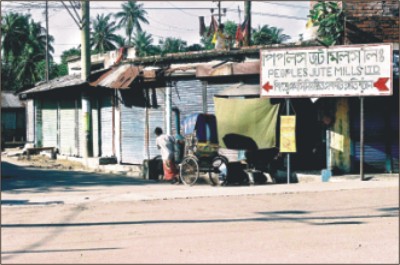
Peoples Jute Mills
Mill closure bankrupts over 2,000 traders
Emran Hossain, back from Khulna
A broad metalled street goes straight in front of the four state-owned jute mills in Khalishpur with rickshaws and motorised vehicles stranded at distance. Most of the wayside shops remain shut following the closure of Peoples Jute Mills Ltd and retrench of around 5,000 workers from the factories.The businesspersons including small traders involved in the sector fear of going bankrupt with an approximate amount of Tk 150 crore due to the labourers. They have little hope to get the money back unless the government pays the labours immediately. Now suppliers to small traders believe they would be compelled to desert business, while wholesalers expect only the return of huge amounts they had invested and plan how to withstand the loss if the retrenched labourers are not paid immediately. The small traders had over 2,000 shops in the area to run their business. Almost 2,000 have already been forced to shut down. A large number of suppliers too have closed their business, while some others had to change track with poor capital. The makeshift businesspeople on footpaths and roadside vendors also deserted their business following workers' unrest in April. The labourers' arrears to the each of the small traders range from Tk 10,000 to Tk 70,000, which they piled up buying on credit. The small traders, on the other hand, owe to the suppliers each Tk 30,000 to Tk 2.5 lakh, while the suppliers as a whole owe each of the wholesalers Tk 10 lakh to Tk 1 crore. The people here established most of their businesses in the last two decades by taking loans ranging from Tk 20,000 to Tk 1 lakh from different banks, NGOs and associations. The loan receivers had to mortgage property including houses on 10 percent to 15 percent interest. Some businesspersons took money on instalment from individuals, while very few had launched business with their own capital. "Though I've stopped selling goods on credit, we could not press labourers for paying their arrears in this situation. At the same moment, I don't know how I would repay my loan taken by mortgaging my house," said Faruk, a grocer, who loaned Tk 20,000 from a bank. A labourer on an average owes to small traders ranging from Tk 500 to Tk 15,000, which has been piled up over the last few months due to non-payment of their wages. The small traders, some of who include the mill officers, employees and labourers, were solely dependent on their business. They used to trade in grocery, food, cosmetics, restaurant, confectionery, jewellery, pharmaceuticals and clothes, while the vendors used to sell bread, sherbet, boiled eggs and seasonal fruit. "We know we would be paid back once the labourers are paid. But how long a small trader like me can wait when they are in debt to so many people," said Shaheen. He deserted his makeshift business two months ago and now pulls rickshaw. He is to get about Tk 5,000 due to labourers. Russell Store, a grocery owned by Khalil, has Tk 35,000 due to the labourers. Suppliers have stopped providing him with g "My shop is becoming empty gradually which was rich in products in the immediate past. I fear I wouldn't get back even half of my capital," said Khalil. "Once I get the dues or even half of it, I will stop the business immediately. Otherwise, what else can I do now?" Khalil established the store taking Tk 1 lakh loan on 12 percent interest mortgaging his house. "The suppliers have stopped giving me goods on credit saying there is no business left in Khalishpur. Some of my nearby suppliers stopped their business while some others changed business and became vegetable suppliers." The rent of Russell Store's space is Tk 4,000 a month and Khalil could not pay the last three months' rent. Earlier, the sale of his shop was Tk 900 each day, which is reduced to Tk 200, hardly to Tk 300. Owner of Mat Store Nizamuddin in the same area took Tk 25,000 loan from an NGO and his dues now stand at Tk 10,000. "I buy goods from different suppliers at different places. But it's getting tough day by day to convince them for goods on credit," he said. "The mill has died and my investment would not return if I continue giving products on credit to small traders. I have stopped selling products on credit," said Kamal, a supplier of grocery materials at Chitrali Bazar. Kamal had set up his own grocery taking Tk 4 lakh loan on 15 percent interest mortgaging his house and land. Earlier, his per day sale was Tk 40,000 to Tk 50,000, which has now been reduced to Tk 7 thousand to Tk 10 thousand. His outstanding bills due to the labourers are Tk 10 lakh to Tk 12 lakh. A wholesaler on Kalibari Road said, "Suppliers owe to me Tk 30 lakh, which exists only on papers now. "Some of the suppliers have left for home without paying me any money they took on credit," he said preferring anonymity in fear of action by the Anti-Corruption Commission. The wholesalers have initiated a process by giving fewer goods than the money paid by suppliers to gradually lessen their piled up arrears. But the suppliers are also not in any better condition, nor the jobless consumers, who once belonged to the workers of a running mill. Life is hampered everywhere in Khalishpur. Happiness disappears from the minds of the people, who are taking preparations for leave. Once a profit-making region, Khalishpur is dying.
|