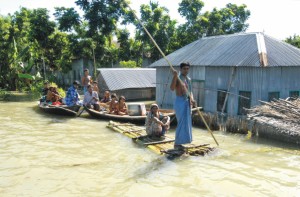
Flood havoc and post-flood priorities
Md. Asadullah Khan
About four-fifth of Bangladesh is flood plain. As a result about one fifth to one third of the country is annually flooded by the overflowing rivers during the monsoon when the rainfall is very high.After the disastrous flood of 1998, this year the country continues to bear the brunt of another worst flood perhaps exceeding the 1988 flood in magnitude and fury. Reports published in the dailies indicate that till now 39 of the 64 districts have been totally affected with about 20 million people suffering extreme hardship due to the loss of dwelling houses, crops and livestock. Reports from the Ministry of Relief and Disaster Management indicate that during the last two weeks of the flood standing crops on about 15 lakh acres, 17000 km roads and 6 lakh 77 thousand dwelling houses, 1500 km embankments and 112 industrial units have been damaged. Tragically, as one official figure reveals, the fury of the flood has already claimed 156 lives, mostly children dying by either drowning, snake bite or diarrheal diseases. The continuing devastation in terms of damages to lives, crops, livestock and infrastructure in the country, year after year, because of this natural calamity has become a major concern for the suffering people as well as those running the statecraft since the first major flood hit this part of the world in 1955. Without contradiction the impact of flood control interventions on the water regime, environment and society in a flood plain country has become apparent in the meantime. Experts now realise that the water regime has also been significantly affected by the construction of 16,000 km of highways and feeder roads, 12,000 km of rural roads and 3000 km of railways. In view of a consensus reached at the experts level about initiating a quick yielding small scale projects the government in 1983 embarked upon a National Water Plan ( NWP) with the objective to maximise agricultural growth and production and contribute to achieving food grain self-sufficiency vis-a-vis flood control measures. After the experience of the 1988 flood, the government of the day initiated the Flood Action Plan ( FAP) with the focus on flood mitigation. But gradually it was recognised that FAP should pay attention to integrated water, irrigation, navigation, environment and socio-economic aspects. With all these objectives on the agenda, a framework for the development and implementation of a strategic National Water Management was adopted at the beginning of 1997. Noticeably, because of the intensive achievement of the flood control and drainage projects, on average about 1,20,000 hectares of land per year have come under flood protection. But the experiences of flood control intervention have made one thing spectacularly clear: the stated objective could hardly be achieved in the absence of due consideration attached to the hydromorphologic features of the flood plain and the socio-economic conditions of the people living in this area. The people continue to suffer relentlessly battered by the ravages of flood. The objective of increasing rice production by providing flood protection to agricultural land got so much priority that the consequential stress on the flood plain ecosystem hardly received any attention. Interventions at one place resulted in flood risk elsewhere, reducing post- monsoon flow in the river and deteriorating its morphology. There are evidences galore that human interventions in the flood plain have caused miseries in the past also as it is doing now. Williams, who was a superintending engineer of the Public Works Department (PWD) in 1919 concluded after examining the past history of the tidal rivers in the Ganges Delta that the construction of railways, roads and private embankments caused the death of many streams. He further observed that wherever embankments existed they posed problems defeating the purpose for which they were raised, to the extent that they in course of time raised flood levels or led to the extinction of rivers by causing siltation and brought about water logging. Almost a similar effect is now observed in the south western region of Bangladesh where polders have been constructed to prevent tidal flooding. Review of polder embankments by Halcrow and Partners, a foreign based consulting firm which prepared the Master Plan report of South West Area River Resources Management Project in the past indicates that the effect of poldering is clearly drainage congestion resulting in the rise of channel bed and tide levels relative to the land levels inside the polder thereby obstructing drainage and in some areas the situation is worse than before the project was implemented. The first systematic study of floods in Bengal done by Mahalanobis after a devastating flood ravaged the northern part of Bengal in 1927 due to rainfalls of unprecedented magnitude indicated that railway embankments hampered the draining away of the flood water and thus served to prolong the duration of the flood. A committee formed by the Ministry of Water Resources of the government of Bangladesh in 1995 after another devastating flood ravaged the north western part of Bangladesh in the same year concluded in its report that abnormally high rains could only be termed as an act of nature and any scheme to combat such event would be uneconomic and unwise. True, natural disasters are a universal reality. But in modern times it is the preparedness that counts. Damage can be minimised, rehabilitation can be effective, but only if a country has an organised disaster management plan. Bangladesh seemingly does not. Speaking about Sirjganj and Haimchar area in Chandpur, these places have always been vulnerable to flood and river erosion. As reports suggest serious breaches occurred in the 20 km long flood protection embankment around Sirajganj town and adjoining areas and in spite of the fact that this embankment remained so much vulnerable during the last five years, no serious structural repair was done other than some patch works done here and there. As reports reveal, Sirajganj district was fenced off by 68 km long flood protection embankment during the Pakistan regime. But as no repair was done during the last five years, three out of eight spurs built at different places of this embankment gave way in the face of the fury of flood water in the rainy season. Sirajganj town is now under waist deep water, with men and animals living together in the same high land. There is water every where but not a drop to drink. The previous governments shook off all responsibilities by just issuing a prescription that people have to cope out with such natural calamities and so Sirajganj, Gaibandha, Kurigram, to name a few among so many worst hit places were left to fend for themselves. If the suffering of about 20 million people having no food, no shelter, no drinking water and last of all no medicine was tragic, the lethargy and insensitivity of the past government was unforgivable. Bangladesh is visited by epidemic, fires, floods, cyclones, train and launch accidents with amazing frequency -- enough practice to get ourselves ready. Still instead of recognising the urgency of the situation and taking appropriate action at the proper moment, an inertia prevailed as if a nation, so often visited by tragedy has become inured to it. The sudden cataclysm that has overwhelmed one third of is no doubt alarming. But the disaster that is unfolding in the wake of the flood triggers further consequences. Water is already contaminated and would remain so for months to come. The prospect of the next Aman crop is still very bleak because seed bed cannot be prepared unless water has receded totally, and consequently the prospect of a bad harvest cannot be totally ruled out. Water related diseases like diarrhea and cholera have already broken out in an epidemic form. People will start dying unless relief aids in the form of food and medicines can be reached in time. On the other hand, cattle population, in thousands might perish in the huge mass of water if water logging continued indefinitely. The people who depend on them for their livelihood have no wherewithal to sustain themselves, let alone their cattle. Undeniably true, even as water begins to recede a tidal wave of despair engulfs the country. In village after village along the soggy riverine districts, namely Sirajganj, Gaibandha, Kurigram and Nilphamari, battered people wait in vain for relief to come. It should not happen like this that while people in the affected districts starve, trucks loaded with food bags and medicines queue for miles in the district headquarters unsure of where to go. The government machinery as it is wont to will take time to get into place, and the enormity of the disaster means we must all help as best as we can. After the flood water has receded, people will start working to help themselves and it would be an onerous job on the part of the government, NGOs, humanitarian and cultural organisations in absence of the political parties provide material support to the flood-stricken people in the form of seeds, fertilizers, pesticides and even livestock if needed. The NGOs and other philanthropic organisations and business communities may come ahead to meet the short-term needs of the communities in the affected villages, such as drinking water, fodder and wage labour for the poor, until the next Boro or IRRI or Aman harvesting season. In the long term, we need to strengthen the community's ability to withstand similar situations in future by repairing and building safer houses for shelter and storage, infrastructure as well in recharging sources of water such a tube wells. Undoubtedly true, nature will always have its way and so it is a calamity that could not have been avoided, but its damage could have been limited. One thing we must understand that the problem is not of money but of management. Time and again we have seen relief measures so deficient Because our political leaders in the past never seemed to understand that no matter how much money they had raised, it ended up being wasted because of the insensitivity of the administrations they ran. What actually happens in such a disaster is that because of multiplicity of departments dealing with mitigation, relief and succour, providing food and medicine, there occurs a serious lack of accountability and co-ordination among them. It is so much shocking that granaries overflow in some places, in others people die for lack of food. Between the ministries concerned there is an enormous amount of buck-passing and the result is that very little trickles down to the needy. What is needed now is an effort to supplement income of all able bodied male members in the flood affected areas in the form of employment in relief work, road and embankment construction and channel digging to allow free flow of water to water ways. True, the regularity with which disasters return to haunt people in different places at different times can lead to debilitating cynicism. But it is not the reason why government agencies fail consistently in disaster management. Lessons are never learnt, preparedness remains incomplete and most of all the willingness to meet the challenges head on appears missing. Md. Asadullah Khan can be reached over e-mail : asad_k@bangla.net
|