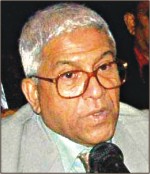
SC to rescue nation from any crisis
CJ says freedom of judge's mind a must for independent judiciary; political divide in judiciary deplored
Staff Correspondent
The Supreme Court judges will weigh in for sure to rescue the nation from any crisis, asserted Chief Justice Mohammad Ruhul Amin yesterday."I want to assure the nation that we will come forward. The Supreme Court played a role in the past at the critical juncture of the nation. It is doing so at present and will do so in future to pull the nation out of mire," the chief justice responded to concerns expressed at a seminar over prevailing crisis including call for reforms in judiciary. But he said judges couldn't be compelled to work independently by enacting laws. "It has to be in their culture. If a judge is not committed to work freely, law cannot make him/her independent," Ruhul Amin told a seminar-- Judicial Reform and Independence of Judiciary-- attended by a host of judicial heavyweights including a former chief justice, leading jurists and judges. Other speakers on the other hand unanimously urged the judges to work independently for a free judiciary, asking the lawyers to rise above their personal and political interests and contribute unitedly to sustain it. The chief justice appeared skeptic about the outcome of a change in judge recruitment process unless the present culture in judiciary is changed first. "We forgot to look at any issue from a neutral perspective. That is why we are in trouble now," he said in an oblique reference to political divide in judiciary. "We all agree on the freedom of judges. I don't differ on the talked-about recruitment of judges through forming a committee. But if we don't change our culture first, who gives us the guarantee that the recruitment committee members will work independently?" Earlier, former CJ Mahmudul Amin Chowdhury proposed a committee involving chief justice, attorney general and president of SC Bar Association to ensure appointment of qualified judges, discarding the present system where president appoints higher court judges and chief justice plays no role other than offering customary courtesy consultation. But Ruhul Amin opposed the idea of inducting chief justice in the committee to keep his office out of controversy. "Chief justice is the head of an institution. If head of the institution becomes subject to discussion and controversy, he loses neutrality and right to judge." The role and quality of judges also came under severe criticism. "Judges should work without fear and favour. They should deliver judgment without considering future gains and browbeating," said Mahmudul Amin, adding that some judges in his time suffered a lot because of intimidation. "We hear carrot and stick policy is used for judges. But judiciary and judges are not to be intimidated. While sitting as a judge in the court, we don't afford to be intimidated," he said. The present chief justice said those who care for carrots must go. "Those who work for carrots not only land the nation in trouble but also harm themselves." Former CJ Mahmudul Amin also played down the fear and pressure factor on judges. "In our country, an atmosphere is usually created to get desired judgment. But the judges have to deliver verdict independently. Otherwise, it will never be possible to bring independence to judiciary by enacting any laws." Meanwhile, eminent jurists Dr Kamal Hossain dwelled on the popular belief that some judgments are delivered considering 'something else', not basing on case arguments. The chief justice did not brush aside the belief, also blaming it on some laws. "I won't say this occurrence is totally absent...Some points of laws are being relaxed for some people and made tougher for some others. As a result, what verdict a judge delivers on a point today gets changed the next day," Ruhul Amin countered. The CJ declined to hold the judges solely responsible for this disparity. Those who are involved with the judiciary have also their share in the blame, he said. He also vented his frustration over lack of assistance from people concerned in addressing some irregularities in judiciary. "I receive complaints through secret letters but neither members of the Bar nor litigants show up when I invite them to help me address those." He said some punitive measures were taken despite the non-cooperation. "But whenever we go to take punitive action, requests from some people really catch us off guard. (Following request not to take action) We get stunned whether this person is the same person we know of." Flooding of such recommendations (in favour of culprits) is the main reason behind corruption, observed the chief justice, citing some instances of judicial irregularities where judgment copy from higher courts were changed keeping the case number same, letting the accused walk away on bail. "I won't say judges are all innocent, there might have been some lapses. But those who could have helped me sort it out did not come forward," he said. Ex-CJ Mahmudul Amin meanwhile urged the Bar members (lawyers) to come out clean along with the judges to uphold judiciary. "The lawyers in no way can destroy an institution for the sake of clients. Self-purification is self-protection. Lawyers must go through purification." Dr Kamal meanwhile dubbed the integrity of the Bar as a pre-condition for independence of judiciary. "We should go for soul-searching whether we try to influence judges out of the way for favourable verdicts." Former SC Bar president Habibul Haque Bhuiyan meanwhile spoke for saying goodbye to the political divide among the lawyers. "I think, the Bar becomes more political these days. Let us not make Bar as a politicised one." Most of the speakers observed that the onus is on the judges to have an independent judiciary. "If I cannot be an independent judge, I cannot protect independence of judiciary. A spineless judge cannot protect the independence of judiciary," said Justice Syed Amirul Islam. Both former and present chief justices meanwhile expressed their unhappiness over delay in separation of judiciary. "Parliament members did not want judiciary to be separated. Had they wanted they would have taken the initiative for separation way back in parliament of 1991," said Mahmudul Amin, who also took a swipe at Bar members-turned-lawmakers. "When they practise law at court, they act as friends and well-wishers of judiciary. But when they become lawmakers and ministers, they turn foes and opponents of judiciary," he told the seminar, organised by the Human Rights and Peace for Bangladesh. Barrister Amir-Ul Islam presented the keynote paper of the seminar, chaired by Advocate Manzill Murshid at the SC Bar Association Building. Justice Fazlul Karim, Justice Amirul Kabir Chowdhury, Barrister Rafique Ul Huq, Advocate Abdul Baset Majumdar and Advocate Khandoker Mahbub Hossain also spoke.
|