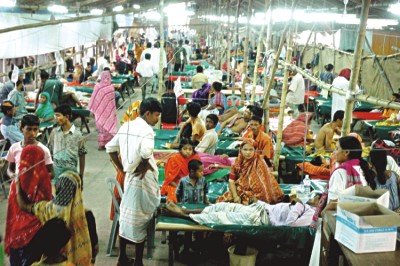
Diarrhoea continues to spread in flood-hit areas
First official report of 4 deaths from the water-borne disease
Star Report
At least four people died of diarrhoea across the country during the last two days, the first diarrhoeal deaths in this year's flooding. Over 1,000 diarrhoea patients checked into an already overcrowded International Centre for Diarrhoeal Diseases Research, Bangladesh (ICDDR,B) in the capital yesterday. The four who died of diarrhoea were from Sherpur, Jhenidah, Sirajganj and Sunamganj. Meanwhile, Flood Forecasting and Warning Centre (FFWC) said at present it is holding 14 districts as flood affected. The districts are Dhaka, Narayanganj, Munshiganj, Manikganj, Faridpur, Rajbari, Madaripur, Shariatpur, Gopalganj, Chandpur, Narsingdi, Brahmanbaria, Kishoreganj and Gazipur. It expected significant improvement of the overall flood situation in the next 72 hours. It also expected the water levels of all the rivers to go below their danger marks in the next few days. Filthy floodwater spreading diseases across the flood-affected areas is compounding the misery of the people. At least 4,110 people were diagnosed with diarrhoea during the 24 hours ending at yesterday noon. "We are struggling... we have treated the highest number of patients yesterday [Friday], in the ICDDR,B's history," Prodip Bardhan, acting chief physician at ICDDR,B, told The Daily Star yesterday. He, however, denied that cholera has broken out. "There is no doubt that patients are coming here with severe diarrhoea, but we need two or three days to see if it is cholera." Even though diarrhoea patients are usually treated with saline only, the doctors are giving antibiotics as patients are coming with severe diarrhoea. Doctors at the ICDDR,B had to introduce a new group of medicine (Azithromycin), as Tetracycline or Toxicycline were not working well. "As the germ became resistant to those antibiotics, we had to switch to the new group", ICDDR,B sources said. Since last week, tents had been set up at the ICDDR,B hospital to accommodate the onrush of diarrhoea patients. Dhaka Medical College yesterday launched a Dhaka Medical College Unit at the Dhaka Medical College Hospital (DMCH). Health Adviser Maj Gen Matiur Rahman inaugurated the new unit at the emergency and burn units of the hospital. DMCH Director Brig Gen Abdus Shahid Khan told The Daily Star that the 100-bed unit was initiated due to the onrush of diarrhoea patients. A 20-member team was looking after the patients there. All government hospitals of the country started running oral re-hydration therapy (ORT) corners. "All hospitals in flood-hit districts, upazilas and thanas are treating patients from the designated corners," he said. In the 24 hours ending at yesterday noon, Diarrhoea Control Room under the directorate of health recorded 323 deaths since July 30. Of them, 292 drowned, 20 died of snakebites and seven died of other respiratory track infections (RTI). Apart from diarrhoea, 1,352 people were suffering from RTI, 205 from eye infections, 11 from snakebites, 194 from different injuries and 4,816 from other diseases--mostly common cold. Meanwhile, all five small rivers surrounding Dhaka and Narayanganj observed a fall in their water levels. The water levels are expected to fall further in the next 24-72 hours. The water level of the Buriganga at Dhaka had a 7cm fall, the Balu at Demra had a 5cm fall, the Lakhya at Narayanganj 4cm and the Turag at Mirpur 7cm. The Tongi canal marked a 6cm fall at Tongi and was flowing 67cm above danger level yesterday morning. The water level of the Jamuna went down significantly at all points and the river flowing 25cm above danger level at Aricha. It is likely to go below danger level in the next 48 hours. The Padma was flowing 51cm and 45cm above danger levels at Goalundo and Bhagyakul. It is likely to recede significantly in the next few days. All flood-affected districts are expected to mark improvements in the next few days. At least four people drowned in floodwaters and another died of snakebite in Sirajganj district yesterday. Hafizul Islam, 8, Salman Shah, 7, of Raiganj upazila, Shadia, 2, of Chowhali upazila and Yusub Ali, 3, of Belkuchi upazila drowned in floodwaters, while Mujibur Rahman, 70, of Kazipur upazila died of snakebite. Sirajganj Civil Surgeon's Office sources said at least 443 people contracted various water-born diseases in nine upazilas in 24 hours ending yesterday evening. Of them 213 were diagnosed with diarrhoea, 22 with skin diseases and 23 with pneumonia. The total number of diarrhoea infected in the district now stands at 2,322. District administration sources said relief distribution and treatment of patients are continuing in flood-affected areas with NGOs helping the government in this regard. In Gaibandha, 161 people were diagnosed with diarrhoea yesterday raising the total to 2,489 in the district. The diarrhoea situation in Fulchari upazila is the worst in the district with around 820 infected with the disease. Shamsul Huq, civil surgeon Gaibandha, however said the rate of people getting infected with the disease is decreasing. Abdul Matin, Deputy Director, Agriculture Extension Department Gaibandha, said aman seedlings should be supplied immediately as the time for transplanting is close to its end. The floods damaged crops on an estimated 8,265 hectares of land, he added. Chief of Bangladesher Samajtantrik Dal (BSD) Khalequzzaman yesterday visited flood-affected areas of Gaibandha and distributed relief goods. He urged the government to rehabilitate flood-ravaged farmers and stop realisation of all agricultural credits until the next harvest.
|