Guidelines for treatment of anal fissure
Prof Dr A K M Fazlul Haque
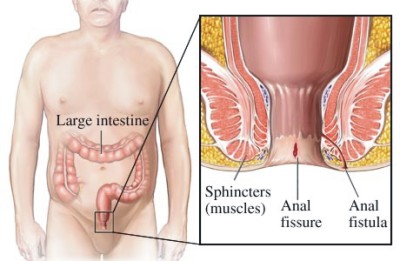
Lots of people in our country suffer from pain in anal canal. It is a distressing and annoying condition. Fissure means an ulcer or a crack in anal canal (the passage through which we pass stool and wind).Anal fissure are of two types - acute and chronic. Acute anal fissure causes severe pain during passing motion. In chronic anal fissure, intensity of pain varies from person to person. It can occur at any age - I have seen patient as young as 40 days old. Young adults suffer more. It affects both sexes equally. Causes and how it happens
It occurs usually due to constipation and application of force to pass motion. It is thought that hard motion tears the anal canal. It occurs less in those subjects who take food containing sufficient amount of fiber (vegetables, raw fruits, isphagula husk etc.). It has no relation with consumption of tea, coffee or wine. Frequent passage of motion and diarrhoea increase the likelihood of being attacked with fissure. During the attack it is hard to examine the inside of anus. Scientists have measured the pressure of anal canal and found that the pressure of anal canal does not rise during this period. Symptoms
Main symptoms of anal fissure are pain and bleeding. This kind of pain usually happens after passing motion and it may continue for few minutes to hours. I have seen many patients complaining of pain for 24 hours. "Proctalgia Fugax" is a kind of disease in which there is pain in anus, but it does not have any relation to passing motion. Patients with thrombosed piles also complain of pain in anus. In this condition they complain of a lump (mass of hard tissue which rises on the surface or under the surface of the skin) in anus. In anal fissure, bleeding is usually minimal but patients may complain of profuse bleeding as well. People with chronic (long standing) anal fissure complain of a different kind of symptom. They complain of lump, discharge of pus, itching or a protruding skin tag in anus. In this condition there may or may not be any bleeding. Pain is usually slight or sometimes there is no pain at all except while passing hard motion. Sometimes, patients also complain of urinary trouble and female patients occasionally feel pain during sexual intercourse. Though patients realise that this problem had perhaps arisen from constipation they do not respond to natures call due to fear of pain. This aggravates the constipation further. There are patients who pass motion once in seven to ten days. Acute anal fissure: In this case there is severe pain and variable bleeding. Anus looks very much contracted. It is not possible to see the fissure inside because of severe pain. It is very hard to introduce any instrument inside. Chronic anal fissure: Chronic fissure is that when it is limited within a circumscribed margin. In this condition, there is a tag of skin which hangs down. Inside the anus also there is a tumour like piece of meat called hypertrophied anal papilla. Many doctors confuse it with a tumour. In this situation interior of the anus and rectum should be tested with instruments called sigmoidoscope or colonoscope so that any tumour or inflammatory cause can be identified. This fissure can sometimes get infected and cause abscess which ultimately leads to fistula formation and discharge of pus. Prevention
One should take care of his bowel so that constipation does not occur and during defecation one should not apply much force. We should give up the habit of going to the toilet frequently. If there is diarrhoea, it should be treated immediately. Some patients have the habit of reading newspaper or magazine in the toilet. Patients have to spend more time due to this habit. It must be avoided. Treatment
Conservative treatment:
If treatment is started soon after the problem starts, there is more chance that the patient will be cured without operation. Different kind of medicine are prescribed to make stool softer. Fibre containing diet is advised to increase the volume of stool. Some pain killers are used for pain relief. Sitz bath (hip bath) is very much helpful. This is done by immersing the hip into a half filled bowl of warm water containing salt or disinfectant. If this does not cure the condition and if the disease continues for long time, then there is less likelihood of treating the condition without operation. Surgical treatment:
Dilatation of anal canal: Now a days, this operation is not done because of its poor result. Internal sphincterotomy: In this operation internal sphincter is divided and there is no need of full anaesthesia. Total two days hospital stay is necessary. The patient can lead normal life after 3-7 days. The success rate of this operation is 95-99 percent. In last ten years we have done research on 31,635 patents all having problem in anal canal, of these 35% was anal fissure, 18% piles, 15% fistula, 2.6% cancer, 3.3% rectal polyp etc. In my series 76% anal fissure patients were cured without operation and 23% patients required operative treatment. After operation, 96% patients were cured permanently. Patients need to be hospitalised for short time. Prof Dr A K M Fazlul Haque MBBS, FCPS, FICS is Head of Colorectal Surgery Department of Bangabandhu Sheikh Mujib Medical University (BSMMU), Dhaka.
|