Coal policy
Nazrul Islam
The Coal Policy review committee needs to be thanked for making the draft coal policy available for comments. It is also nice to know that the committee plans to invite stakeholders to hear their opinions. These steps will serve as good examples of bringing transparency and public participation in Bangladesh's policy making.The current, 6th, draft coal policy has been formulated with considerable caution. In general, it tries not to make rash propositions. In the following, I offer one major comment and an additional minor comment. Many other comments are warranted, but space constraints do not permit these to be made here. Major comment
Despite the caution with which the draft has been formulated, it suffers from a major contradiction, which is as follows. One of the main propositions that the document makes is that Bangladesh's remaining gas reserves will prove insufficient (in meeting the country's demand) beyond 2011, and even the available coal reserves will fail to keep the country's coal-based power plants running beyond 2022 (if mining is done by closed-pit method) or 2033 (if mining is done by open-pit method). As a result, there will be no scope to export coal. This may be called the coal "insufficiency proposition," which is repeated at least six times in the document (see p. i, 2, 3, 5, 16, and 25). The logical conclusion that follows from this proposition is that export of coal is simply not an option for Bangladesh. Yet, the same draft policy devotes considerable attention to developing terms and conditions for export of coal. The draft stipulates, in (p. 5), that if discovery of new gas and coal fields can ensure energy security for 50 years, export of surplus coal may be allowed with the permission of the coal sector development committee. This may be called the "export proposition." The draft further states that the amount of coal exported should not exceed the amount that is used for compulsory electricity generation. To follow up on this "export proposition," the draft policy devotes considerable effort to devise a formula for determination of the royalty that the government should earn from export of coal (see p. 18). This formula, by the way, is confusing and unsatisfactory, because it depends on base export price of coal, ECPb, to be $25. It is very illogical for a formula, which is to hold for decades into the future, to base itself on a current price figure. The contradiction lies in the fact the "export proposition" goes against the "insufficiency proposition." True, the "export proposition" has been formulated with caution, laced with several qualifications. However, the question is why is there so much concern about the "export proposition," as it is maintained that available coal is insufficient for domestic needs, unless there is some hidden agenda? It may be instructive here to recall the debate regarding gas export that was waged in Bangladesh not too long ago. Foreign companies operating in the Bangladesh gas sector exerted tremendous pressure for approval of gas export. They did not even hesitate to use the influence of the governments of their home countries, of the and multilateral lending agencies with whom they keep close relationship, in order to pressurise Bangladesh to approve gas export. Yet, here we are, just a few years later, panicky because the remaining gas reserve will not take Bangladesh beyond 2011, which is just around the corner. Are we not indulging in a similar folly by entertaining the export option with regard to coal? Are we again yielding to the pressure of foreign companies to consider an option that is not viable, and which is detrimental to national interests? Yes, no one should rule out the possibility of future discovery of gas and coal reserves. As noted above, according to the "insufficiency proposition," the current coal reserves can take the country only up to 2025. How can Bangladesh survive beyond that year, without continuing exploration and finding additional reserves and new energy sources? But, will we discover so much coal that there will be a surplus even after meeting future needs for 50 years? We can certainly wish for that. However, as the saying goes: "If wishes were horses, beggars would ride!" Given Bangladesh's small size, given the huge population, and given her current, extremely low per-capita energy consumption, it is very difficult to believe that the country will ever have such a surplus. Hence, there is no harm in wishing. However, it is a waste of the nation's time and energy to get involved in a hypothetical scenario, the chance of which becoming reality is very remote, unless again there is a hidden agenda. Also, the coal policy is not going to be something cast in stone, something that can never be modified. Any policy requires periodic review in order to reflect the changes in circumstances. The same will be true for the coal policy. If, by luck and effort, Bangladesh indeed happens to strike so much "surplus" gas and coal reserves, then certainly the coal policy can be reviewed to allow for an export option. But there is no necessity for doing that now. Inclusion of the export option now will only intensify the suspicions that people have regarding the motivation behind the coal policy. They have already seen bureaucrats and politicians signing detrimental-to-national-interests contracts with foreign companies operating in the gas sector, and they do not want to see a repeat of those sordid acts in the coal sector. The review committee should try to alleviate the suspicions and remove the glaring contradiction that currently besets the draft coal policy. The best way to do that is to rule out the export option altogether and drop all further discussion of that option. Instead, it should focus entirely on optimal domestic use of our coal. Other comments
It is nice to see that the draft coal policy envisages a primary role for the public sector in the development and extraction of coal in Bangladesh. In the neighbouring country, India, coal is also mainly in the public sector. The proposal to establish Coalbangla for the purpose is a welcome one. Bangladeshi engineers and managers in Petrobangla and various other gas-related public companies/bodies did a good job in exploring and extracting gas. Unfortunately, under pressure from different quarters, the government subsequently started to rely more on foreign companies, and let the national capability get degraded. It is necessary to revive the commitment for developing and using national capability for harnessing the country's mineral resources. That is how countries like Malaysia, which was behind Bangladesh in the 1960s and 1970s in terms of national technological capability, have now emerged as world players. Given the necessary commitment and effort, Bangladesh can also emulate that success. However, setting up of an appropriate management and incentive framework is a pre-condition for such success. Otherwise, there will be a repeat of the sad experiences of Bangladesh Biman and many other sectoral corporations, which have served only as milking cows for bureaucrats, politicians, corrupt labour leaders, etc. Bangladesh is currently aiming at national regeneration. If that is the case, will it not also be possible to create honest and efficient companies in the public sector, at least in its minerals sector? It may be worth giving it a try. Dr. Nazrul Islam is Senior Economic Affairs Officer, UN Department of Economic and Social Affairs.
|
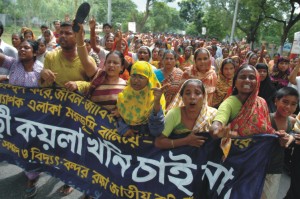
Phulbari protest, August 2006. PHOTO:Mumit |

