
Dhaka
Sunday March 6, 2005
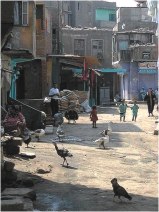 Life goes on in a street of the Dead City |
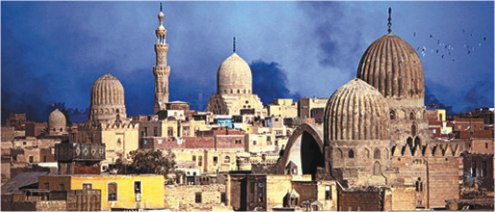 An overview of the City |
|
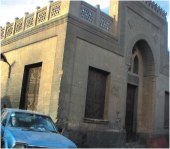 The view of the entrance to a tomb |
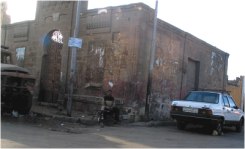 This tomb turned into living quarters |
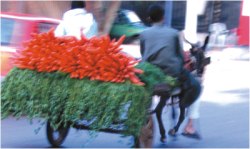 A donkey cart carries vegetables; they collect garbage too from the city |
Dirt, death and life: The other Cairo
The car rattles and lurches violently, and I sway from one side of the seat to the other my sides beating hard against the frame. The strands of hair at the back of my head stand on their ends at the nerve-racking noise of the car's bottom scraping boulders. The engine groans as the car crawls unwillingly uphill and then the screeching of brakes as it turns course to go downhill all of a sudden. I can see a trail of yellow dust, and pieces of polythene sheets and scraps of paper. We are entering a strange, unknown world right in the middle of Cairo.
Around me is pure poverty, and dirt, and filth, and courage, and struggle, and life... goes on. The road, if it could be so termed, is just a hard, uneven dirt one. Where did the suave, plush Cairo that I saw the day before disappear? Ramshackle, unplastered buildings with cardboard window panes and doors stand naked here. Slums seem to have a universal character everywhere in the world and the lives of people here are no better than those people living in Dhaka slums. The difference -- the boys wear torn jeans and T-shirts and women wear scarves round their heads. The air reeks of all kinds of odours and things -- chemicals, rotten food, tyres, plastic, garments waste, donkey dung and what not.
"This is Cairo's recycling centre," says Rashida (not her real name), not bothering to take her eyes off the road while manoeuvring the steering, "these people, poor and dirty, keep the city going. If this place ceases to exist, we will drown under heaps of filth and waste."
This is a huge settlement of downtrodden people and there are 20 more like this in Cairo. Every night, these people go out with their donkey-carts to collect waste dumped in city bins. In here, I see the waste is sorted out manually, piece by piece, bit by bit. Men, women, and children sit inside rooms or along the alleys doing this strenuous job. In a long narrow alley, the silhouette of a teenage girl stooping over some food packages morphs into the sunlight slipping through the narrow opening at the end of the tunnel-like alley -- sad and depressing.
Metal scraps are carried on donkey carts. The men wide chested, with dirty open shirts, thick moustache brown from smoking give me curious looks. Rashida who works with the slum dwellers is known to most of them .
"Look how they struggle," Rashida jutted her chin in the general direction of the activities around. "They are fighting against the multinationals who want to take over the garbage collection business. The greedy multinationals think recycling is a big business and do not want to part with the waste. The city corporation towing their line has already banned garbage collection by donkey carts. Only those who have motorised vehicles can collect the garbage now. But these people outfoxed the multinationals and collect garbage before the multinationals can do."
The multinational dump-trucks come early in the morning to collect the garbage, but these people clean out the bins by midnight.
We find a long queue of men, women and children in front of a damp and dingy room.
"The bread supply has arrived," Rashida explains. "You never know when the supply comes, but when it does, queues build up because you won't get such cheap bread anywhere in Cairo."
Vendors push carts fitted with tin drums to sell kerosene. There is no power supply in this sprawling area. Children and women carry water in jerry-cans. Water pipelines do not run through here either.
"Here begins the Christian neighbourhood," Rashida points out to shops with crosses. Cross lockets dangle from the necks of the people. Colour posters of Jesus Christ hang on the walls inside the shops.
"It is usually a peaceful living environment by the Muslims and Christians," Rashida explains. "But sometimes trouble flares up, say when a Muslim or a Christian boy by any chance breaks a windowpane of the other religion by throwing a ball. But that is not a big deal. The worry is that the extreme poverty and government neglect to this area has made it a breeding ground for Islamist militants. Until a few months ago, the police would come and round up the militants regularly from different quarters."
Soon, we emerge from this strange world on to the metalled main road and enter another world, weird and foreboding. As Rashida swings the car into uncountable narrow alleys through very old looking single storey buildings, I ask her which neighbourhood it is.
"This is no neighbourhood. This is the City of the Dead," she answers.
My heart thumped wildly. So this is the enigmatic place I read about many years ago.
"Where are the tombs?" I ask.
"Why, those are the tombs," Rashida points to the structures that I mistook for buildings. "The sultans some 1,000 years ago set up this whole place as a graveyard. The tombs were built like buildings so that relatives of the dead could stay inside to mourn for 40 days.""But how did the graves turn into a 'City'?" I watch the centuries-old ramshackle buildings and bring out my camera.
Rashida immediately slaps my hand down. "Don't show your camera. You can be detained by police. The government does not want this place to be exposed to outsiders, specially journalists. You will be in trouble if they catch you. If you want to take pictures, do it secretly."
Then she told me the story. As the conquerors of Egypt -- Fatimids, Abbasids, Ayyubids, Mamlukes and Ottomans -- faded away in time, the caretakers of the tombs took over the structures, turning them into living quarters. And slowly, the homeless crept inside the tombs, squatting down to turn the whole area into a living place for five million people.
"They are joined by a greater number of cockroaches, mosquitoes, flies and vermins of all sorts," writes Nedoroscik in The City of the Dead, A history of Cairo's cemetery communities.
They sleep on the tombstones, they use them as tables for dinner, they use them for cupboards, while the dead sleep under. I shiver at the thought of it.
As we travel through the labyrinth of this strange City, I find the community more and more intriguing. Ropes are tied from one tombstone to another to use as clothes line. Tattered jeans, women's gowns and pajamas flutter in the bone chilling winter breeze. Lambs trot idly, chewing on the plastic foils and paper food packets. A pick-up sits awkwardly with the tyres missing. Men idle on the footsteps of the tombs and watch us lazily. A baby cries. A radio plays Arabic songs.
As darkness gathers in the lanes, dim yellow electric lights turn on one by one inside the tombs. Acrid smoke coming from the kitchens fill the air. Against a pale blue evening sky, I can still make out the illegal power lines drawn from poles in the street. Here people live among the dead. Here life does not end, but begins.
As we slowly cruise back, a lonely donkey cart trundles along the dusty road, a lonely figure shadowing the lonely life in the City of the Dead bobs with every bump.
"Who goes there?" somebody asks from the shadow of a tomb, as Rashida interprets it for me.
"Abbas," comes the reply in a dull dead tone.
And then the man stops the cart and slips inside another tomb.I think of the great ancient city of Cairo, the pyramids I visited earlier that day, the sleepless Sphinx, the Cairo squares with huge statues of Ramesis and all that. Then I shrug, and walk back to the car.
.........................................................
Story & photo: Inam Ahmed
© thedailystar.net 2005