Dhaka
Sunday May 15, 2005
Flames in the mind
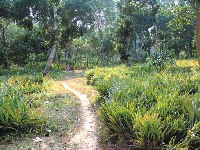
ACross the road from the Ramgar Horticulture Centre stands a deep lush green forest. We find a narrow dirt road to follow. It is a much trodden path as the trampled pattern of the grass shows. Tall Shal trees frill the road.
We walk unhurriedly in the slanting afternoon sunshine. It happens in winter, the sun suddenly crosses the mid day sky to bathe everything with an ethereal soft glow. The rays become crystal clear, only the intensity dull. It is then that you become contended, you suddenly have that overbearing sense of wellbeing. You feel you have no weight at all, you feel you don't exist, only your eyes exist, only the colours exist, and the senses work.
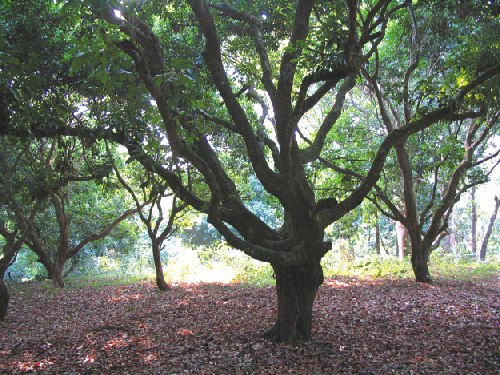
Several hundred yards inside the forest area we come across an orchard of jackfruit and lichi trees. The ground is spread smooth like a golf course. Just beside it is a pineapple orchard. The prickly leaves spring up threateningly. It is a beautiful place to rest and feel the beauty of the forest.
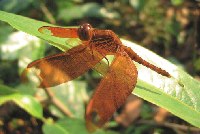
Hundreds of dragonflies are floating on shimmering wings in the golden light. A warbler tweets from a branch and then suddenly darts into the air snatching a fly between its beaks. A magpie flutters from tree to tree.
We discover a wide variety of spiders basking in the winter sun. Their stolid patience rubs on us to make us feel lazy too. Then there are the ants; diluted red, large and wholesome; chipping leaves and marching into the bark holes in a straight line. Sometimes they stand still, communicate with their antennas touching each other tenderly, and then move on. Some carry white eggs. The winter afternoon could bring no repose for them.
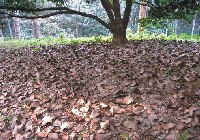
We hauled ourselves up -- the forest is yet to be discovered. In the sylvan shadows of the afternoon forest we walk on. Large leaves shed from the Shal trees spread like a carpet. They crumble under our soles.
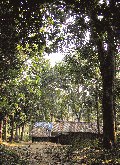
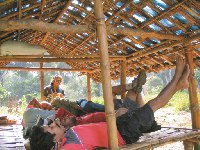
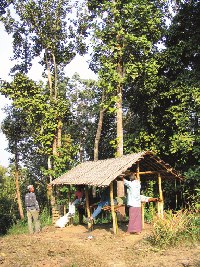
Deep into the forest we find a small thatched bamboo structure with no walls. We wonder why this has been made. Maybe to guard the pineapple orchards. But for now it could be the perfect respite for us. We lie on the bamboo floor. The trees, the green, the poignant smell of the forest, the humming of the birds, the deep blue sky peeking through the foliage, the tranquility, the muted beauty, all these make us drowsy and softly we drift into sleep.
We don't know how long we had been sleeping for. But a voice makes me open my eyes. A face. An unknown face--that of an indigenous man--looking at me with curiosity.
"Where are you from?" the man asks.
"Dhaka. Tourists."
"I am Mong Song Marma. I look after the pineapple gardens."
After a while, his tense face relaxes and he starts talking. We talk about the Marma society, their way of living and their tales of happiness and sorrows.
Mong tells us how the Marma community has been slowly diminishing at the onslaught of Bangali infiltration.
"We are losing our lands. We are losing our culture. We are going deeper into the forest and hills where we can find peace," he tells us. "Sometimes the Bangalis clash with us and burn down our homes. We cannot fight them, because we are fewer in number. My house was torched," he murmured.
It is getting darker and we have to return. Otherwise, we might get lost in this unknown wilderness. We are walking through an orchard. The last rays of the day are filtering through and creating a mosaic of light and shadows. We walk silently as if we are the lost Hansel and Gretel. Behind every shadow lurks a monster. A sudden rustling noise startles us. A large Malayan squirrel. Black and furry, at least three feet long. The squirrel scrambles up a trunk and disappears into leaves.
Night descends quietly in Ramgar. Everything is so quiet that you can even hear your own breath. The crickets have gone into hibernation in the winter. Only a night bird cries to shatter the night's sombre mood. Like a thick blanket, the cold seems to descend from the sky. The mercury drops. And then comes the thick fog.
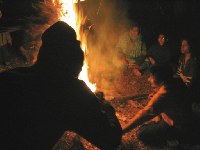
We build a campfire. We collect dry twigs, douse them with kerosene and torch them. The flame leaps up into the air. A strange light dances on the forest trees; something beyond light and shade; something mysteriously gloomy; something mesmerising. Then you know why insects hurtle into flames. We stare into the light without thinking anything.
Somebody throws a mug of kerosene into the fire and the flame leaps even higher, almost singeing our bodies. The caretaker of the centre.
"Be careful. Let it just glow," I warn the caretaker.
"It's no fun if the flame is not big," says the man, a thin, dark figure. "We had fun when we torched the houses of the paharis (hills people)," he said, "the flames were so huge, almost touched the sky."
"When did it happen?" I ask the man.
"Oh, when we had the fight with them. Had we not torched their houses, it would have been difficult for the Bangalis to stay here," the man reasons.
I don't say anything. I suddenly remember the face of the Marma man we met in the evening. The man with a sad face and sad eyes who said his house was torched. I remember the berries he offered us. I remember how keen he was to talk with us. I remember he said he has three kids. I remember he has a wife. A mother. He must have many more things. But he must be missing one thing -- trust for the Bangalis.
I keep looking at the flames dancing so wildly.
..................................................................
Story: Inam Ahmed
Photo: Towfik Elahi