Dhaka Sunday July 24, 2005
location > SONARGON & Langan bandh category > Family
Sonargaon: still live…captivating
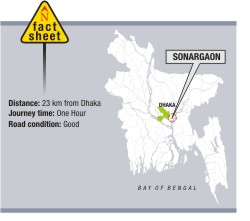 My friends have deserted me. Photographer Zakir did not turn up because of his little interest in the Sonargaon ruins as he had already published a book on the medieval capital city of Bengal. Inam had several visits to the area. So, I started the trip with a heavy heart. My friends have deserted me. Photographer Zakir did not turn up because of his little interest in the Sonargaon ruins as he had already published a book on the medieval capital city of Bengal. Inam had several visits to the area. So, I started the trip with a heavy heart.
But moments after we were motored through the even metal road that leads towards Chittagong, strong fresh wind broke in through the window of the microbus to blow away my gloom.
Anyway, within an hour or so we reached historic place. Leaving the highway we turned towards east and took a bumpy narrow metal road on the way to Painamnagar.
Whenever my mind goes back to the 13th century I can hear the sounds of the hooves of cavalry soldiers of the Seljuk Turks from Asia Minor under their great leader Shamsuddin Ilyias Shah who found Sonargaon as a suitable place for building their capital against the quarrelsome Tughlok Dynasty of Delhi. But Ilyias Shah could not escape the fate as the soldiers of Ghiasuddin Azam Shah, eldest son of Ilyias, brutally murdered Ilyias along with his other sons for the throne. Ghiasuddin was arguably the most successful and benevolent ruler the province of Bengal ever had. But one of his aides-de-camp Raja Ganesh treacherously killed him and took the throne for four years.
 Ghiasuddin turned the villages of Mograpara, Painam and adjacent areas into a prosperous township. Some mosques and tombs scattered in the area still tell the tale of the past glory. Ghiasuddin turned the villages of Mograpara, Painam and adjacent areas into a prosperous township. Some mosques and tombs scattered in the area still tell the tale of the past glory.
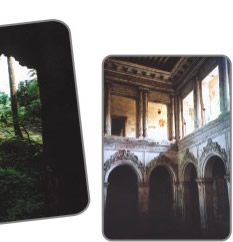
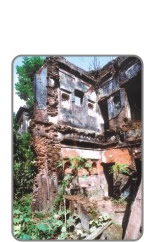
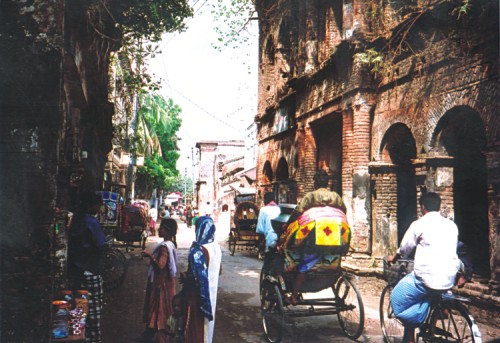
The Sonargaon folklore museum is a place of great interest where one can have a glimpse of the craft of medieval Bengal. But to me the most attractive place is the street of Painam village. Both sides of the street are well decorated with closely knitted buildings. Most of them are two-storey, some are transformed into ruins and deserted. One can easily be fooled by the look of the buildings as their condition does not speak of the medieval period. Actually, these buildings were built by the merchants and indigo planters between the 19th and 20th century. Worn out walls, depleted columns, broken arches have still kept these building alive to the visitors' amazement, but for how many days, nobody knows.
Nevertheless, who loves the haunting places, Painam must be his first choice.
Porshuram, a mythical character of the great epic Mahabharata, committed the most grievous and unpardonable crime by killing his mother with an axe on provocation by his father on the ground of adultery. Cursed, Porshuram saw the axe fixed on his hand for good. Fearing dire consequences in the hell, he started meditation to please the God for mercy, which he was granted in dream but with an instruction. He was asked to use his axe as a plough and to plough down the earth. On the way where he will find the axe being stuck on earth, he can stop there to find himself freed from the spell of the sin. The epic reveals that Porshuram's axe got stuck at the bed of Brahmaputra river and the name of the place became Langal Bandh that means stoppage of plough. Ultimately, the area became a holy place for the Hindus where they use to bath in the river to get rid of their sins in the Bengali month of Chaitra.
We drove for fifteen minutes to reach Langal Bandh bathing point without much difficulty. A flight of big stairs stretches the wide bathing 'ghat' from the paved bank of the Old Brahmaputra river to the water level. Here the water is stagnant and well carpeted with water hyacinth. Other than some local bathers and stray goats, the ghat was almost deserted.
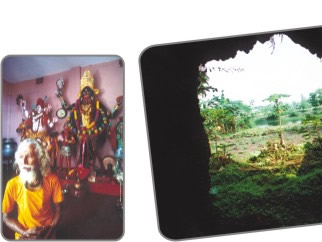
Close to the ghat, I met a Kali devotee (Shadhu) at a small temple. He told me that I would find this place more interesting during the 'mela' (village fair) when pilgrims from India and Nepal along with locals throng there.
"This place will be crowded, where I will stay?"
"No problem, at my place, I will be happy."
The area was preparing for the festival. While going round to some shrines I saw some potters busy making clay deities, specially the Shiva at different places. One of Jajoman (the arranger) came forward to me and said: "Sir, can you write for us?"
"Nowadays prices are hiking so rapidly that we cannot cope with. You see, these clay statues cost more than a lakh taka each, which we hardly can afford. This is a national event, if the government comes forward to help us then it will continue, otherwise we have to stop it," he said.
There are several temples in the area, old and new, managed by the local community. While searching for an old temple I found some gypsy boats and could not resist temptation to take some snaps. As I got close to the boat and opened my camera, one of the gypsy maids screamed out: "Hey, you fetch money by photographing us, can't you never give us our share!"
................................................................
Story & Photo: Khasru Chowdhury
|