We were out of Dhaka crowd and the spell of month-long scorching heat. We drove down to the Mawa ghat through the smooth metalled road under the cover of gray cloud and occasional friendly drizzle. Before us, the mighty Padma River was flowing as it was thousands of years ago. This part of the river is bifurcated into two channels making a huge island in the middle and the two branches joined again.
We were cruising on the smaller branch of the river but strong wind created huge waves that rocked our boat. Though we had some life jackets, the waves made some of us a bit worried. But soon the worrying time was over and all of us started singing suppressing the whirring of the engine. Mr Alam and Mr Maroof of JABA Tours, our host of the trip, were always busy looking after us. Soon then joined the chorus. The weather was not photographer-friendly as most of them hate such lighting condition, but surely it was perfect for the outdoor-loving tourists. The condition was ideal for the autumn Padma landscape as if came out of poems of Tagore who used to spent quite a long time on the river. Apart from the mechanised boats, small dinghis were plying here and there. The colour of sky and water became dirty gray and the horizon could only be defined by the lines of lush green vegetation. After an hour or so, out boat anchored at the junction of the main course of the river with strong currents. It was time for swimming but the level difference of boat and water made it difficult to drop into the water. Fortunately, Inam volunteered by dropping his inflated boat into the water. Alam dropped down some lifebuoys entangled by a strong rope for the relief of the tired swimmers. One must admit that swimming in swimming pools and free flowing water is always a different experience. Suddenly clouds disappeared and an intense blue sky with brilliant sunlight came out from nowhere. We did not waste time to enjoy the magical moments. We got to swimming, mud-bathing, squeezing through the paddy and jute vegetations and everything that came to our brain. We were tired to our bones and our stomach persuading us to call it the fun. We obliged.
........................................................... Bird watching with Dr Ali Reza Khan
This is the most colourful of our barbets. It is most common in the Shal and Semi-Evergreen forests as well as in the north, west and south-western Bangladesh. Not found in and around Dhaka. In the North Bengal the mid-day silence of hot summer day is often broken by the loud and repetitive call of the Blue-throated Barbet. It is basically a grass green bird with prominent blue throat, breast and sides of the face and head. The head being tri-coloured with crimson nape, black band ahead of it and on top of the head that is being followed by a narrow white one and the forehead is crimson again. There is a crimson blotch at the side of the breast. The bill is very heavy, and the head and neck regions are bulky. The bill is bluish black and its bases are encircled by black bristles. Both sexes appear similar in size and colour although the male could be slightly bigger than the female. Its plumage merges with the foliage through which it moves. It lives in small loose flock of few birds but could be found in dozens when many from the neighbourhood congregate to feed on ripening figs, banyan, Debdaru, Boulagota, Jamun and other soft fleshy fruits. In addition to fruits and berries it can also feed on insects. This barbet produces a loud Kutroo-kutroo-kutroo from a perch and could be heard from far off places. It is more often heard than seen. It drills out a hollow in a tree and keep using the same hole for nesting year after year. It can also recommission hole-nests of other birds such as the woodpeckers and parrots. Actual size± 23 cm. © thedailystar.net 2006 |




















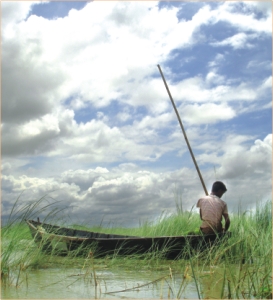 We were on a newly-built wooden boat 'Panshi Nao,' a name chosen from its traditional design. As we settled comfortably on top of the boat's hood, it started moving with much noise from the engine.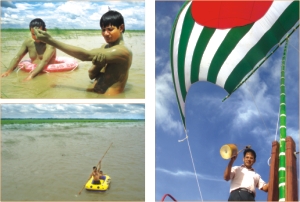














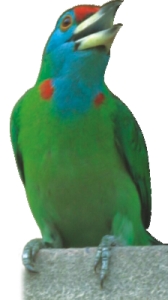 Blue-throated Barbet Megalaima asiatica