|
 |
|
|
| Home | Issues | The Daily Star Home | Volume 8, Issue 02, Tuesday, January 08, 2013 | |
|
|
|
|
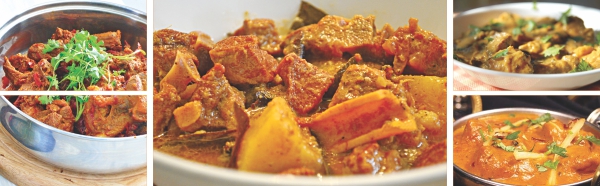
AAPPAYON Royal indulgence By Shawkat Osman January, the coldest of months in Bangladesh's short-lived winter, is the perfect time for rich food in a climate that discourages that kind of gastronomic indulgence during other much warmer seasons. Now is the time to satisfy our inborn craving for heavy food that will help keep us warm through wintry nights. To that end, Shawkat Osman presents five recipes that date back to Mughal times, so that you too can dine like royalty.
Ingredients: Method: In a large mixing bowl, combine the following: baresta paste, yoghurt, mace, nutmeg, tejpata, cloves, green cardamom, green chilli, green chilli paste, garlic paste, ginger paste. Whisk to get a smooth paste. Dunk the meat into the mixing bowl; rub with your fingers to coat them with the spice. Cover the bowl with cling-film. Marinate refrigerated for eight hours. After the marinating period; with a pair of kitchen tongs, pick out the meat pieces, scrape off marinade sticking to meat, and lay them on a platter. Retain the marinade and set both items aside to bring them to room temperature. Place a deghchi/pot over a medium flame, pour in: 4 tablespoons oil, 2 tablespoons ghee, reserved ghee. When fat is very hot, toss in the dry red chillies. As soon as the chillies turn a shade darker; chuck in the meat pieces. Sauté, turning frequently until meat browns on all sides. Add: marinade, rose water, and kewra water, salt. Mix up. Cook until tender. Occasionally scrape the base and sides of the deghchi/pot with a wooden khunti/rubber spatula. If the gravy tends to catch the bottom of the deghchi/pot, sprinkle 2 tablespoons water and dilute the gravy. This will bring down the cooking temperature and help to avoid scorching. Alternatively you may cook it in a preheated oven. Make soft dough with the plain flour and enough water. Roll out the dough into a long thin strip; place the strip on the rim of the pot, covering the whole circumference. Rest the lid on the dough strip and firmly press down to attach the lid with the dough tightly. Place deghchi/pot in a preheated oven (170ºC) and cook for 40 minutes. Baking in a sealed deghchi/pot gives the dish extra flavour. Korma Ingredients: Method: Drop the meat into the mixing bowl and coat the pieces evenly with the spice. Marinate for an hour. (Since marinade contains raw onions prolonging the marinating time will give the dish a sour taste). Heat oil and ghee in a korai/wok and lob in the sliced onion. Sauté until they are golden (baresta). Using a slotted spoon, strain out ¾ of the fried onions (baresta) from the oil and grind them with 2 tablespoons of water, to facilitate the grinding. Keep baresta paste aside. To the remaining baresta in the korai/wok add the meat along with the marinade. Over high heat bring to a boil. Reduce the flame and simmer until meat is tender. Take care to scrape the bottom of the korai/wok with a wooden khunti or spatula, add 2 tablespoons or more milk if necessary to avoid scorching. Once the gravy starts to catch the bottom of the korai/wok, sprinkle a little milk to dissolve the spice and avoid charring. Stir in the ground baresta paste and salt. Mix up. Cook for further 5 minutes. After the fat separates from the gravy -- take korai/wok off flame. Kalia Ingredients: Method: In the residual fat, toss in the following -- red onion paste, ginger paste, cardamom, and cinnamon, cloves, and 'coriander-cumin' mixture. Sauté stirring vigorously until spice releases its flavour. Return the meat to the korai/wok. Stir in the garlic paste -- fold to coat the meat with the spice. Then progressively include the yoghurt -- 1 tablespoon (15 ml) at a time. Stir-fry after each addition to blend in the yoghurt. Once the yoghurt assimilates with the meat add the next batch of yoghurt. Keep on adding and stir-frying until you exhaust the entire yoghurt. Stir in the ground 'cilantro' mixture. Swirl hard to fuse the mixture with the meat pieces. Cover with a lid and cook for a further 10 minutes. Shake korai/wok frequently to keep spices from sticking to the korai/wok. Add milk, salt, red chilli rings. Mix up. Bring to a boil. Reduce heat and cook uncovered until the meat is tender. Sprinkle with rose water and kewra essence; take deghchi/pot off the flame and serve hot.
Morich mangso Ingredients: Method: Heat the ghee in a korai/wok; chuck in the meat along with its juices that was drawn out by the salt. Cook stirring until the meat pieces are coated with the oil. Dust meat with pipool powder. Mix up. Cook stirring occasionally until the liquid released by the meat evaporates and only the ghee remains. Shorse mangso Method: Method: In a stone mortar, grind the following with a pestle: mustard and chopped green chillies. Transfer mustard--chilli paste to a glass bowl. Cover with cold water to come about 2cm above the paste. Leave it in the refrigerator overnight. In a large mixing bowl, whisk the following: garlic paste, yoghurt, salt. Drop the meat pieces into the mixing bowl. Coat them evenly with yoghurt. Cover bowl with a lid/cling film. Keep refrigerated overnight. Return to room temperature before cooking. Place the meat along with the marinade, in a deghchi/pot; pour in 1 cup of water. Swirl with a khunti/spatula to dissolve the yoghurt mixture with the water. Set the deghchi/pot over a medium flame and lead contents to a gentle sizzle. Lower the flame and cook uncovered; until the meat is tender and most of the liquid is absorbed. Take the deghchi/pot off the flame and allow the meat to cool for 10 minutes. Tip off the surface water from the mustard paste. Mix in the mustard-paste with the cooled meat. Fold to coat the pieces evenly. Next blend in the following: mustard oil, slit green chillies, salt. Mix up again to give the meat pieces a glistering coat. Return the deghchi/pot back to the flame; and bring contents back to boil. As soon as it reaches boiling point, lower the flame. Cover with a lid and gently simmer for 10 minutes. LS PICK
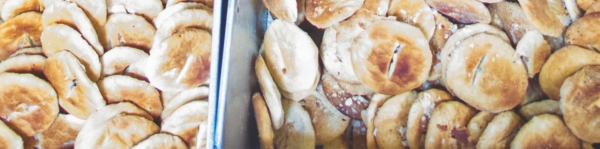
The many layers of the Bakarkhani Standing amidst the chaos and congestion of Old Dhaka and munching on the dry yet delectable Bakarkhani, a few things may happen. As one succumbs to the taste of Old Dhaka's most famous snack, the noise and the crowds are blocked out. Then, one is lulled back into a reverie, with the mystical landscape of the area playing a vital role. An epiphany then follows; this land, steeped in Mughal tradition, retains the cultures that gives it its unique character and although the buildings will become modern along with the people, the Mughal influence will never fade. All this happens, while munching on the inimitable Bakarkhani. Bakarkhani, a type of layered bread made with helpings of ghee and finally cooked in a tawa, gained prominence centuries ago. A popular delicacy in the royal court of the Mughals in Delhi, demand from there fuelled the growth of the industry. As the Mughal influence grew in Dhaka, so did the demand for the item. However, Bakarkhani has always been more than a snack and in fact much more than an emblem of Old Dhaka; in fact it is a symbol of love and modern-day artefact. Its tale is of as many layers as the bread itself.
Jitu, one of the numerous Bakarkhani-bakers in Old Dhaka speaks with pride of his work. “I come from a family of Bakarkhani bakers. This is a traditional job, passing from father to son,” he explains. Such Bakarkhaniwallas now number in the hundreds, however very few can boast the lineage that Jitu claims to have. “For more than three decades, the men in my family have been doing this,” he says. Another baker, Shaheed of Lalbagh, says he has been in the business since before Independence. The first in his family, Shaheed learned the trade from a person he only refers to as Ustad, meaning master. He also now teaches his workers the same art and they share a bond as that between a master and a pupil. The love they have for their trade is evident and this lends yet another layer, that of dedication in to the making of Bakarkhani, transcending the craft into an art-form. The Bakarkhani we know today hasn't changed from the first one baked centuries ago. However, the addition to Bangladesh's already rich list of types of bread has spawned numerous variations. Originally baked with ghee, molasses solution is now added by some bakers to give the bread a red tint. These variations have transcended borders as well, an example of which is the Kashmiri Bakarkhani. This kind is thinner, with eggs often used to give it a redness in appearance, whilst maintaining the crispiness associated with the original Bakarkhani which is considerably thicker. Another version is the Cheese Bakarkhani which is lined with mohanbhog mishti or selmolina halwa in every fold, instead of using ghee. Bakarkhani, though a breakfast item, is also perceived as a snack, usually consumed with Shutli Kebab, which is available at both branches of Anado, located at Old Dhaka and Wari. Another aspect of its traditional use is when it is served in a groom's house, dipped in creamy milk and topped with raisins and almonds. The bread also has numerous health benefits, being rich in carbohydrates, proteins and fats.
“My family always has to have Bakarkhani at least twice or thrice a week, whether with something else or on its own,” Dipu, 24, a resident of Old Dhaka says. Shabbir Ahmed, 22, a former resident of Old Dhaka and now living in Mohammadpur, also impresses the significance of the delicacy. “Even though we no longer live in Old Dhaka we must have Bakarkhani and thankfully there are shops serving just that right nearby in Shakertek,” he says. Bakarkhani is now as much part of Dhaka as it once was of the Mughals. The romanticised tale of this famous bread is one that few other edibles can boast. It is a symbol of love, a totem of our history and beacon of hope for those still clinging onto the last vestiges of a culture in decline. The Bakarkhani is more than just multi-layered bread; it is in fact a reminder of the richness and grandeur of our ancient times. By Osama Rahman |
| home
| Issues | The Daily Star Home © 2012 The Daily Star | |
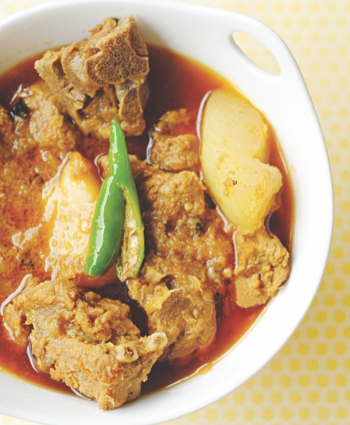 Rezala
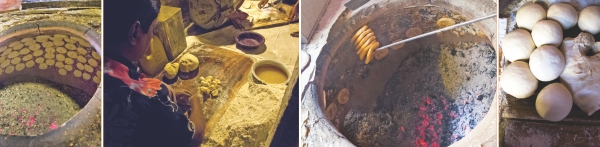
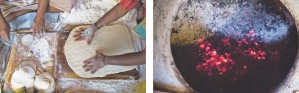 The name Bakarkhani was first perpetuated back in the reign of Nawab Siraj-ud-daulah, back in the 1800s. Aga Bakar, a general of the last Nawab of Bengal in Chittagong, fell in love with a dancer called Khani Begum, who was also the object of affection of another officer. The two fought to make the lady theirs and in the struggle Khani Begum was killed. As a testament to their love, Aga Bakar prepared the special bread which he christened Bakar-Khani, linking the two for all eternity. The Bakarkhani then became a staple item in Chittagong, remaining as such till today, with the only distinction being that the Port City still treats it as a dessert, as it is sweetened. When a Chief Officer brought a young Bakarkhani maker to Old Dhaka, it gained fame in the capital as well. The rest is history.