
Civil Society Initiative for Accountable Development
A Regional Dialogue on: "National Election: 2007: Civil Society Initiative for Accountable Development,” was held in Faridpur on 12 August, 2006 under the joint sponsorship of CPD, The Daily Star, Prothom Alo and Channel-i. Members of the Citizens' Committee, leaders of various political parties, people belonging to various professions and from all walks of life joined the dialogue. This supplement contains the summary of the discussions. The names and identities of the participants are published below. Due to constraint of space we are not able to publish the comments of all the participants. -- Editor
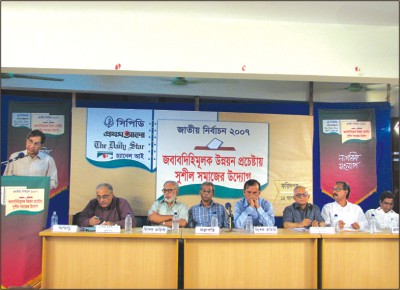 Debapriya Bhattacharya
There has been considerable development in Bangladesh in last 15 years. Since democracy has been revived 15 years ago, we observe that a positive relationship between democracy and development has evolved in the country. In last 15 years the size of the economy of Bangladesh has doubled, and at the same time its population has increased. The per capita income of the people has increased by one and a half times. The percentage of people living below poverty line has come down from 48% to 42%. There has been development in sectors like education, health and other social sectors. Food production during this period has increased by 50%. There has been five-fold increase in export earning. If the growth rate continues to increase for next fifteen years then by 2020 the size of our national economy will be 144 billion dollars from the present 60 billion dollars. That means the per capita will stand at 875 dollars from the present 445.
Some people say that we do not project the positive sides of Bangladesh. From this paper you will understand how specifically we talk about the positive sides of Bangladesh. But the fact is, even if Bangladesh's economy continues to grow at the present rate, there will be five crore poor people 15 years from today, just as we have five crore poor people today. It is because the present rate of population growth is more than the pace of development. As a result, even by hen the per capita income will not cross the thousand-dollar mark. That means, even 50 years after our independence, there will be apprehension whether Bangladesh will be able to emerge as a middle-income country. We feel that the reason for the apprehension isin spite of having immense potential, huge resources and creative people in the country, there is corruption, misuse of resources, and absence of equitable distribution of wealth and lack of skilled manpower. The root cause of the problem is absence of good governance. To ensure good governance, the following institutions have to play vital role, these are, Election Commission, Judiciary and Parliament. If we cannot send competent people to parliament then the relevant institutions will continue to remain weak.
With this aim in view, we have tried to focus on two things. One, how would Bangladesh look like when the country will celebrate Golden Jubilee. We call this Vision. The public representatives will translate this dream into reality. It is the representatives who will go to parliament will implement the dream. We shall entrust them with this important task. Therefore, we may have some say with regard to those people. This is not about doing politics; it is about exercising political right. We shall try to create the opportunity for the people to exercise their voting rights and elect honest, skilled, competent and patriotic persons to lead Bangladesh.
Matiur Rahman
We cannot be very hopeful after the way the Election Commission is acting. It is being questioned whether this EC is capable of holding a free and fair election. There is also question, apprehension and doubt in the minds of the people regarding the possible role of the caretaker government. Both the people of the country as well as our friends from other countries of the world have the question in mind what is going on and what is going to happen?
After 35 years of independence we remind ourselves of having a dream of a democratic and secular country. There will be no inequality in society. But we did not have a good beginning. The military rule for one and half decades has increased the suffering in society and also at state level. The political governments could not establish democracy in the country. There have been three elections after '90. After winning, the winning party takes everything. The ruling party politicises the government and gets involved in corruption. They cannot make the parliament functional. The party in opposition does not go to parliament. They give calls for hartal and blockade. But this cannot go on. Anarchy has found a permanent place in our society. We have elections but we do not see any progress. Even though we have become self-sufficient in food and we have progressed as far as education, health and human development is concerned, we are still lagging behind. The party that wins in elections does not implement its own manifesto.
There is going to be elections in January 2007. We have to share certain responsibilities for that election. Some changes in the administrative system needs to be done. Corruption and politicisation ought to be stopped by any means. Judiciary has to be separated from the administration. Local government has to be made effective. Television and radio have to be given full autonomy.
On top of all, there has to be a free and fair election. That is why we are talking about finding honest and competent candidates. This concept has become very popular among the people from all walks of life. People now demand honest and competent candidates to build a corruption free society through the next elections. We want to assist the political parties and we want to generate public opinion. We do not have any political ambition. We want welfare of the politicians. We want them to help people live a better life.
| List Of Participants |
| 1. Prof. ANM Abdus Sobhan, president, regional Nagorik Sanglap, Faridpur, educationist and researcher 2. Matiur Rahman, editor, Prothom Alo 3. Adv. Shahidunnabi, president, lawyers association, Faridpur 4. Munshi Harun Ur Rashid, president, district journalists samity 5. Abul Faiz Shahnewaz, district commander, Bangladesh muktijoddha sangshad 6. Khadija Begum Moni, general secretary, bangladesh Mohila Parishad 7. Forkan Ahmed Khan, vice-president, Faridpur Chamber of Commerce and Industry 8. Prof. Altaf Hossain, general secretary, Shahitya Parishad 9. Aliar Rahman Khan, chairman, FEMA, Faridpur branch 10. Anjali Bala, pesident, Phulki 11. Asma Akhter Mukta, executive director, RASIN 12. ASM Shahjahan, former adviser of caretaker government, former IG police and member Nagorik Committee 2006 13. Begum Rabeya Ahmed, Mother of martyr and president, Nandini Shahitya Pathchakra 14. Kochi Reza, shahitya sampadak, Kabi Jashimuddin Parishad 15. Adv. Shahana Shoily, human rights worker, Madaripur 16. Md. Mehdi Hasan Shoaib, general secretary, Faridpur Debate Forum 17. Shipra Goswami, staff lawyer, BLAST 18. Shamsun Nahar, lawyer 19. Md. Mosharraf Hossain, student, Rajendra University and College 20. Shubrata Gosh, president, Faridpur Debate Forum 21. ATM Amir Ali, editor, Faridpur Idaning 22. Khan Mahbubur Rahman, executive member, Chamber of Commerce & Industry and president Ghatok Dalal Nirmul Committee, Faridpur 23. Golam Faruq Howladar, Entrepreneur, Madaripur 24. Dr. Fakir Abdur Rashid, president, Rajbari Nagorik Committee 25. Nur Mohammad, assistant director, PEPBRDB, Faridpur 26. Shahana Nasrin, project director, Madaripur Mohila Kallyan Sangstha 27. Muhammad Ali Rumi, secretary, Shammilito Shangskritik Jote, Faridpur 28. Md. Murad Hossain, student, Rajendra University and College 29. Syed Sohel Reza Biplob, joint convener, District Jubo League, Faridpur 30. Ivy Masud, member secretary, District Mohila Awami League, Faridpur 31. M Saiduzzaman, former finance minister and chairman, Bank Asia, co-convener Nagorik Committee 2006 32. Shah Mohammad Abu Jafor, MP, Faridpur-1 33. SM Nurunnabi, member, advisory council, Bangladesh Awami League, Faridpur 34. Shahazadi Begum, head master, Sharada Shundari Balika UcchaBidyalaya, Faridpur 35. Bashir Ahmed Chowdhury, president, Prothom Alo Bandhu Shova, Faridpur 36. Adv. Ruhi Shamshad Ara, executive director, Women Orientation Rural Life Development 37. Shuchitra Shikder, lawyer 38. Nasrin Sultana, science & education secretary, Khelaghor, Faridpur 39. Eva Majumder, Faridpur Debate Forum 40. Shupriya Dutta, teacher 41. Kazi Mosharraf Hossain, retired head master, Madaripur Government High School 42. Md. Shahjahan Mollah, lawyer 43. Gazi Shahiduzzaman, member secretary, Shushashoner Jannya Nagorik, Boalmari Upazila branch 44. Abdul Haque Shikder, former president, Press Club, Faridpur 45. Prof. Kamal Ataur Rahman, former principal, Rajendra College 46. Prof. Abdul Hamid, former principal, Govt. Rajbari College 47. Sheikh Mohammad Salehuddin Daniel, student 48. Adv. Fazlul Haque, secretary, Madaripur Legal Aid association 49. Hasna Jahan, Commissioner, Faridpur 50. Khondoker Manjur Ali, president, town Awami League and commissioner, Faridpur 51. Md. Delowar Hossain, chairman, Bhawal Union, Nagarkanda 52. Sheikh Firoz, general secretary, Sramik Union, Faridpur 53. Kazi Jainul Abedin, president, District Awami League, Faridpur 54. Gopal Chandra Sarker, president, CPB, Madaripur 55. Ali Ashraf, organizing secretary, District BNP, Faridpur 56. Khondoker Saidur Rahim Bitul, joint secretary, JSD, Faridpur 57. Monoj Shaha, district secretary, Workers Party, Faridpur 58. Kazi Humayun Kabir, convener, District BNP, Madaripur 59. Adv. Shubal Chandra Shaha, co-chairman, District Awami League, Faridpur 60. Rafiquzzaman Laek, general secretary, CPB, Faridpur 61. Adv. Md. Asadur Rahman Khan, general secretary, town BNP, Faridpur 62. Md. Jahid Bepari, joint convener, District Jubo League, Faridpur 63. Adv. Syed Modarres Ali Isa, general secretary, District BNP, Faridpur 64. Md. Azizul Haque Khan, former principal, Govt. Yasin College and president, Shammilito Shangskritik Jote, Faridpur 65. Md. Haider Ali, political worker 66. Dr. ASM Jahangir Chowdhury 67. Anwar Karim, president, Nirnoy Shilpi Goshti, Faridpur 68. Monoranjan Bose, Alipur, Faridpur 69. Altaf Mahmud, general secretary, Kelaghor, Faridpur 70. Pasha Khondoker, Jatiya Kobita Parishad, Faridpur 71. Prof. Rezvi Zaman, adviser, Debate Forum, Faridpur 72. Md. Aolad Hossain, regional manager, NGO Forum, Faridpur 73. MA Salam Lal Mian, president, Bangladesh Muktijoddha Sangshad, Faridpur 74. Khan Mohammad Shahid, Madaripur Legal Aid Association 75. Rajib Hassan, theatre worker 76. Adv. Nasir Uddin Ahmed, District Bar, Faridpur 77. Md. Ashraf Ali, general secretary, AVA, Faridpur 78. Saiful Bashar Sohel, member, Sujan, Faridpur 79. Md. Nur-Uz-zaman, secretary, Prothom Alo Bandhu Shova, Faridpur 80. Shamim Khan, observer, JANIPOP 81. Shuresh Chandra Halder, development worker Coordinator: Debapriya Bhattacharya Executive Director CPD. |
Adv. Shahidunnabi
The question that comes to every mind isare the politicians social workers anymore? Do they work for the welfare of the people? I believe that they do politics of business. The big parties look for people having thousands of crores of taka while giving nomination. These are black money. What good these people can do for society? Can people expect these people to be accountable?
We believe that people are the ultimate source of powerbut this is being said by the politicians only to befool the people. You are the owner of a vote. After giving your vote you become one among those exploited. Only 10 per cent of the people in this country are involved in corruption. You have to catch them. There is no practice of democracy among the politicians. They are not tolerant. They attack each other with brute physical force.
Munshi Harun Ur Rashid
There is no trace of democracy in the political parties in this country. Then how will they present us democracy? We are talking about corruption, we are talking about anti-corruption commission and we are talking about members of parliament. There was news in Faridpur Dateline on the 10th where one possible candidate said that his election cost would come to Tk. 70 lakh. He has already spent Tk. 15 lakh. How can he give declaration of spending Tk. 70 lakh whereas the Election Commission has fixed the ceiling of election cost at Tk. 5 lakh? The people we elect never keep in touch with us afterwards. I feel they have no principles, no guideline and no scruples and that's why they behave like this.
Abul Faiz Shahnewaz
If we build a Bangladesh where there will be no spirit of Liberation War and our glorious cultural heritage, then will not that be a robotic Bangladesh? Today, we see that those who have a loud voice and muscle power, they find a place for them in society. Today we have to bow down our head before the armed forces that we have created to defend our country. This force is running the country from time to time. We have to think about this issue seriously. Those whom we send to parliament as our representatives they try to keep our voice down. We want that the process of selecting public representatives for 2021 should start from now. It has to start from 2007.
Khadiza Begum Moni
Bangladesh Mohila Parishad has been struggling for a long time for the right of direct election of women. Our movement began after the elections in 2001 and it was included in the manifesto of various political parties. But unfortunately, whoever has gone to power has forgotten to implement the demand. Our demand is we want to contest directly in 100 seats. I also want to say that we are apprehensive of the rise of the fundamental elements in the country.
Prof. Altaf Hossain
I had forgotten to see dreams. Today's meeting has woken me up. Personally I feel that the system of caretaker government is not something honourable for the nation. I expect to see election without caretaker government in 2021. In 2021 there should be wide practice of reason and intelligence. I want that in 2021 women should run the affairs of the country. I feel that would ensure a terrorism free Bangladesh.
Anjali Bala
The big two parties are too greedy for power. That is why they nominate owners of black money. We do not want such people should get nomination. If such exchange of opinion could be arranged at upazila level then the common people would become more aware. I hope the Bengali tradition will not disappear and that we do not lose our characteristics.
ASM Shahjahan
Political parties do not keep their promises after elections but at the same time we also do not keep this in mind when it is time for the next election. The Vision that we prepare for them ultimately turns into a fairytale. Just as many of our dreams during the time of our liberation have become fairytales. Our dream was that every citizen in this country would enjoy the same rights. They will enjoy education and health rights. The country will be governed by public representatives elected on the basis of free and fair elections. They will ensure social and economic development and there will be equitable distribution of wealth. And we shall not go to the donors to solve our problems.
We want honest, competent and courageous people. I endorse the view of the person who said that we should go to the upazila level to hold discussion. But, all of you here today should go and spread the message. This is our responsibility as citizens.
Begum Rabeya Ahmed
I am the mother of two martyrs. My two sons died in the Liberation War. I carry the pain inside. Nothing of the liberation spirit has been implemented. Today we all have forgotten that we have to serve the humanity. How can people do politics when they do not believe in showing care and love for people? How will they run the affairs of the country? Therefore, all I want is you should remain honest and hard working and you should love the people. Practice what you preach.
Khan Mahbubur Rahman
I think it was not right for us to have the independence in nine months. If the country had achieved independence after a prolonged war for nine years instead of nine months then the fruits of independence would have reached every family. The total picture would have been different. Many MPs have thousands of crores of takas, many own satellite channels, newspapers and so on. The question is: where did they get so much money? First of all, political leaders have to come out clean. Otherwise all our efforts will go in vain.
Mr. Debapriya Bhattacharya has said that if he remains busy with this type of work then he will find no time to do research. I think this is not right. In the present situation, you should come forward and the people are behind you. We had joined the Liberation War in 1971 when we were students. We did not consider whether our education would be hampered or not. If your country falls into an abyss then what good will your research do?
Ivy Masud
I think only nomination of honest and competent candidates will not solve the problems. First of all, we have to stop black money and muscle power and then we need reforms of the electoral system. The present lot of politicians has no trace of principles left in them. As a result, nomination is being bought and sold. The citizens' committee has to play its due role to ensure that no owner of black money, godfathers and war criminals get nomination.
M Saiduzzaman
I want to say a few words about the initiative for forming citizens' committee on 20 March and its objectives and the present situation. The objective of the committee was to make the citizens aware of the political, economic and social rights. That awareness would then help in forming a government that would be accountable to the people. This government would take initiatives to change the condition of the people through a pro-development administration. We call this: How Bangladesh would look like in 2021: Vision 2021. Three things worked behind our taking the initiative. These were: the spirit and inspiration of our Liberation War; our pledge and our constitution. All the political, social and economic rights are ensured in our constitution. It is written in our constitution that Bangladesh would be a democratic state. But today democracy is being distorted. Therefore, to achieve our goals we have to ensure the voting right of every citizen and create a favourable environment to help exercise that right. We have to elect honest and competent people. But the precondition is creating a nonpartisan and acceptable electoral system. With this aim in view we have organised dialogues in the districts.
We can see that while the influence of black money has increased, the quality of good governance has eroded to a large extent. We believe that if Bangladesh's own recourses and possible foreign aid are invested properly to ensure good governance; and there is a change in the political system to ensure an accountable government then the development activities will be carried forward. We believe that achieving 8% GDP is not a difficult task. On the basis of this we shall progress toward the Vision 2021. We shall present that vision before you so that the political parties can include them in their election manifesto. This will ensure their accountability.
We believe that the main two political parties will work together to solve this problem and they will also solve the difference of opinion regarding caretaker government in the light of the constitution.
Shah. MD. Abu Jafar
I feel that this dialog is very important for our national life. It is mostly politicians who have come under severe criticism. I am a political worker and a trade unionist. I have been involved with labour movement for a long time. Actually whatever we want to do, it is the politicians who will have to do it. It is the politicians who have fought wars and if any reform needs to be done it is they who will have to do it.
The ministers and MPs of greater Faridpur should have been present today. Those who would seek nomination for future parliamentary elections should have been present here too. They should have listened to what I have listened today as an MP. There is both good and bad in politicians. Today they have been criticized for their wrongdoing. There are twenty-two proposals here; on the other hand, citizens' comity has given thirty-seven proposals for electoral reforms. These have to be accepted by the major political parties. The owners of black money have taken control of politics. Politicians who do not have money are running around to collect that. Otherwise they will not be able to contest in the elections. CPD's initiative is to improve this situation.
It is not only politicians who are corrupted but bureaucrats are also corrupt. There is also a question how people are bringing out volumes of newspapers. There is also something called yellow journalism. We have to find out how we all can become better citizens. Those who become rich overnight cannot do so with honest earning. There has to be corruption behind it. There should be laws to take people who will break election promises to the court. Because of loopholes in laws, dishonest politicians, bureaucrats or businessmen cannot be tried for corruption. As a result, corruption remains unstoppable.
Those who are looting national property know that they will not have to go to jail or their property will not be confiscated. There should be proper implementation of law so that no one will be able to get nomination if they cannot justify their wealth with their legal earning. In this country, there is a ceiling of taka five lakh but in reality crores are being spent for election. I have never seen any action taken against these people. Public opinion has to be generated not against politicians but against the corrupt people. There was a time when people did not develop relationship with corrupt people. But now they are eager to establish relationship with them. This is quite unique in this society. If at any cost you can make the two major parties sit for dialog then your task will become easier.
Debapriya Bhattacharya
We have written letters to the prime minister and the leader of the opposition to place the reform recommendations before them. We have not received any reply from them. We are still hopeful. There are many persons here who have contacts with the top ranking leaders of their own parties. My request is if you can create pressure from within the party then it will become quite effective.
SM Nurunnabi
I appreciate the initiative of Nagorik Committee. They will have to play an important role in this regard. This initiative should have been taken ten years ago. There is monga (near-famine) in Gaibandha and Rangpur but we have never seen anyone from the civil society going there to distribute relief. You shall have to go and work among the people. After the atrocities done on the minority community and opposition workers Nagorik Committee did not say a word. If you want welfare of the country and the people then please work among them. If you want to see honest people in parliament then you shall have to go to the voters and earn their confidence. If you want to enjoy rights then you will have to shoulder responsibilities. If you want to come up as a third force then thousands of people will support you because people want to be free from the clutches of the corrupt people.
Gazi Shahiduzzaman
My proposal is, instead of putting up candidates for 300 seats, election should be done on the basis of party or symbol. Because even if we elect honest people, as long as Article 70 is there, members will have no work other than raising their hands. If election is done on the basis of symbol then violence and influence of black money will reduce. If seats are distributed according to percentage then the parties will give nomination to honest, meritorious and patriotic people. Local level leaders will be given nomination for local government election so that they do not feel left out. My proposal is, let the local government election be done on the basis of party nomination. This will make the local government stronger.
Adv. Fazlul Haque
If the citizens become aware then it will bring about some changes in the state. For this reason, organisations at the grassroots level have to be formed to create awareness. Those who will contest in elections have to submit accounts of their wealth. Judiciary has to be separated from the administration. While talking about women's rights, we have only talked about seats for women in parliament but actually there is no law that guarantees equal rights of women. Though it is written in the constitution that in the eyes of law men and women are equal, but Hindu women have no right on family property. We did not touch Hindu law. After the reforms done in Muslim law, women have fifty per cent right on property. But in the constitution it is said that everyone has equal rights irrespective of religion, caste or gender. These should be included in the party manifesto in the coming election.
In our law it is said that son of a foreigner father and a local mother will acquire citizenship of the father. These laws need reform. In our country the prime minister conducts party meetings sitting in government house. We know that one should hold such meetings in party office. Such practices have to stop otherwise there will be no healthy practice of democracy. Though they want to come to power talking about democracy yet when they get power the first thing they do is strangle democracy.
Hasna Jahan
If women can be elected directly in union, pourashava and City Corporation elections then why can't they come to parliament through direct vote? Why should they be selected? Half of the 14 crore people in the country is women. But only 45 seats have been kept reserved for women in parliament. We cannot accept this discrimination. Our demand is, in the next election women should contest directly in 100 seats. As a conscious citizen we want an end to this discrimination.
Khondoker Manjur Ali
We welcome this discussion in the backdrop of the dismal situation in Bangladesh. The conscious citizens will be with you. If you can carry on with this discussion meeting with the conscious citizens then there will be another War of Liberation before 2021.
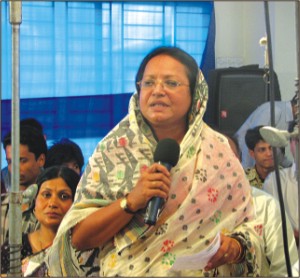 Mohammad Delwar Hossain
Everyone including BNP, Awami League and civil society talks about taking development activities to the grassroots level to ensure good governance. But I hold a different view. Because, we have observed that ministers and MPs interfere in the works of union parishad. Governments past and present have always interfered in the works of the UP. In Local Government Articles 9, 11, 59 and 60 of the constitution it is clearly mentioned that union parishad or local government is a neutral and independent elected parishad. But the political parties in Bangladesh have used union parishad in various ways for political gain through violating the constitution.
Sheikh Firoze
If newspapers and televisions had presented the suffering of the people at grassroots level then it would have made our task easier. Media hardly entertains the stories of common workers. Today we are talking about the elections to be held in 2007. I want to give a personal example here. On the last day, before the deadline of making the voter list, a teacher had come to my house to collect our names. I told him that all these days I did not find anyone but how come you have come on the last day? Then I asked him that even though I have filled up the form why didn't he give me a receipt? I wanted to know what would be the proof that I did become a voter?. Actually this is how things are going on in the country.
There are people who live in the towns and do not know how to cultivate a land, but they have become leader of the farmers. In fact corruption is in every sector. Those who did not join the Liberation War have got certificates. There is no unity among the lawyers. In the past, rich people established welfare institutes and became immortal. Today's MPs and ministers end their life running around to make black money white.
Kazi Jainul Abedin
Besides nominating honest and competent candidates for 2007 elections, the Election Commission needs a total overhauling. We do not believe that under the present chief election commissioner a free and fair election will be possible. The caretaker government system also needs reforms. In 2021 I do not want to see unified system of education. In your No. 12 proposal, the secular education is acceptable. But if all the educational institutes are not nationalised then it would not be possible to implement discrimination-free education system.
At present we do not see meritorious students coming from village or district level. Nowadays, only students of famous educational institutes are doing better results. Teachers in district towns cannot complete the full course. I got letter marks in matriculation examination but I could not solve a math of my grandson. That means present courses have changed drastically. If this goes on then the children of the poor villagers will not be able to go up in life. I request you to include these in your recommendations.
Khondoker Saidur Rahim Bitul
In Bangladesh, for the sake of democracy what is needed is national consensus. If the political parties do not reach a consensus, then Prothom Alo, CPD, The Daily Star or civil society will not be able to force anything on them. It is for the interest of democracy that Awami League and BNP need to reach a consensus. Here the administration is used to rig votes. In order to stop this practice, the political parties will have to have minimum honesty and principles. The Election Commission must have the power to transfer officials from election-sensitive positions who have been given posting by the present government in power.
The Bangladesh of 2021 shall be one having no 5th, 7th and 8th amendments. It shall be a secular Bangladesh on the basis of the constitution of 1972.
Monoj Shaha
I am proposing some additions. I want to propose the word 'secular' here. Because the connotation of the words 'secular' and 'noncommunal' are different. I propose to write 'classless social system'. The number three point is, here it is written: 'Language and cultural development and equal rights of the minority adibashis.' But one thing is probably missing here. Adibashi and tribal is not the same thing. That is why adibashi and tribal should be written together. The fifth point about hartal may encourage the vested groups. I request you to phrase it differently. As the sixth point, instead of representative parliament, a parliament composed of representatives from various professional groups has to be developed.
In the ninth point, local government organisation has to be changed into autonomous organisation. Because of absence of autonomy, the elected local government representatives are treated as servants of the administration.
Kazi Humayun Kabir
Advocate Fazlul Haque has said some sensible things here. In 1991 I had told him that he could get BNP nomination in Madaripur-2 seat. It was discussed in the highest forum. But he did not agree. He is an honest person but he did not take part in the election. If honest people do not want to take part in elections then how will you bring about changes?
People's dream will be reflected in the next election. Barrel of guns is the source of all poweris an obsolete phrase. Some adverse remarks have been passed here about politicians. I feel all of them are not true. We do politics for the welfare of the people. Those who do politics for personal benefit stay at the top. In the present political arena, we see dominating role of some moneyed people. Majority of the people do not want to listen to the people of civil society. They listen to the rich people and those having arms. Real politicians have not acquired black money or have arms. I feel the present crisis can be solved through discussion. If the Election Commission becomes strong then there would be no need for caretaker government.
Rafiquzzaman Laek
Regarding reforms of the electoral system, opposition parties have submitted proposal and the government has also talked about holding discussion. But today, we see no discourse on this issue. But it is important that we have one. Common people are gradually drifting away from politics. There is a process of depoliticisation. In this initiative if more people are not involved then this will also become a part of that depoliticisation process. The names of owners of black money and corrupt people have to be made public. The nation cannot be salvaged only with election related dialogue. The day-to-day struggle of the people must also come into focus.
Adv. Syed Modarres Ali Isa
There are many people from CPD here who want accountability in democratic system of governance. At the same time some of them were connected with the trump card programme of the general secretary of a political party for toppling a democratic government. Therefore, we as political workers may have the questions in our minds as to what is their role in the democratic system of governance. I have criticised them but that does not mean we do not endorse their views. We as political workers question as to where would their role end finally. Because of absence of political character, and because of the feeling of distrust and enmity among the ruling party and opposition, they do not make public the faults even after holding discussions in the parliamentary committees. CPD, Prothom Alo, The Daily Star and Channel-i could let the people know the faults. We want to assist you but are you beyond criticism? Cleverly you are putting all the blames on the political parties. At the same time you accept the fact that it was political parties that took part in our glorious Liberation War. Personally I believe that your initiative in the present context of our politics is correct. But my question is how long this initiative will last. If it is being done at someone's direction then it will end soon. But if it is coming from the heart then you will be doing something worthwhile.
Mohammad Azizul Haque Khan
So long I have had the idea that no one thinks about this country. But today after listening to you all, I am convinced that you do think about your country. Unless this thinking turns into action it will have no meaning. When I see the word 'non-political' beside the name of an organisation I get perturbed. Because it is something without which a country cannot move ahead. Such feeling has grown into people because of the pollution in politics. If one is involved in politics, people say he is doing something bad. It is because of the deeds of some politicians.
Prof. ANM Abdus Sobhan
The qualitative changes in politics have to come from the major two political parties. The progressive, conscious, honest and decent people within the party will have to exert pressure. The duty of the civil society, media and intellectuals is to bring this out and place it before the people, create awareness among them so that they may create pressure on the government. One has to maintain neutrality to criticise a political party or the government. It has to be constructive criticism. If criticism tilts to one side then people will become confused. If we know that a particular intellectual belongs to Awami League or BNP or the Communist Party then that will not be a problem. But if that intellectual appears on certain occasions only and talks one sided then that will be questioned. I would like to ask CPD and civil society to maintain neutrality when you will talk. Then we shall have no suspicion. It is important to study past political history. Deputy Speaker Shahed Ali had died when chairs were thrown at him. That had paved the way for Ayub Khan to seize power. It took ten years of movement to oust him. After Ziaur Rahman was assassinated Ershad had seized power. There was a nine-year movement to oust him. Now BNP and Awami League are pulling Ershad from two sides. Then how can we say that there was any qualitative change in politics? Until there will be qualitative changes in politics, we shall not go anywhere.
| Recommendations from the dialogue (in brief) * Money has to be recovered from the loan defaulters and it has to be distributed among the farmers. * There has to be pledge in election manifesto for direct election of women in 100 seats. * Citizens' dialogue should be held at grassroots level under various banners. * Voters should cast their votes for a candidate not on consideration of his political identity but rather of what kind of a person he is and whether he is a person with integrity. * Election work has to start from the grassroots level and then go upward. * The controversy surrounding the voter list prepared for the elections in 2007 has to be resolved. * Nomination of owners of black money and corrupt people has to be stopped at any cost. * Caution has to be taken so that war criminals do not get nomination. * Election manifesto will be treated as a social contract. There should be a system so that people may seek the help of law if the contract is violated. * Retired armed forces officers and bureaucrats should not be allowed to join politics within five years of retirement. * Changing political party frequently will not be accepted. * Security of the minority community has to be ensured during and after elections. * Local government elections should be held on party nomination. * Election should be held under symbols. That would help minimise expenditure. * Number of seats shall be determined based on percentage of votes polled by a party. * While forming a government the following posts may be filled in: * Prime Minister to be selected from the party that has secured most seats. * Speaker to be taken from the party that is in second position in seats secured * Deputy Speaker from the party in third position in securing seats * Nagorik Committee or mass media may prepare a list of nomination seeking terrorists and make it public. * There should be a system of special training for elected public representatives on how to govern and relevant laws. * Action has to be taken against corrupt people by the party. * There is little representation of professional groups in parliament. They should have representation. * If one wants to join a political party (as a new member or by changing party) one has to work as a member for three years before contesting elections. * People want to see elections held without caretaker government within 2021. |