
Civil Society Initiative for Accountable Development
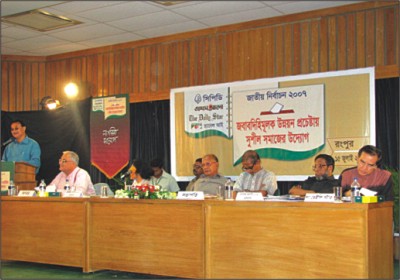
A Regional Dialogue on: "National Election: 2007: Civil Society Initiative for Accountable Development,” was held in Rangpur on 15th July, 2006 under the joint sponsorship of CPD, The Daily Star, Prothom Alo and Channel-i. Members of the Citizens' Committee, leaders of various political parties, people belonging to various professions and from all walks of life joined the dialogue. This supplement contains the summary of the discussions. The names and identities of the participants are published below. Due to constraint of space we are not able to publish the comments of all the participants.
-- Editor
Debapriya Bhattacharya
I welcome you all to this forum on behalf of CPD, Prothom Alo, Channel I and the Daily Star. You are probably aware that four months ago we started a dialogue at Dhaka keeping in view the forthcoming election. But it is important to note here that the dialogue in effect began much earlier. CPD, Prothom Alo and the Daily Star embarked upon a similar dialogue nationwide prior to the national election 2001.
 At this time there does not exist any mid term or long-term policy infrastructure in Bangladesh. Formerly, there was a five-year plan, which is not being implemented for the last four or five years, instead we have introduced a three year Poverty Reduction Strategy. At this time this is also being questioned. It is not clear as to how people should think about the country and what should be their expectations in the long-term future. It would be, in fact, much better if we could present a mid-term perspective of the future to the people. We argued a good deal amongst ourselves as what time frame we should take into consideration. Finally we felt that 15 years would be the right period of time since much of Bangladesh's journey into democracy has been for about 15 years and the country has made significant progress in various fields. Progress has been achieved in the areas of education and economy. On one hand development have taken place in education and the health sectors, and on the other in export-oriented industries and agriculture. At the same time, however, its benefits have not been duly shared. The poor have not received their legitimate share, like the people who are affected by monga and those of the north suffering due to river erosion. People of the Chittagong Hill Tracts were also deprived of their due share, including those living in the coastal areas. In other words there is a large group of people and areas that remain underdeveloped, either because progress is hindered or they are being unjustly treated. We then thought as to what would happen to the country if it continues to proceed in this manner for the next 15 years? One may question as to why not 16 years instead of 15? The reason for that is Bangladesh will complete its 50 years of independence in the coming 16 years. We felt, based on the last 15 years of progress, we could visualize now of things to come by the end of the next 15 years. I have said that we have made progress, but if the progress continues to be at this rate then even in coming 15 years it may not possible for Bangladesh to be among the middle-income group countries of the world. Having analyzed various factors we have come to the conclusion that the main factors that stand in the way of desired level of development are prevailing inefficiency, waste and corruption. The main cause for this is, however, the absence of good governance, which in turn hinders equitable distribution of wealth. We felt, with the election ahead of us we can bring up the issue of good governance now. The institutions that can ensure good governance in Bangladesh are the local governments, the Judiciary, the Election Commission and the Anti-Corruption Commission including the administration and the Parliament. The role of the individual becomes important when the institutions are weak. In such cases the concerned individuals often behave according to his or her individual will.
I have forwarded to you two specific issues in a pink colored paper, one regarding reforming of the electoral process and the other on political reforms. Both contain divergent views. You will notice that the main difference between the politicians and us is that that whenever they speak of proper election, they only talk about the voters and the returning officers, whereas, we also maintain that along with this the issue of black money must also be taken into consideration, or else there can be no proper election. Side by side we also say that if the due reforms within the political parties do not take place then there can be no real reforms of the electoral process. The reason for this is that no matter what, even if the electoral process is duly reformed without actual reforms taking place within the parties the chances are that the committed workers and dedicated leaders of the party may not get nominations, rendering the reformed electoral process ineffective. And the bad people will return time and again. We have talked about electoral reforms we now seek your opinions regarding identification of right candidates for contesting election.
Mahfuz Anam
Whatever dillydallying tactics the Election Commission may adopt I have my right to vote. Nobody can snatch that right from me. Therefore my first and foremost appeal is that we have to express our sincerest solidarity with this. No one will give your freedom in a platter if you decide to be a backbencher. If you are given freedom, exercise your rights. You have to come forward and establish your claim to your rights. In other words the primary task is to become a voter. I would urge you to go and register yourself as a voter, irrespective of wherever you are and whatever pains you have to undergo to become one. Make sure that you are enlisted as a voter. I propose that appropriate committees be set up at different places for preparing a proper list. Let the entire Bangladesh stand up to become voters. We wish to see such a government that will at all times protect the interests of the people. A point has been raised here as to whether the government is indeed looking after the interests of the people? It is argued that there are fulltime politicians and the political parties are entrusted with the job. I am a journalist while you are a doctor and you carry on with your work. Those of us who are engaged in politics ' we will carry out our functions'. I believe statements like these are aimed at usurping our democratic rights. The reason for this is that as a doctor I am not standing in the way of politician in carrying with his functions, likewise as a journalist I am not obstructing the functions of a lawyer, and a teacher is not performing the functions of anyone else, but one who administers the country is with everyone. That is the way it should be. This means that whatever may be our profession talking about the functions of a government and the politics of the country is an integral part of our day to day to living. I have that right as a citizen of the country. This is my government and I have every right to say as to how one would be a politician, and how will he conduct the affairs of the country. No one can take that that right away from me. I would say our present initiative is a march towards empowering democracy, and an endeavor to steer the country into the right direction. .
A.K.M. Abdur Rouf Manik
Those who are seeking nominations for the election are industrialists and holders of black money. People who work at grass roots levels have no place. There is no place for the politicians in politics. The politician cum businessmen is busy looking after his business interests. They are of no use to the public. I believe that in order to be a good parliamentarian one has to have a minimum level of education whose doors will be open to the public. I believe such a person is the right candidate.
Mostafa Azad Chowdhury
The country is passing through a critical stage. This is hampering the prospects and the flow of development. The civil society has come forward to play an important role: help the country to come out of this debacle. They, too, have the right to speak on behalf of the people of the country. They are talking against nominating black money holders and terrorists and they are doing this on behalf of the people. This has indeed made the people hopeful. I believe a number of other vital issues should also come into focus such as election of the leader of a political party, accountability of a leader, policy covering membership of the party particularly with regard to nominating of civil servants, party's organizational structure in a particular constituency, its level of strength and its policy on nomination including transparency of its finding. There should be a clear policy covering all such issues. Although the political parties often talk of democracy we do not find any democratic culture within the parties. I do not recall any party Secretary General or a President being elected to the posts.
It is common knowledge that large parties are giving nominations against donations of large sums of money. From that very day the individuals are given the license to indulge in corruption. We believe anyone seeking nomination has to be with the party for at least five years. Initiatives like this one will succeed provided we are able to impart education to the people of the country. So long as 90 percent of the people are not educated such trading of votes will continue.
 Marhamutunnessa
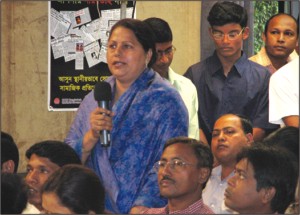
Children who enter secondary school after completing primary school are ignorant of many things, as a result they drop out from the schools. We see the reflection of this in the public examinations. There are many schools from where not a single student has passed the matriculation examinations. Cases of women oppression in villages are often “bought” by some middlemen or agents. This is possible since the poor oppressed women do not have the financial backing to conduct cases. There also exist innumerable problems like women trafficking, oppression of women workers and unemployment. In order to free ourselves from these problems we want representation of women in the local governments right up to the Parliament including adequate empowerment of elected women representatives.
Sadrul Alam Dulu
We are of the opinion that politics that regulate the entire affairs of the country need to be changed. It has been possible for us to reach our desire for changes to the appropriate authorities. I believe the people are divided between the two major parties of the country. I believe our initiatives cannot succeed unless we are able to reach our opinions to the leaders of these two parties and the same time build awareness amongst the people. These members of the civil society should also discuss their recommendations with the two major parties.
| List of participants 1. Prof. Reza Shah Taufiqur Rahman, distinguished educationist. 2. Mahfuz Anam, Editor, The Daily Star 3. A. K. M. Abdur Rouf, Chairman, Rangpur Municipality. 4. Mostafa Azad Chowdhury, President, Chamber of Commerce and Industry, Rangpur. 5. Marhamatunnessa, President, Mahila Parishad, Rangpur. 6. Sadrul Alam Dulu, President, Rangpur Press Club. 7. Mafizul Islam Mantu, Vice President, Rangpur Shahittya Shankskriti Parishad. 8. Imrul Kayes, Director RDRS. 9. Advocate M. A. Bashar Tipu. 10. Mukul Mostafiz, President SHUJON and Editor the Daily Atol. 11. Hasna Hena Rosy, member shaheed family. 12. Dr. Mala, Gynecologist, Rangpur Medical College. 13. Advocate Shamima Akhter, Bngladesh Jatiyo Mahila Ainjibi Samity. 14. Muhammad Yakub Ali, Advisor BADHAN 15. Advocate Hosne Ara Dalia, President Rangpur Theater 16. Maksudur Rahman Mukul, Cultural activist. 17. Naseema Akhter, Department of Bengali, Mahiganj College, Rangpur. 18. Muhammad Rezaul Karim Raju, Student. 19. Hira Huq, former Chairman, Rangpur Municipality. 20. Feroz Faruk, President, Prothom Alo Bandhushabha, Rangpur. 21. Advocate Chowdhury Nargis Akhter Banu, Gaibandha Bar Association. 22. Arup Sarkar, President Chatra Maitri, Rangpur City Branch. 23. Lubna, Project coordinator, RDRS. 24. Laila Rahman Kabir, former President, MCCI and Executive Director, Kedarpur Tea Company Ltd and Deputy-Convener, Nagorik Committee. 25. Prof. Mazharul Mannan, Vice Principal Ahmaduddin Shah College. 26. Moinul Islam, Convener, Shacheton Nagorik (TIB), Lalmonirhat. 27. Advocate Rukhsana Alam Liza, President, Prothom Alo Bandhushabha, Nilphamari. 28. Muhammad Afzal, Central committee presidium member and former Chairman Democratic Party. 29. Muazzem Hossain Lablu, President, Shaechashebak League, Rangpur Zilla Shakha. 30. Muhammad Sirajul Islam Siraj, General secretary , JSD. 31. Abdul Quddus, Convenor, Bashad, Rangpur 32. Nazrul Islam Hakkani, Member Central Committee, Workers Party. 33. Dr. Ekramul Hossain Shapan, President, District JSD, Rangpur. 34. Rozy Rahman, General Secretary, Mahila Awami League. 35. Syed Nur Ahmed Tulu, President, Zilla Jatiyo Party, Rangpur. 36. Ashraf Hossain Barada, Vice President, Zilla BNP, Rangpur 37. M. Hafizuddin Khan, Former Advisor of Caretaker Government and former Comptroller and Auditor General, Member Nagorik Committee. 38. Advocate Moezul Islam Moyez, President Zilla Ainjibi Samity, Lalmonirhat. 39. Pradip Kumar Goswami, President, Mithapukur Press Club. 40. Rashid Babu, General Secretary, Rangpur Press Club. 41. Manik Sarkar Manik, Staff reporter, Jankantha. 42. Muhammad Salequzzaman Salek, District representative, Daily Dinkal. 43. Wadud Ali, Reporter, Dainik Ittefaq and Rangpur Representative, Channel 1. 44. Salma Begum, Poet and writer, Abhijatrik Shaittya Shangshad. 45. Pintu Shaha, Cultural activist, Rangpur. 46. Muhammad Entazur Rahman, Principal, Sheikh Shafiuddin College. 47. Amirul Hayat Ahmed, Lalmonirhat. 48. Muhammad Mahbubur Rahman, Executive Director, Shamadhan, Rangpur. 49. Rozina Safreen, Vice Principal, Arcadia International School and college 50. Muhammad Abul Kalam Chowdhury, Rangpur District Shopowners Society. 51. Muhammad Farhad Hossain Ripon, Member Rangpur Union Parishad. 52. Tapan Chatteerjee, Student, Carmichael college 53. Zohurul Qayyum, President, Udichi, Gaibandha. 54. Lovely Yasmeen Ratna, Information Assistant, Nari O Shishu Pachar Protirodh Shahayak Kendra. 55. Muhammad Nazrul Islam, President, Insaf, Rangpur. 56. Muhammad Sohel Rana, Student. 57. Muhammad Shariful Alam, Instructor, Government Technical School and College, Rangpur. 58. Advocate Rafiqul Islam Mukul. Secretary Bar Bhaban, Rangpur Bar Association. 59. Sohel Elahi, Agricultural worker. 60. Banamali Pal, President, Hindu- Boudha- Khrishtan Oikka Parishad. 61. Muhammad Ashraful Alam-al Amin, General Secretary, Udichi and Assistant General Secretary, Shammilito Shanskritk Jote. 62. Dr, Muhammad Hedayetul Islam, President, BPMPA. 63. Mozahar Hossain, Vice Principal, Rangpur Government College. 64. Krishibid Ahsan Habib, Mirbag Degree College, Kaunia, Rangpur 65. Md. Abdul Abdul Wahed Mia, General Secretary, Bangladesh College University Shikhak Samity, Rangpur. 66. Captain Azizul Huq, Birpratik. 67. Muhammad Nur Islam, Service holder 68. Advocate Abdur Rashid Chowdhury, Lawyer. 69. Habibunnabi Khan Sohel, General secretary, Zilla BNP, Rangpur 70. Anwar Hossain Bablu, Convener, Bashad, Rangpur. 71. Muhammad Arshad Haroon, President, Gantantri Party, Rangpur. 72. Anwar Hossain, Vice President, Gonoforum. 73. Muhammad Tareq Bappi, Organizing Secretary, Jatiyo Chatra Oikko, Rangpur 74. Advocate Md. Abul Kalam Azad, Member, Central Committee, Gonotantri Party. 75. Hasna Chowdhury, Secretary, Mahila Parishad, Rangpur. 76. Dr. Zaki, Rangpur. 77. Syed Mahbubur Rahman Hirok, Karmajibi Nari, Field Office, Rangpur. 78. Abdun Nur Dulal, former Vice President, Rangpur Government College Students' Union. 79. Md Shahzada, student, Government Carmichael College. 80. Md, Rabiuzzaman Palash, Government teacher, Lions School and College, Rangpur. 81. Advocate Ratish Chandra Bhowmik, President, Padatik, Rangpur 82. Liton Pervez Manna, Member, Sound Touch, Rangpur 83. Moshfeqa Razzak, IVAS, Rangpur. 84. Md. Rezaul Huq, Teacher, Begum Rokeya Uccha Balika Biddalay, Rangpur. 85. Rajesh Adhikari, Coordinator, SHUJON, Rangpur. 86. Manik Chand, Member, Abhijatrik 87. Shafiqul Islam, Lecturer, Department of English, Rangpur Government College. 88. Goutam Roy, Convenor, Shamajik Shangathan Paribardhan Dhara 89. Akbar Hossain, Secretary, SHUJON, Rangpur. 90. MD. Nurul Islam, Executive Director, Bangladesh Computer Education 91. Sohel Mamun 92. Advocate Munier Chowdhury, Human Rights activist, Rangpur. 93. Sirajul Islam Siraj, Founder Editor, Sharathi Academy, Rangpur. 94. Munni Akhter, Volunteer, JONIPOP 95. Mostafa Kamal, JONIPOP. 96. Rakibul Hassan, Student, University of Dhaka. 97. Md. Hafizur Rahman Lablu, Member, the Daily Star Readers' Club 98. Md. Al Mahmud Kabir Romel, Prothomo Alo Bondhushabha 99. Md Syful Islam, President Zilla Dokan Malik Samity 100. Advocate I. E. M. Sarwar-ul- Aalm, Former President, Zilla Ainjibi Samity CORDINATOR |
Mafizul Islam Mantu
Today the committed civil society has begun to think about the welfare of the country. The major political parties are actively engaged in criticizing them and looking at them with suspicion, such is the environment. As a citizen of the country I wish to register my protest against this and express my indignation over the matter. Today, the country's peace, education and prosperity are caught in a dirty whirlpool. We want good governance, and proper democratic control over the activities of the public representatives. I am quite disappointed when I look at the state of our student politics. The student politics that played an important role during the 50s through the 70s and in the independence of the country are today engaged in the politics of tender and terrorism. We have to rid the student politics of this curse. Student politics has to return to the traditions on which Bangladesh was founded. I give my full support to the recommendations made by CPD. I also endorse my support, in no uncertain terms, in favor of the “no” vote.
Imrul Kayes
When a political party that was once in the opposition goes to power you clearly notice some changes in the party's political culture. Empowerment based on facts is of vital importance. In this regard the media could play a significant role particularly in the matter of black money that is being discussed extensively. Let the face of those who are turning black money into white be exposed before the public prior to the election. A political leader should not be elected for more than two terms. They will vacate the field of politics and then go into retirement.
Advocate M. A. Bashar Tipu
Those who are illiterate and do not understand the essence of democracy we have to show them the right path, but instead we are misguiding them. We are using them. Where is the people's democracy we had been aspiring for? We wish to speak out against dishonest empowerment. Today, we find that particularly in the field of politics what have been established are nepotism, dynastic rule including confining of national politics within the family. The civil society is fighting a massive evil force. We have with us the strength of our minds and souls. We wish to establish a healthy political and an accountable environment. We believe that the entire country is behind us.
Mukul Mosatfiz
It is imperative that account of the resources of not only the politicians, but also of the bureaucrats must be accounted for from the liberation of Bangladesh right through to the present day. The reason for this is that once there is change in party status the politicians belonging to the party are sent to jail whereas a Secretary returns to his former position or, at times, he even gains access to a better position. Businessmen have hijacked politics. 58 percent of the MPs are businessmen. Usually it is the businessmen who go to the politicians and not the other way round. The situation is such now that whoever is involved in politics based on ideology is looked upon with pity. In the past if there was an idealist in a village people would often talk about the village with pride but nowadays an idealist is described as a fool.
 Laila Rahman Kabir
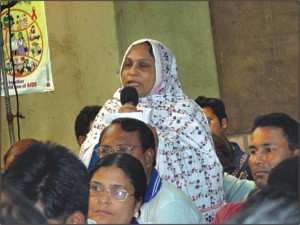
Our prime success over the past 15 years has been that we have been able to uphold our democratic Constitution. We have succeeded in holding regular elections to the Parliament and retaining the continuity of the government. Credit for this goes to the political parties of the country, particularly the major ones. But we have not succeeded in one particular field, that is, the culture of democratic practices. In accordance with our Constitution, the Parliament, the Government and the Judiciary are the three main institutions of our democratic state. There should be a proper balance between the three. It is the constitutional responsibility of the Opposition to ensure accountability of the government, whereas the Opposition remained absent in the Parliament, as a result the Parliament has become inoperative and obsolete. However, it may be pointed out that in order for the Opposition to effectively carry out their constitutional obligations it is the duty of the ruling party to provide all kinds of facilities. Unfortunately, no government has been able to fulfill that obligation. Judiciary is the defender of the constitution, upholds the rule of law in the society and prevents misuse of governmental authority. But we have seen that it has been obstructed from carrying out its functions independently as per provisions of the constitution, as a result all powers are concentrated in the hands of the government. There is no way to put a check on this enormous concentration of power. Wherever there is a scope of exercising this power by the government it has been brought under the influence of the ruling party. An end to this situation is only possible when the voters become aware of their democratic rights and are ready to cast their votes for candidates after careful consideration, and to vote for the right candidate who will be prepared to protect their rights. On the other hand, since, in the process political parties are voted to power, if the voters become conscious then this will, in turn, be bound to bring about a change in the mentality of the political parties.
Prof. Mazharul Mannan
Are there no honest and competent politicians in the two political parties: Awami League and BNP's coalition? Yes there are. But unfortunately they are not able to get nominations to contest elections. Why don't we put pressure on this issue? Whether it is for Awami League or BNP, the nominations are given at Dhaka. My suggestion is that the major parties should be asked not to give nominations in this way, instead let the leaders and workers at grass roots hold a conference and then if need be, let there be voting through secret ballot and then, let them say as to who are the right candidates for their respective localities. In this way, whether one has money or not, whether there is lobbying not, the one nominated will be the people's representative. At the same time we also need to nominate a person who is non-communal, ready to treat the entire population of the country on an equal footing and who shall be free from all kinds of prejudices. Finally, I would like to say that any one who has no respect for our War of Liberation must not be nominated.
Moinul Islam
We have to determine the system of selecting the honest and the competent candidate. Is a successful and established businessman, who is earning through honest means, the right candidate? Is a businessman who is earning through dishonest means the right one? I am placing my questions to today's forum. Today's initiative is being held in a political environment where threats are being given over mobile telephones every now and then, and shrouds for burial are being sent to individuals with due forewarning. We have to make our own arrangements for our security. Dishonest people have made their way into our politics and are using it for evil purposes; the only way to rid us from this is for the people with conscience to hold their heads high in protest.
Muhammad Afzal
In long 35 years we have not been able to establish a society that is non-communal and free from any form of discrimination. Although Bangladesh made some progress at the beginning it nose-dived soon after. Today's Bangladesh cannot be called democratic. The government that is in power today has considerable fascist tendencies. One of its coalition partners is a fascist party, and opposed our War of Liberation. It is a religious fascist party. I would like to particularly speak about a particular party. There is yet another party whose entire philosophy is based on religion. Jamaat-e-Islami is yet to accept the existence of Bangladesh. Even to this day it is against the independence of Bangladesh. It is this party which is at the seat of power. It is they who have created JMB with its mentor overseas. The American imperialists gave birth to Bin Laden and the Al-Qayeda. Bangladesh's Hirkatul Jihad, or Mujahid, or whatever you call them are all part and parcel of that outfit. Yet whoever has the support of America they will continue to flourish. It is no exception here in Bangladesh. To me it is a danger signal for Bangladesh and the Bengali nation as a whole. It is the responsibility of the entire 14 crore people to be fully prepared to resist this evil force in order to ensure that none of these people dare to come out with any weapon or bombs. If the people remain awake and alert they will not dare to come out with weapons. Just as these four organizations are working towards holding of a just and fair election the various political parties, social organizations, groups of professionals including many student youth organizations, are also carrying out their own movement alongside them. Although CPD, Channel I, Prothom Alo, the Daily Star, including the Nagorik Committee, have not come forward directly with the reform proposals they are not against it. I believe the programs launched by these four organizations are a program awakening, alongside the movement launched by the 14 Party Alliance and other political parties. There is no conflict between the two; this endeavor is complimentary to the program of launched by the 14 Party Alliance.
 Moazzem Hossain Lablu
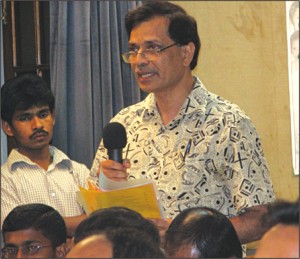
It is the 35th year of our independence, yet can we really say that our national, district level and other leaders say the truth without giving false hopes at the time of contesting election? Today we see news in the TV and the print media that terrorists are dying in cross fire while shooting at the RAB. There is a law that prohibits loan defaulters from contesting elections but they are able to vote. There should also be a law prohibiting terrorists and their sponsors from contesting, although they may vote. I believe that this will free our politics from terrorism. I believe that a person, who is a judge himself but ignores court orders, cannot hold a credible election.
Muhammad Sirajul Islam Siraj
We often call for hartals as a strategic tool of our politics and a part of our democratic right, whether it is BNP or Awami league or any other party. On the other hand I shall take my child to the school and will keep my business house open which is also my constitutional right. But there I am attacked with bombs. I shall drive my car procured by my own money, on the streets; this is also my constitutional right. No one has the right to break it. Whichever political party may be involved in snatching such constitutional rights of the people the civil society resist such acts. Let us unite and stand up against all such acts irrespective of our party affiliations. Whatever party I may belong to I shall always stand by you.
Abdul Quddus
People who are involved in theft, corruption and plundering of wealth are the so-called educated ones and not the poor people. Karl. Marx once said that capitalism, in its early days, had given mankind a lot and helped the society to move forward. Today, it is on the path of decline. In 1991 we held the election through the Caretaker Government a makeshift arrangement, ignoring the left progressive forces. At that time we thought that this was the option open to us. Whatever reforms we may undertake the capitalist system shall not be able to sustain them.
Nazrul Islam Hakkani
Politics is becoming difficult for the politicians. It has been vandalized. It is now in the hands of businessmen and holders of black money. People have lost confidence in politics. People think that politics cannot be of any good to them, but we have not brought about this kind of politics. It is clearly written here about a non-communal democratic Bangladesh. It is not possible that we, the politicians, will be the only ones to dream but others of the society will not. Various groups of people may have their own dreams. It is the politicians that will take forward their dreams. Independence of the Anti-corruption Commission is to be ensured. Alongside meting out exemplary punishment to corrupt people, their ill-gotten wealth and properties acquired through corrupt means should also be confiscated. The terrorists are to be identified, arrested and tried. They must not be allowed to join any political party and given nominations for contesting election. We have to bring about a healthy trend in politics by reducing corruption in politics.
Dr. Ekramul Hossain Shapan
Whenever the question of nominating candidates for the national assembly comes up we find that we are stuck with traditional thinking as to who should be nominated. There is often talk of competent candidates, but whenever the election draws near we see that there is a kind of contest amongst the political parties, big or small, and those who are running the Administration. The contest is for giving nominations to those who have most money and muscle power. I believe that the civil society has to come forward. The political parties also have to play their due role. I confess that those of us who have been engaged in politics have committed many mistakes over the last 35 years. We are paying for all those mistakes, big and small. Today, those of us who belong to the various professional groups, social organizations and the civil society must come forward in protest and initiate appropriate actions. We have to make all out efforts to transform Bangladesh into a working democracy.
Rosy Rahman
Can these recommendations be made into a law and can we achieve our objectives through the process of that law? We wish to nominate those who are engaged in politics on a fulltime basis and are dedicated politicians, those who would talk about the poor and the people at large and about the development of the country. Above all they have to be honest, and people of character. Those who are in this compound today are not the only representatives of the civil society. There are many more belonging to the civil society living in the rural areas. We wish to extend the present civil society by including them, too. Through this forum I wish to reiterate that if we are to hold a credible and proper election in 2007, and establish an accountable government, the two election commissioners should resign.
Syed Nur Ahmed Tulu
I am an optimist and I see no reason for loosing hope, looking at the present state of the country. Today, CPD have embarked on this venture with whatever resources they have. They have described their initiative as the journey to the path of democracy, through which people will travel. A few Muslims, bureaucrats and some worthless politicians may block the passage of this path. Election is the right path, and there is no alternative to it. Elections have to take place everywhere, from electing the chairman of an institute right up to the top. Both the Upazilla and the District administration have to be brought under a chairman. The parliament has to be made accountable.
Ashraf Hossain Barada
If we are able to discharge our individual responsibilities only then we will be on the right path, the path that the Nagorik Committee is trying to show us. But the Nagorik Committee has to come out above the mistrust that is eating into the vitals of the entire nation bit by bit. Nagorik Committee has the means to come out of this. You are to reflect our hopes and aspirations through your Media. Surely you will be the think tank for guiding the country if you are able to successfully fulfill the task you have undertaken. The two leaders have to sit together under pressure from the public. Surely, you would be able to find a solution if all the political parties adopt an open minded policy. I hope you will play an active role not just during the 2007 national election, but also in all other elections in the future, including the local elections. I believe the responsibility of an MP should be restricted to formulating of laws and the rest should be entrusted with local governments. The local governments should be so empowered that they can function freely without the interference and influence of the local MP.
M. Hafizuddin Khan
You will notice that the paper we have distributed contains 41 points with regard to reformation of the electoral system. As you have rightly observed, this does not apply to this one single election. Since we have an election right ahead of us we wish that some of these points be implemented. At least some of the suggested measures like preparation of a correct voter list, freeing the election from the influence of black money and undertaking of due measures for electing good and honest people. Thereafter, we should raise our voices again for whatever institutional changes that should take place with regard to reformation of the political and electoral systems. We have no confidence in the present Election Commission and we believe that no free and fair election can be held under this commission. This Election Commission has committed a crime by spending the amount the amount of money in connection with preparation of the voter list and the money spent has been a total waste. For this the Chief Election commissioner himself is responsible. Some one amongst us has mentioned about mistrust and suspicion amongst one another, he could not be far from the truth. The Caretaker Government itself is a product of that mistrust and suspicion. It cannot be an instrument of governance in any democratic form of government. There are no firm criteria for appointment of the election commissioners. Anybody can be inducted into the offices of the Chief Election Commissioner and the commissioners. Following the tradition built over the past 25 years it is the ruling party that had been appointing individuals of their choice into these posts. This is surely a deterrent to the smooth passage of democracy. The Deputy Commissioners and the UNOs that are to be entrusted with election will be placed under the control of the Election Commission only after declaration of the election schedule. Furthermore, they cannot be transferred to a different location without the approval of the election commission. Under the existing system the transfers can take place only 15 days after the conclusion of the election. We are proposing this period of time be extended, so that anyone found guilty of any election related offence could not escape justice. In Bangladesh elections are held in a single day. We plan to propose holding division wise elections on a per day basis, like in neighboring India, and then declare all the results in one day. Perhaps it will then be possible to control the law and order situation and avoid any untoward situation.
Habib-un-Nabi Khan Sohel
I frequently have this feeling that whatever goes wrong in this country is the work of the politicians and whatever is right is the work of others. Is it really so? A politician works right through till two and three in the morning each day working for the people. Is it right to put the blame on all politicians because of a few? As a matter of fact there is no difference between the politicians and the civil society. They also want the good of the country just like the politicians. Why only the civil society, even if any other social organization worked for the good of the country, all honest politicians will stand by them. Today I have come to this discussion meeting by CPD in that frame of mind. Since the politicians provide the leadership to the people they expect more from them and that is but natural. Today we have a set system where elections are held every five years in the country. Many countries of the world are yet to have such a system. Even after this you will notice that during the eighties there used to be hijacking of ballot boxes and mastans would come from different areas and snatch votes. Does such an environment exist today? We have come a long way out of that situation for the better. We are also making progress in the area of our economy and, hence, I see no reason for feeling disheartened. Not much can be achieved in preventing the use of black money and nominating of honest and competent candidates, through enactment of relevant laws only. I believe that there is no alternative but to create public awareness. I would hope that the way CPD is conducting a meeting here today within closed doors it will also go out to the people who are voters and hold similar discussions with them. Not all responsibilities should be put on the shoulders of the politicians. Everybody should take that responsibility, come forward and talk to the people.
Advocate I. E. M. Sarwar-ul-A lam
I have not leased out my conscience to any political party. I say whatever I think to be just. I am not obligated to any political party. But I am obligated to one force that is the defenders and the caretaker of the War of Liberation. When our Constitution was framed the preamble declared that freedom was achieved through a noble War of Liberation. But the very words “ great war of liberation” are no longer there in the Constitution. We see our national flags are flying on the cars of those who do not believe in our very independence. I consider this to be a shame for the entire nation.
I shall hint at two issues, one, the concept of the Caretaker Government. An elected government is qualified to govern the country for a period of five years unless a no-confidence motion is passed, or it is removed through a constitutional process. Strange as it may seem, whenever the election approaches the government can longer be trusted. The entity with whom we have lived for five years we longer trust. I believe we have become a laughing stock in the eyes of the world. I propose that this concept be scrapped. There is yet another provision in the constitution with regard to appointing technocrats as ministers. Despite the fact that you had been working so long for preventing the technocrats becoming ministers, one out of ten is still able to qualify to become a technocrat minister, as if we would not be able to run our gas establishments and oil operations. I propose that the constitutional provision of appointing technocrats as ministers be scrapped. It is against the very principle of democracy that an elected person is not allowed to speak freely. I am therefore proposing that Article 70 (a) of the Constitution should also have the provision for free speech by an elected representative. I believe all these three clauses of the constitution should be scrapped.
Prof. Reza Shah Taufiqur Rahman
The wise people of the country are not sitting idle at this critical juncture of the country. They are all the time thinking about the country and have expressed their views. Their objective is to pave the way for a good government There can be no such crisis in a country whose wise men of its civil society are so active. Those who are engaged in leftist politics love to talk about class distinctions. I also say the same. In other words this means that the rich will be richer and the poor poorer. But the program of our economic development should be as such that, we are known as a country of mid level economy, for this we need to have a government, a government consisting of people from the civil society. There is no alternative to democracy throughout the world today. Under the democratic process it is the politicians who should be engaged in politics but we hope that they are civil, too. We shall merely be complimentary to their efforts. Those of us who claim ourselves as civil wish to stay beside them as helping hands.
| Recommendations of the dialogue (in brief) Politics and reform of the political parties 1. Political parties have to be registered. 2. Student politics has to be regulated and streamlined. 3. Attendance in the Parliament of the MPs should be legally binding. 4. There should be candidates from amongst the laborers and the farmers. 5. Nominations by the parties have to be area wise, by the respective councils and not by the central committees based in Dhaka. 6. Democratic practices within the parties have to be ensured. 7. Selection of the party leader through nepotism has to be resisted Election Commission and electoral reform Institutional framework |
Civil society and the role of CPD. Economy and miscellaneous |