Morshed is always unpredictable. You cannot guess when he will fly off the handle or when he is talking serious. So when he suddenly proposed a boat trip on his 'Ashar Tari', we were both sceptical and half-hopeful. All we knew is the next day's weather should be perfect for a boat ride -- a bit of rain, a lot of clouds, no sun and rivers swelled up with rushing water.
"See you tomorrow morning at 8," Morshed said and left office.
The call came at 7:30 in the morning. "Shit, why the hell are you still sleeping?" Morshed's angry voice rang loud. "We must leave early or we can't reach Mawa."
The next half an hour saw me making a stream of calls, giving everybody the same message: "It is taking place.
Morshed is waiting on the boat. We must reach there by 9."
Of course, we didn't reach by 9, we never reach any place on time. As our autorickshaw pulled to a stop at Rayerbazar Ghat, we saw Morshed sitting anxiously on the 'deck' draped in a yellow Fotua and blue shorts. A cricket cap at on his head. For the next 15 minutes, he let loose his tongue to shower us with a volley of abuses that bordered on virtual physical assault. Disregarding his verbal assaults, we boarded his Ashar Tori' (boat of hope).
It was a 40-feet country boat fitted with a big Deng Fong engine, a cabin with a bamboo canopy, one set of sofas and hand-woven mat on the floor. But that was not all. What cheered us up is the toilet hanging out there at the back -- a neat job fitted with a foreign commode and no flush; enough room to make yourself comfortable. Between the toilet and the cabin is the cooking place. A kerosene stove sits by the side. A fair deal for a day trip.
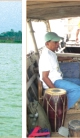
"Javer, start the engine," Morshed called out and the lankiest of his three boatmen disappear inside the 'engine room'. A little later, the familiar chug-chug-chug came. The noise was surprisingly low for such a big diesel engine. Off we sailed.
The stench of the Hazaribug tannery waste was still strong in the monsoon and the water looked suspiciously blackish. We took a turn and came face to face with a huge swath of hyacinth, negotiating which without getting the propeller entangled with them was a daunting task. But then the river started widening and we were puttering along.
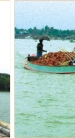
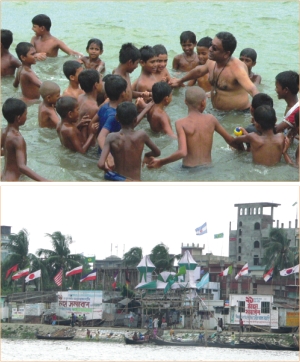 We were passing Keraniganj. The buildings on the banks looked messy and rundown. Most have no plasters or colourwash. Narrow as they were, tall they looked. Almost every building had at least half a dozen flags of world cup football playing nations. We crossed the banks at close range and were amazed at the high level of activities going on there. People were building new houses, carrying wood blocks, carting goods, washing and dying clothes, sorting bits and pieces from garbage and what not. Hundreds of engine and non-engine boats criss-crossed the river at every possible angles. Big cargo boats almost submerged with the weight of cargo cruised in slow motion. Most of them carried sand for construction. It was amazing to see the range of activities this dying Shitalakkha river supports.
The river bore the telltale signs of approaching death -- encroachers were pushing ever deeper to the middle, fencing off large parts of the water, signboards of different developers stuck in the water ridiculed the law.
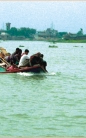
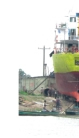
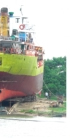
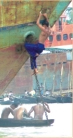
Soon, Kamrangir Char was gone and with it the bustle and filth. The river turned quieter and wider, fewer boats sailed. Villages came into view, villagers taking a wash in the river. We passed two Navy ships and a number of dry docks. Huge ships were yanked up the shore and cut open with open torch, others were being patched and painted. Suddenly to our surprise, we saw a pile of earthen pots floating our way. At a closer range, it turned out to be a country boat almost half sunken with the weight of pottery.
As we were enjoying the river scenes, we felt a distinct change in our boat's speed and the engine coughed dangerously. The cylinder missed fires.
"Diesel! We don't have diesel," Morshed yelled. Only a little while ago we saw a small tin shed with a small signboard -- 'Fuelling station' -- standing in the water. It did not occur to us then what purpose this hut served. But now we knew why fuel stations are important in the river.
With sinking hearts, we crossed a few more hundred meters and then came to a Ghat. Small children frolicking in the water gathered around our boat. Morshed sent his boatman in search of diesel and then with a loud cry he jumped into water in his shorts and sunglasses. First the children scampered around, probably thinking that a monster has materialised before them to gulp them up. But then Morshed started his habitual singing and dancing in the water, lifting the children on his shoulder and tossing them into water. Soon the whole village thronged to the Ghat to watch this great show. Soon the children were all over us, climbing on the rickety canopy and diving into water.
Half an hour later, the boatman arrived with a can full of diesel. The engine started again and we sailed off.
.................................................................
Story &
Photo: Inam Ahmed
© thedailystar.net 2006