LEt's time-travel, back to mid seventies or maybe late seventies, if you wish. It was a time when Bangladesh, a mere fledgling of an independent country, was beginning to spread its wings. With its own Parjatan Corporation promoting tourism, its jute products, the traditional deshi fabrics like Comilla's khadi and Rajshahi's silk was beginning to lift their faces and gain status among city dwellers.
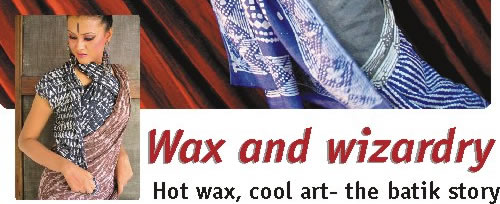
 It was also a time when wax print or batik of Comilla was set on the same platform of encouragement. A blood red silk sari with asymmetrical wax prints in black and white was quite a hit among fashionable women of Dhaka during that time. The batik silk sari from Comilla and other batik products enjoyed a brief period of popularity but fell flat ever since, as far as our fashion scene is concerned.
Around that time though women from different backgrounds learnt the art of batik printing from Bangladesh Small and Cottage Industries Corporation, merely as a pastime, but their experience was never put into much use.
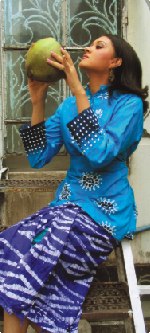 Now our liking for batik is strictly limited to rare trips to Comilla and those souvenir shopping sprees. We stop at any store that is open for business and pick a few batik bed spreads or shalwar kameez yards and even before we return to Dhaka, the enthusiasm dies down.
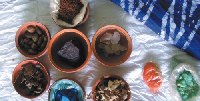
However we are drawn to a certain rustic and ethnic feel of our local batiks, which keeps us turning back to give this print fabric a second thought. The fact that vegetable dyes are mainly used, further attracts our fancies because it makes a very contemporary style statement. Unfortunately, only a handful of our local designers give this medium much thought or explore its market probability.
Batik, a Javanese term, denotes a kind of resist technique for producing designs on fabrics, the popular resist substance is wax. The history and evolution of batik is debated and India, China, and Middle East have all claimed to be the original cradle of this craft form, but it is in Indonesia, Java in particular that batik's second renaissance has occurred.
In stores here
Aranya, a classy boutique that specialises in vegetable dyes has some unusual batik work using the unique Japanese shivori technique of stitching, folding using sticks, bottles, and pipes. They also have blocks and free hand batik work in the store and their ensembles are very stylish and more for the upmarket.
Ruby Ghuznavi, the store owner feels strongly about the art form and says "in Bangladesh the batik work is done in quite a shabby manner. We take little pride in the work and are content to do five pieces a day in a hurry to cut production cost and stay in competition. This hampers quality. We believe in short-cuts but with so little time and effort nothing good can be achieved. Malaysian or Indonesian batik are so sought after because they have taken the printing to an art form and do each piece with keen interest."
Bonoj, a small yet very chic store in Anam Rangs Plaza, is also another place where we get to see the remnants of this amazing art in a more commercialised manner. Nasira Mustaque Bashi, the owner of this shop says, "The technique of this batik printing is not very standardized in our country. The batik of Comilla was very popular at one point in time but since there's not much variation, its fame has come to a complete standstill and with it the art form also took a downward drive among the fashionistas of Dhaka"
"There are different ways of doing batik. You can use blocks, which you dip in hot melted wax and stamp on sari, after waxing, the cloth will go for a dye bath, once done you get to see the crackle effect. This is the method I use. I personally prefer to use vegetable dyes but also use chemical dyes if I am asked to."
“Tjanting is another way of doing it. It is a pen-shaped instrument with a spout, which has a hollow bowl for hot wax that is channelled through a thin nozzle. Very thin lines or dots or circles can be drawn with this instrument. Another method involves the use of a brush. However tjanting is not used in our country," she explains.
Vegetable dyes if used in batik prints, gives the cloth an earthy mystified tone and simply takes it to trendy heights. It is sad to see that such a chic form of fabric printing has not gained any popularity among us. Its time that our style makers give this medium a thought and bring it the limelight that it so deserves.
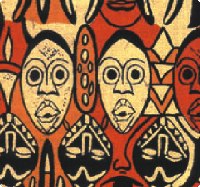 The Malaysian story
Let's now look at Malaysia's batik. It has always been shadowed by Indonesian batik until the sixties when slowly the Malaysian batik industry has managed to distance itself from the early Javanese foundations and develop a style of its own. Recently Malaysia's First Lady Datin Paduka Seri Endon Mahmood has given the batik industry a thrust and has re-launched it in a fun way, with the main focus being on the fashion industry. So much so that her endeavour has managed to take Malaysian designers using batik to Milan fashion week.
"The batik industry is a creative and fashionable medium and it creates excitement in designers, giving their work a touch of style that is modern and exclusive. It is a lucrative option to consider for designers here and the fashion industry has been propelled to immense heights here in Malaysia," the First Lady said in a press conference during KL fashion week earlier this month.
In the first week of December, Kuala Lumpur will host the Kuala Lumpur International Batik Convention or Klib Convention 2005 which aims to develop an international network of batik enthusiasts, to share techniques, innovations, technology and marketing strategies for the batik craft and industry. Its sole intention is to foster closer ties amongst batik producing countries. The theme of Klib 2005 is 'The business of batik'. Any one of our Bangladeshi batik patrons and designers or enthusiasts can participate in the convention to highlight our perspective on batik, to the world.
For further information on Klib 2005 e-mail yabpm@tm.net.my
By Raffat Binte Rashid
Disclaimer: there might be other stores that carry batik products but the ones mentioned in the article are the most prominent ones.