|
Perspective
Spreading
Democracy
Mustafa
Zaman
Bush
is now sitting at the top of the moral high ground. It may
seem ironic to the world other than the West, but Bush along
with Blair is truly the one who has had the upper hand in
the Iraq war. Or so the voting turnout has proved.
At
last the pro-Iraq-war lobbyists have found an oasis to step
onto. After successfully drawing many Iraqis to the polling
booths strewn across the country last week, they are now all
set to reinstate the hope of staying around for a longer period
of time, purportedly to supervise a 'complete' transition
to democracy. The phrase, "Seeing it through", always
drove human races, American authorities actually have the
habit of putting it in practice with a diehard ambition.
 "It
is only the beginning", many Western leaders now proclaim.
Before election, the withdrawal of troops was in the air,
now, even the Iraqi authorities do not want to let go of foreign
soldiers. Iraq's interim President Ghazi Yewer says, "It
would be nonsense to ask coalition troops to leave now".
The sudden resounding success in managing the ballots amidst
the tightest security the world has ever seen, there has been
a change in the wind. Now it is blowing in favour of staying
till things become stable. "It
is only the beginning", many Western leaders now proclaim.
Before election, the withdrawal of troops was in the air,
now, even the Iraqi authorities do not want to let go of foreign
soldiers. Iraq's interim President Ghazi Yewer says, "It
would be nonsense to ask coalition troops to leave now".
The sudden resounding success in managing the ballots amidst
the tightest security the world has ever seen, there has been
a change in the wind. Now it is blowing in favour of staying
till things become stable.
The
"vacuum of power" and "chaos" that the
president sees "in the midst" of all that is going
on, is the work of the US and it's allies. This realisation
now seems to taking a heavy beating. After all, voting has
been successful, so the fact that it cost dearly is best forgotten.
Even
in the British Lower House, where there were staunch anti
war voices that troubled the British supremo, only few raised
the relevant questions. The most pressing of them was the
question of "how many Iraqis lost their lives" in
order for the country to earn the label of being a democracy.
There
are little efforts on the part of the occupying forces to
tally the Iraqi casualties. The American body count in the
face of the insurgency that still rages on stood at 1,110
before the election. This was the cost of combats, while another
250 died in accidents.
The
violence is steadily rising. According to data collected by
the Brooking Institution, a think-tank in Washington, the
number of attacks on the occupying Americans is now more than
four times the rate of a year ago. The IraqBodyCount.com,
an anti war but fastidiously American group, as reported in
The Economist, provides the number of Iraqi casualties. They
claim that between 15,000 and 18,000 Iraqi civilians have
been killed since the American invasion. "The human rights
organisations have suggested twice as many, or even more,"
reveals a special report on Iraq Election in the January 29th
issue of The Economist.
The
Brooking Institution recorded 32,000 insurgents' death since
the fall of Saddam in April 2003. The estimate was based mainly
on Pentagon briefings.
Do
these figures mean anything to Bush and Blair? Their perceived
and well-disseminated 'morale victory' against "terror"
overshadows the pre-election mayhems and missteps. Even the
issue of torture and gross human rights violation that still
continues, now, it seems, being wished to vanish in the air.
The camp carnage sparked by "regular security check"
and the recent attacks that killed four Americans provides
ample proof that all is not well in Iraq. It also proves that
even after election or forming of a first elected government,
the fight against foreign occupation will continue.
The
head of the Iraq's intelligence services claim that there
are 40,000 hard-core rebels, with another 160,000-odd Iraqis
helping them in their efforts. The number has risen dramatically
over the year. It is believed to have been increased several
folds and is still swelling.
For
the US force that stands at 150,000 out of an allied total
of 175,000, there are little options in practicing restraints.
A July, 2004 New Yorker ran a story on a young American soldier
named Carl Cranstone who, after returning home in one piece,
tells the tale of how the Iraqis fell to the cannon fires
of his Bradley, an army vehicle. Iraqi soldiers, believing
they were concealed by darkness or smoke, would expose themselves
to the Bradley's thermal sight and the devastating rapid fire
of its five-milimetre cannon, he relates to the reporter.
"We'd
put up signs in Arabic saying 'Stop.' We would say, 'Ishta,
ishta,' which means go away. But people would approach with
flags in their hands and then whip out AK-47s or rocket-propelled
grenades," says Carl to the reporter. The group that
he headed adopted a "play-it-safe policy": if a
driver ignored the signs and the warnings and came within
thirty metres of a roadblock, the Americans opened fire. This
is the strategy that kept Carl alive. "We killed a lot
of people," was his unpretentious declaration.
Carl
belonged to one of the Sledgehammers, the groups that led
the American soldiers in Iraq. He came back from war last
July. The policy that many refer to as "shoot first ask
questions later" was adopted by most units, as was by
the one headed by Carl. And that has only worsened the situation
multiplying the miseries of the Iraqis. Accordiing to the
report in The Economist, "a heap of anecdotal evidence
suggests that most Iraqis, barring the Kurds, place the overwhelming
burden of blame for their misfortunes on the Americans".
It
is unfortunate that the White House and the Pentagon as well
as many dignitaries at the British Parliament are yet to wake
up to this reality. Perhaps they bank on the evidence that
pours in to boost their morale -- notes and accounts that
try and cancel out the presence of the other side of the coin.
Lt
Bryan Suits, a US soldier sent a mail on the Election Day
to the CNN. It brings to the surface the mindset that denies
not only all wrongdoings but also their role in having anything
to do with the jeopardy that Iraqis have gone through and
are still in. "They (Iraqis) thanked us profusely and
joined in an impromptu dance called 'dabka'. One of the men
said, 'God sent you to give us freedom' My Iraqi translator,
who's a practised (sic) cynic, became silent and looked away.
The man put his hand on my American flag patch and then kissed
his hands," writes Bryan. This is the brand of American
patriotism that led their country's troops to a foreign land,
and this is the fervour that Bush and Blair are relying on.
The soldier turns a blind eye to the translator as well many
other who shares his emotion. On top of all this, if putting
Iraq in democratic course means something similar to the democratisation
across the nations that were formerly called the Soviet Union,
then Iraqis still have causes to worry.
As
for Sunday's election, the turn out, in the face of the threat
from the Sunni insurgency, was huge. It was estimated to be
almost 62 percent.
The
Iraqi Independent Election Commission even failed to provide
ballot papers for all. "Tens of thousands were denied
a vote," testifies President Yawer. According to his
account even in Mosul, Iraq's third main Sunni city, they
ran out of ballots twice. The same thing happened in Basra,
Baghdad and Najaf.
Condoleezza
Rice termed the election as a "huge step forward".
And before they even took the stride there was a tightening
of the noose. Security measures were heightened. And it worked.
Violence on Election Day was kept at a relative minimum.
A
lot was invested in the election. So, how is it that the ballots
were out-numbered by the voting enthusiasts? Is it that the
authorities planned it merely as a face saver, or are there
any more home truths lurking behind this otherwise well-planned
exercise in franchise?
Whatever
it is, a longer stay for the Americans was made possible as
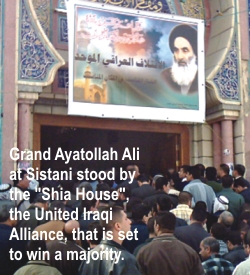
a great fault-line runs across the Sunni and Shiite communities.
The magical turnout too seemed to have been possible as the
Shiite majority felt that the time had come to lay claim to
what rightfully belongs to them, namely political power. This
is one area they were denied access to for the last 60 years.
Election
held under foreign occupation, or to use the phrase of The
Economist, "at gunpoint" may not have gone well
with the world communities had the turnout been nominal. The
Shiites, the majority population, have made a difference.
While most Sunni clerics asked the Iraqis to stay clear of
the ballot boxes, the Shiites along with the Kurds turn the
event into an occasion for Bush and Blair to feel resuscitated.
Even
the Sunni community was not entirely opposed to the idea of
going into polls before the withdrawal of troops. The divide
and distrust that grew between the two factions -- one that
is one fifth of the country and the other three fifth during
Saddam's misrule, is one thing that went in favour of the
'democracy' aspirants. As a Sunni ruler among the majority
of Shiites, Saddam, the tyrant, kept all oppositions at bay.
The elections provided a chance to come back and secure a
role in the political future of Iraq.
The
surge of voting that resulted in the surge of enthusiasm in
the world community puts the insurgency in an awkward position.
Trapped in between the two extremes -- the occupying force
and the resistance -- election for the Iraqis was like an
escape route. They have voted for the 275-member assembly,
where 84 parties and 27 independent candidates were listed
to choose from, and the results put the Shiite in an overwhelming
majority. They are now all set to ride power and rope in the
Sunnis. The question remains, will they be able to take charge
of things with the US watching over their shoulders.
Copyright (R)
thedailystar.net 2004
| 