Outstanding
Woman in Business of the Year
Pristine
harvest
 It
all started with a casual hobby and genuine
interest that, over time, turned into a
successful and export-oriented agri-business.
It
all started with a casual hobby and genuine
interest that, over time, turned into a
successful and export-oriented agri-business.
Selina
Quader was born in Jessore in 1947. Her
father was a lawyer by profession but he
took a keen interest in gardening that he
shared with the rest of his family. Selina
graduated from Jessore Women's College in
1967 and married an agri-scientist the following
year. When her husband, Dr Shaikh Abdul
Quader, returned from Germany in the early
eighties, he was posted in Chuadanga.
Selina
was excited by the large piece of land that
was available within her home premises and
promptly started growing a kitchen garden.
Soon there was no looking back. She reinvested
everything she earned from selling her vegetables
into leasing more and more of nearby land
and grew an increasing amount of produce.
Now, her total area of production is nearly
200 acres including her own land, leased
land, and those of her contract growers
in Chuadanga and Thakurgaon. Her direct
employees number over 200 and her total
turnover reached Tk 25 million in 2004 after
demonstrating an impressive growth rate
in the last five years. Her company, Agroconcern,
works closely with client and contract farmers
on both production and marketing aspects.
Inspired
by her success, Selina's neighbours in Chuadanga
have also joined the bandwagon of vegetable
production -- now almost 6-8 truckloads
are shipped everyday from the vicinity for
destinations in Dhaka, Chittagong and Sylhet.
With this spectacular performance in a previously
arid geographical region, has come the benefits
of economic development for all; villagers
in the area now have access to electricity,
concrete housing and Selina's previous workers
themselves have now moved onto their own
lands.
Even
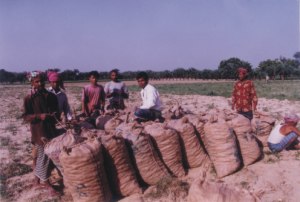
though Selina's production basket includes
a whole variety of items like cauliflower,
cabbage, broccoli, capsicum, papaya, egg-plant,
rice, maize, watermelon and sugarcane, her
biggest success so far has been her potatoes.
At first, she grew the seeds herself with
the help of her husband to produce a variety
that is high-yielding and disease-free.
Large-scale production ensued in 1990 with
the help of contract growers. Prompted by
high acceptance of these potatoes, she first
exported 4 containers in 2000 to Singapore;
since then, she has also exported to wholesalers
in Sri Lanka and Malaysia. Furthermore,
after three years of research, she has found
a new variety of tomatoes that can be grown
even during rainy seasons. Selina plans
to produce this highly-demanded strain in
bulk next year. Consistent quality in all
her products is ensured by importing seeds
intermittently from European countries and
by bringing in foreign technicians to monitor
progress.
Selina's
journey to this day definitely has not been
obstacle-free. As is true for all other
agricultural produce, she is plagued by
the middlemen who dominate the supply chain
and eat up a chunk of the total margin.
Lack of access to financing is also a factor
that constrains her growth potential. The
bags she needs to export her produce are
not available in the local market, they
must be imported from China or India, and
hence increase the lead time involved. Most
importantly, she still has not been able
to avail of the government's declared cash
incentive because of procedural delays.
Despite
these challenges, Selina is determined in
her future ambitions. She plans to build
further on her existing work of developing
improved strains and introducing exotic
seeds. She is exploring the export potential
of her newly-developed tomatoes as well.
At the same time, she feels that a joint-venture
partner in the seed development industry
for industrial vegetable production would
help her go much further.
Throughout
her life, Selina has maintained a multitude
of interests and activities. She has been
an active athlete for most of her life and
has won numerous prizes. Starting with student
politics in her college days, she has continued
to lead and implement various welfare projects.
Today, she takes immense pride in the fact
that her production quality is above average
without the use of toxic chemicals and her
seeds are highly sought after by farmers.
After all, she has been able to exact a
discernible difference in the lives of many
of her community mates.
Special
Achievement Award of the Year
Brands
that enrich lives
 "90%
of Bangladeshi households use one or more
of our products", "More than 99%
of our products are manufactured locally",
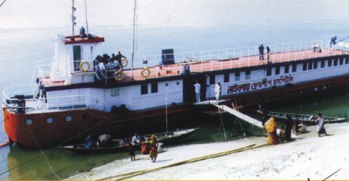
"Our floating hospital has served over
a hundred thousand people since commissioning
in 2002", "More than 10,000 people
directly derive their livelihood from our
operations"…. Do these words
bring to mind any particular name? Actually,
no other single company can proudly claim
this breadth of achievements in Bangladesh
other than Unilever Bangladesh, the company
chosen for the Special Achievement Award
2004.
"90%
of Bangladeshi households use one or more
of our products", "More than 99%
of our products are manufactured locally",
"Our floating hospital has served over
a hundred thousand people since commissioning
in 2002", "More than 10,000 people
directly derive their livelihood from our
operations"…. Do these words
bring to mind any particular name? Actually,
no other single company can proudly claim
this breadth of achievements in Bangladesh
other than Unilever Bangladesh, the company
chosen for the Special Achievement Award
2004.
The
journey of Unilever first began in 1930
with the merger of British soap-maker Lever
Brothers and Dutch margarine producer Margarine
Unie. Today, Unilever is a world renowned
fast-moving consumer goods producer that
is present in more than 150 markets, employs
hundreds of thousands of people, and markets
400 powerful brands. In Bangladesh, the
saga started with Lever Brothers Pakistan
first founding a soap-manufacturing unit
in Kalurghat, Chittagong in 1964. After
independence, the company was incorporated
as Lever Brothers Bangladesh Ltd. with Unilever
owning 60 percent of the shares and the
Government of Bangladesh owning the remainder.
The company recently underwent a name change
to become Unilever Bangladesh Ltd.
The
reasons why Unilever Bangladesh has been
chosen for this year's special award make
a long list. But what attracted the attention
of the organizers the most were essentially
threefold: the impressive growth in business
performance, the growing and market-appropriate
product portfolio, and the range of social/philanthropic
activities.
Businesswise,
Unilever Bangladesh has grown into a Tk
800 crore giant, in terms of turnover, fuelled
by consistent double-digit growth rates
in the last six years. What is particularly
impressive is that this growth has been
achieved despite ordeals like floods and
hartals and in the absence of any price
increases. Considering the annual inflation
numbers, this actually means that real prices
have gone down over the years -- good piece
of news for the consumers.
Secondly,
the product range of Unilever Bangladesh
deserves genuine appreciation. Starting
with the familiar names of Lux, Wheels,
Lifebuoy and Vim, the company has made serious
effort to continually develop new products
that fulfill the unique needs of Bangladeshi
consumers. Unilever, leveraging on its dual
strengths of global expertise and local
insights, has been the first mover in this
country into emerging categories like detergent
powder, dishwashing bar, face wash and deodorants.
It has invested considerable amount of resources
to build up each of these categories in
terms of generating awareness about a latent
need, developing a brand experience, and
packaging that suits the need of our specific
consumer sets. With fourteen brands plus
variants at different price points, the
company today has a diversified portfolio
that matches a whole range of purposes of
a typical household.
Last, but not the least, Unilever takes
its corporate social responsibility role
very seriously. The company contributes
towards multiple causes and has also constructed
social events around many of its brands.
It has just refurbished and added a new
operation theater at the 'Maa o' Shishu
General Hospital' in Chittagong. Pepsodent,
the only oral care brand endorsed by Bangladesh
Dental Society, organizes free dental check-ups
across the country to raise awareness about
oral hygiene. The Lifebuoy Friendship Hospital
is a converted oil-tanker that takes healthcare
services to people in riverine areas who
otherwise have no access to a doctor. The
Fair & Lovely Foundation provides vocational
training and education scholarships to women
from economically challenged homes in a
bid to improve their future.
Interestingly,
the company has not always been in this
top-notch form that deserved notice. As
recently as 1998, operations in Bangladesh
were much more limited and complacent. Then
came the blow of 'halal' soaps which took
up the market by storm and overnight ate
into Lever's shares. Lever management wisely
was able to exact a complete turnaround
and, through tremendous hard work, has brought
the company to where it stands today a true
gem in the global Unilever crown. And international
decision-makers have noticed this superior
level of performance too. Awards that have
been received in recent months and add to
our national prestige include, among others,
Unilever's prestigious Sustained Innovation
Performer award and an A rating at the Unilever
International Quality & Consumer Safety
Audit.
In
a recent survey by an independent research
agency covering a wide range of respondents,
Unilever Bangladesh was voted as the company
with the "best overall reputation"
-- a feedback that speaks volumes indeed.
A finding that shows what is expected from
a true corporate leader and what really
matters at the end of the day. Modern society
expects a high-performance company to possess
not only above-average business financials
but also efficient processes that allow
lower prices, investment in human resources,
and nurturing of business partners -- and,
of course, ethical means is assumed to be
a given. Companies like Unilever Bangladesh
that gain respect in the long run do so
after years of demonstrated professionalism
and integrity. In a world of global competitiveness,
we can only wish that more of our local
companies will adopt a similar mantra for
advancement.