|
Cover
Story
The
Creative Communion
The
meeting of minds at the bengal Foundation Workshop
Mustafa
Zaman
It is
not until one reaches the riverside that the panorama presents
itself in its full glory. Standing on the bank of the river
Bangshi at Fordnagar, Savar, the quaint beauty overwhelms
us. We, a mixed contingent of media personnel and visitors,
have been bused to the riverbank. Before the ferry of the
Bengal Foundation arrives to get us across, there is enough
time to contemplate the danger triggered by the sight of the
swelling water -- looking yellow-brown and restless.
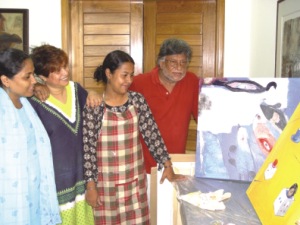 As
the steel-bodied boat arrives, many resort to mock-alarm to
cheer the crowd. Though my photographer and I, both of non-swimming
kind, put up a brave face, we have been apprehensive of the
over-the-danger-mark flow of the water from the start. As
the steel-bodied boat arrives, many resort to mock-alarm to
cheer the crowd. Though my photographer and I, both of non-swimming
kind, put up a brave face, we have been apprehensive of the
over-the-danger-mark flow of the water from the start.
We were
also ready to conquer our fears. The ferry -- a motor-boat
with plastic garden chairs for more than 20 people to sit
with a tarpaulin roof on it -- seems like a stable structure.
As the vessel rushes across the river, dodging the other regular
boats plying along its flow, I see no sign of a rest house
that is supposed to sit on the other bank. Blanketed by trees,
the other side looks like a stretch of untouched land. As
the boat draws near, a brick-built ghat with well-designed
steps becomes visible, I realise the first sign of construction
that strives to blend in with the rural setting.
The rest
house of the Bengal Jute Factory is a modern building surrounded
by a well-planned garden. It is a patch of land designed according
to urban taste. As we disembark, the employees who accompanied
us, and the ones who greet us on the bank, lead us to the
fare that we all came here for -- the Collage Kalpa or a "project
of collage" -- the art workshop conducted by expatriate
artist Monirul Islam.
Amidst
the quaint natural environ, the rest house seems unreal a
place, fit for an expensive weekend away from the treadmill
of Dhaka. Though only 20 or so kilometres away from the capital,
in this hub of nature, all preconceptions must be set aside.
The artists are all working indoors, a few have also lodged
themselves on the veranda. The intermittent rain for the last
two days, has kept the artists packed inside the rest house.
"Otherwise you would have seen them on the lawn or out
on the river bank working on their paintings," says Luva
Nahid Chowdhury, an official of the Bengal Foundation.
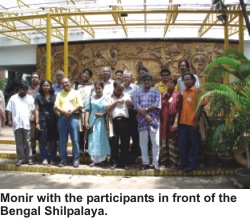
Seventeen
artists from all over Bangladesh are participating in this
Collage Kalpa. Luva puts a different spin on the concept of
collage. She says, "The workshop itself is a collage
of sorts, there are artists of different age and stature."
 The
Bengal foundation has so far been instrumental in stretching
the corporate clout to help nurture art and culture. After
two major art camps and one workshop on art writing, the College
Kalpa is set to bring together artists from far and wide --
not only in terms of where they are working now, but also
of the artistic languages they practice. The
Bengal foundation has so far been instrumental in stretching
the corporate clout to help nurture art and culture. After
two major art camps and one workshop on art writing, the College
Kalpa is set to bring together artists from far and wide --
not only in terms of where they are working now, but also
of the artistic languages they practice.
The word
collage stands for a collection of things. For an image, whether
an oil painting or a water colour, to be called a collage
entails the artist to put together scraps of paper or other
materials that comes outside the canvas or paper. Any painting
with added or extraneous materials in it, is considered a
collage. But here on the bank of the river Bangshi, under
the auspices of Monirul Islam, things have to be a little
different. As we greet the artist of international fame and
ask him how his workshop is coming, Monir, with his usual
humility declares that he is only trying to assume the role
of mediator, one who is here to trigger off the urge to explore
something new.
As a matter
fact, on July 15 -- the day the workshop was inaugurated at
the Bengal Gallery, Dhaka, where Qayyum Chowdhury was present
as chief guest -- Monir asked all the participants to gear
up to do something they had not tried before. He was determined
to do something out of the ordinary by using indigenous materials.
Another feature of this workshop, which the artist wished
to incorporate, is that the participant will try and work
on corrugated and grey boards. Monir, with his usual panache,
and a tendency to transgress rules, has tried out many materials
as the surface of his paintings. In Collage Kalpa he wants
others to feel that joy of breaking free from the use of conventional
material.
"I
thought we should grab this chance to spend four days away
from the hustle and bustle of the city and try our hands at
something unconventional, resorting to newer materials,"
says Monir. He believes that in collages materials are used
to break the monotony of the picture plain. However, as the
conversation veers to the subject of the strong presence of
nature in all its pristine glory, he says, "One needs
to adapt to such beautiful surroundings. The scenes are comforting
for the eyes. In Dhaka the horizon is blocked, here the openness
seems to overwhelm you." Monir is more than familiar
with the effects of the surroundings on the mind of an artist,
and he has this personalised tenet that he thinks applies
to artists in general -- artists need comfort but they cannot
afford to relax.
Here in
the midst of nowhere, in proximity with the sloshing water
of the river, and with the fresh, damp air constantly presenting
the distinct whiff of the virgin nature, one tends to lose
oneself in oblivion. Artist Rafi Haq, who lodged himself on
one corner of the veranda, says that he is struck by a strong
sense of nostalgia. "I grew up beside a river in Kushtia,
and I find it hard to keep myself engrossed in work alone,"
he confesses. This 30- plus artist is working on the prescribed
corrugated board, and is contemplating two circles colliding
in the middle of his piece. "It may not remain the same,
a painting that begins with a circle may change into something
else in the end," Haq says to elucidate the uncertainty
that guides the course of the creative process.
 As
for the guideline or the basic principles of art, the man
at the helm, Monirul Islam, has humbly asked all the participants
to find their own solutions to the problems at hand. Seventeen
practising artists have their own way of forging an artistic
solution as the works in the workshop testifies. As
for the guideline or the basic principles of art, the man
at the helm, Monirul Islam, has humbly asked all the participants
to find their own solutions to the problems at hand. Seventeen
practising artists have their own way of forging an artistic
solution as the works in the workshop testifies.
In the
two-storied rest house work is in progress in every corner.
Rain keeps them from venturing outdoors. It is the second
day of the workshop and many of the participants have amassed
two or three works. The workshop provides materials for as
many works the artists can produce within the stipulated time
frame -- which is four days. However, each artist is to submit
four paintings at the end of the workshop.
Monir,
the venerable 60-plus artist, has laid out the procedural
map for this workshop. He wanted to demonstrate how the acramyn
colours which come in dust and are usually used for colouring
fabric, can be used. "I brought a strong binder adhesive
from Spain, the artists were provided with the same kind of
materials to make their own paint," Monir explains. If
there is a rule to follow in Collage Kalpa, it has to do with
the way colours should be applied.
In this
workshop, water-based acramyn colours are put to the test,
and on top of that, one innovative process of making the colour
black is being introduced for the first time. The colour is
made from the dust of charred rice. "I first learnt it
from a Moroccan artist who made a paste from the dust of burnt
rice and achieved a different kind of surface quality,"
discloses Monir. He is dead against keeping technical secrets.
"This is not the age of keeping professional secrets
to oneself," he says emphatically. As an artist, Monir
is disseminating the latest technique he mastered. "Technique
can seem like a trap if one cannot use it to achieve one's
own end," he cautions. In the workshop, in going about
doing what artists do well, which is making paintings, all
caution seems to be set aside. The floors of the two-story
building are taken up -- artists at work are oblivious to
the arriving guests. Some even feel a bit trammeled by our
presence, but most keep at their work.
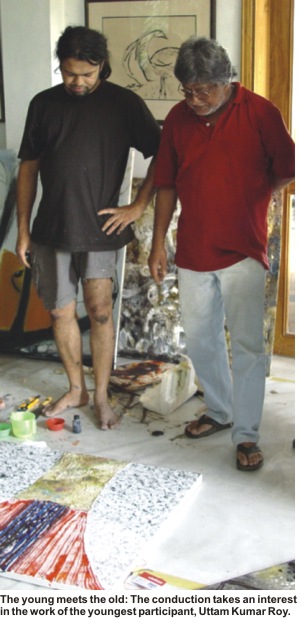
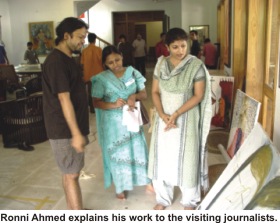
Ronni
Ahmed, one of the youngest participants, is in his usual form
-- full of irony-fueled mirth. If most painters are schooled
in high-art sensibility, he is an exponent of the low. The
first sight of an indigenous collage material on Ronni's canvas
amuses many. I ask the artist how it got there in the first
place. "I just went out for a stroll and noticed these
dried twigs and picked them up to add them to my canvas,"
says Ronni. Monir is duly excited about this, as it is his
contention that the environment will inevitably encroach on
the space of the painting.
In the
warm and cosy interior of the rest house, many other artists
were harping on the subject of communion with nature. In their
usual romantic gesture, the river, the rain, have made their
way into the otherwise abstract expressions.
Ronni
too believes that newer things and ideas are creeping into
his paintings as he is in a different ambience. "Here
the existing expertise of many artists may have been renewed,"
says Ronni. As a keen observer of the art scene, he also explains
that "here in the workshop the tendencies in mainstream
art practices are distinctly surfaced". When I ask him
about the effort each artist puts in is work to attain a distinct
personal identity, Ronni retorts, "The idea of 'self'
is absent in our time, identity itself is determined in context
of a changing reality as there is nothing constant in the
world." Ronni ventures more into his philosophical terrain
and explains how the trends in art relate to the patterns
of civilisations which are always virtual in nature.
 Meanwhile,
in the glass-walled left corner of the ground floor, a virtual
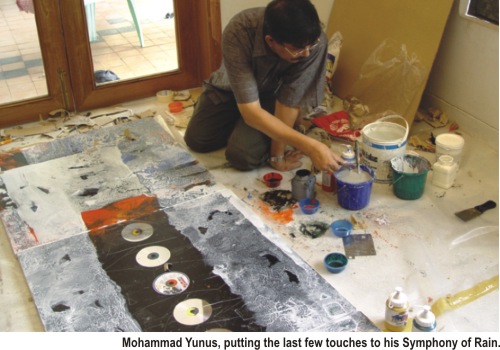
play on rain is in progress. Eminent artists Mohammad Eunus
is melding his brush on an almost finished painting. Ronni
is working on canvas right next to him, but Eunus is working
on the prescribed corrugated board. In fact he is the only
artist who should feel most at home working on corrugated
board. He is used to it, as he has been working on similar
surface for the last ten or so years. Meanwhile,
in the glass-walled left corner of the ground floor, a virtual
play on rain is in progress. Eminent artists Mohammad Eunus
is melding his brush on an almost finished painting. Ronni
is working on canvas right next to him, but Eunus is working
on the prescribed corrugated board. In fact he is the only
artist who should feel most at home working on corrugated
board. He is used to it, as he has been working on similar
surface for the last ten or so years.
"Corrugated
board itself is a painting. Once the board is peeled, the
layers are a visual feast to the eye. Often there are signs
and letterings on the board that can be used as elements,"
Eunus exclaims.
He puts
several CDs on the middle in a row in his longish work laid
out on the floor. "They are to affirm my connection with
modern technology," the artist comments. The work, according
to Eunus, is a symphony of rain.
Right
beside him, another visual symphony is in the making. It is
a unique experience to witness so many artists working so
close to each other on multiple works.
Nilufer
Chaman, who boldly declares to her neighbour that she has
reached 42, certainly looks younger in person. She is busy
working on a Durga's hand spinning the chakra while talking
to the 50-plus artist Yunus. Although Chaman is adamant about
not conceding her artistic principles and start doing the
informal abstraction that some have taken up, the two agree
on one point: that the workshop provides a space where artists
can interact as co-workers.
"This
is the first time I am getting to know you by talking to you
in an informal manner. I have known you through your art,
but now this workshop has created an opportunity to interact
on a personal level," Chaman lets her neighbour know.
However,
she is unflinching in retaining her own signature image. "I
don't belong to the mode that sir (Monir) practices, so I
thought I would learn his techniques and wait to use them
at an opportune moment," she declares.
Her other
nieghbour, Tarun Ghosh, is intent on using the recently acquired
knowledge with zeal. He applies the black colour made out
of the rice dust in all three of his works. Ronni and Eunus
both try out its application with excellent results. As far
as collage is concerned, however, Ghosh, has his usual kind
of material, which is the golden and silvery papers taken
out from cigarette packets.
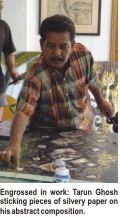 "I
have the habit of collecting them, they add to my imagery,"
Ghosh says. "I
have the habit of collecting them, they add to my imagery,"
Ghosh says.
"As
Monir sir has demonstrated, the corrugated board holds immense
possibilities, all I am trying to do is combine this with
my own images," he adds, insisting, nevertheless, that
his subject-matter essentially remains the same, only the
technique has seen a newer direction.
Here,
in the middle of all such artistic drama, most participants
value one thing -- sharing of the experience and ideals. As
Ghosh puts it, "It is an opportunity to observe the relationship
each artist has with his or her work."
Artists
at work, applying their own crafts with their idiosyncratic
styles, the transforming of canvases or paper after going
through phases after which little remain in the final products,
all this is revealed to the layman's eyes in a workshop. For
any visitor intent on coming to an understanding of the creative
process, a workshop of this nature opens up hitherto unknown
doors.
Three
young women artists have placed themselves in the small space
at the end of the stairway. Meanwhile Zahed bhai,
our photographer, has acquired a better digital device from
Monir himself. In fact, he has been trusted to record the
day's events for the maestro. As we walk up to the second
floor, the glass-walled corner allows for a view of the roof,
where we spot Dilara Begum Jolly and Tayyaba Begum Lipi, two
well-known artists. We walk up to them and interpolate their
bi-lateral exchanges with greetings. It rained a little while
ago. The grey sky and the dampness in the air make the surrounding
landscape look more like an atmospheric rendition of a reality
in water colour.
As we
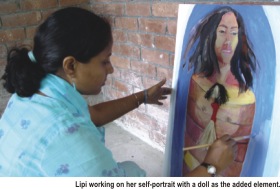
walk back to the works, which are in progress, Lipi says that
she has lodged herself on the second floor to avoid the crowd.
She had to stop working because the rain intervened. She sits
right beside the door to the roof, where her painting of a
human figure with a hand-made doll attached to it is splashed
with the light.
"Since
it is a collage workshop, I thought of using leaves as an
added material," says Lipi. It is the submission of four
paintings that keeps bothering her. "The obligation to
produce four works in four days is something that I can never
really feel comfortable about," adds Lipi. She and her
companion Dilara Begum Jolly, both announce with jest that
in this drenched weather adda is a better option than working
on canvas or paper. On the second day of the workshop, both
the artists, Lipi in her mid 30s and Jolly in early 40s, have
received their fair share of newsmen and visitors since morning.
The only canvas Lipi is working on looks finished. But she
says, "If I had time I would've changed it to something
else." Certainly the method of her work -- which is a
meticulous one -- does not allow her to wrap things up in
a hurry.
 However,
her neighbour Jolly's style of work suits the conditions laid
down by the organisers. She has even worked on a series of
small paintings applying the newly acquired knowledge of making
blank ink-like paint with charred rice. However,
her neighbour Jolly's style of work suits the conditions laid
down by the organisers. She has even worked on a series of
small paintings applying the newly acquired knowledge of making
blank ink-like paint with charred rice.
"I
am excited about the whole thing. The new colour has made
me do more," Jolly exclaims. "I have my work on
popular sayings or epigrams. In this workshop, the subject
remains the same yet there is a change in my expression as
I am trying to interpret my immediate thoughts," she
continues.
For Jolly
this workshop has created a possibility for newer things to
be born. She even proposes that a brown colour be made from
half-fried rice dust. As for Lipi, she thinks there is little
time here for formulation of ideas, and it is the chance to
interact, which she believes is benefiting the artists as
a whole. Jolly as well as Shulekha Chowdhury, one of the youngest
participants, agree on this point.
"It
is a small art world, but we still hardly ever have any time
for social intercourse. This workshop is an opportunity to
start that process," says Lipi.
The workshop
can boast having brought together artists from places far
and wide, and on top of that, ones who pursue varied methods
as well as artistic principles. From Shulekha, who made a
name for her playful depiction of objectified women in our
society, to Shiddhartha Talukder, who has settled in Rajshahi
as he is an associate professor in the Fine Arts Department
in Rajshahi University, to portrait based artist Shahjahan
Ahmed Bikash, to landscape artist Alokesh Ghosh, the workshop
strived to cut a swathe through the whole spectrum of the
arts. It has even dared to put younger generation exponents
of the new with that of the old guards. Hamiduzzaman Khan,
Mohamamd Eunus, Ranjit Das and Shishir Bhattachargee -- these
illustrious artists were given a turf. We could not have the
chance to meet Shishir da as he fell ill and joined the workshop
the day after.
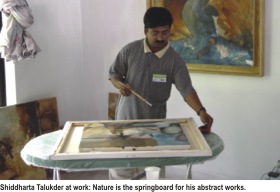
For artists
like Talukder and his colleague in the RV Golam Faruq Babul,
it has been a way to reemerge into the art scene of Dhaka.
Talukder's biggest discovery has been the corrugated board.
"I have been doing non-figurative works for the last
few years, and as I have tried to base my compositions on
landscape, the corrugated board has given it a new dimension,"
says Talukder. Media is not an important factor for this 40-plus
artist. "Now I have found the cheapest way to make art,"
boasts Talukder.
 It
is a pity that in Bangladesh, at every art institution, water-based
colours are looked down upon. Oil -- the most expensive medium
-- is taught in a way as if the value of a work depends on
the medium. It
is a pity that in Bangladesh, at every art institution, water-based
colours are looked down upon. Oil -- the most expensive medium
-- is taught in a way as if the value of a work depends on
the medium.
Before
Monir burst into the scene in the early 90s, here was this
fined notion that water colour could only be a vehicle of
landscape and design. The culture of dabbling into visionary
stuffs using water-based medium is a recent development. And
the workshop at Fordnagar is a testimony to its rise in the
rank among practising artists.
It is
afternoon, the time to shift our mental gear from art to art
connoisseureship. The roundtable is the foyer served as the
venue of an informal press conference. Abul Khair Litu, Chairman
of the Bengal Foundation, and Monir, the conductor of the
workshop, answer the queries of the newsmen. While Monir rules
out any sudden burst of enthusiasm on the part of the buyers
in Bangladesh to acquire art works, he thinks the present
conditions are conducive to the art scene. Litu pledges to
continue with his effort, which will see a gradual broadening
of their network spreading to the far corners of Bangladesh.
But what he feels is the most urgent need of the time is that
more private foundations be built to promote art and artists.
Luva sums up their recent activities that includes a show
in Jessore in collaboration with Charupeeth, a local organisation
for artists, which is scheduled to open on August 6.
During
the conference, some of the journalists complain that art
at the government level seems to be slipping out of sight.
School level art training has become almost nonexistent which
has contributed to the downgrading in artistic sensibilities
among the masses.
From this
populist concern, we are soon released. As the steamy white
rice, the edible kind, is heaped up on several dishes, we
know that we have to rush for the nearest wash basin with
running water.
Lunch
is a treat comprising of fried chicken, fish, vegetable and
daal. As we are wiping our hands in our handkerchiefs ready
to forage for tea, an announcement lets us know that the boat
has arrived and at 4 pm, the bus will depart. So, that is
the end of a day at the workshop.
Some days
later, at an opening of an art exhibition, Monir is surrounded
by a few of the younger participants. "We should go back
one day to have a look at all the paintings to find out how
they will look now," enthusiastically says Monir. The
compulsion to do this moves all.
Bikash,
who finished his tenth painting on the last day, says, "It
was the last two days that I was most productive." Ronni
Ahmed produced eight in all. However, it is not the number
that they are enthusiastic about, but the urge to create that
overwhelms them, and it is evident that this was an immensely
enjoyable experience. A workshop is not only an occasion to
pick up a few tips, it is a platform where creative minds
may have the chance to get the stimulation that is in such
short supply in every-day existence.
Copyright
(R) thedailystar.net 2004
| 