|
Education
Where
have all the English Language teachers gone?
BELTA
Revisited
Razia
Sultana Khan
There
was a hush of expectation broken every now and then by a muted
comment and a snippet of conversation from the assembly of
people gathered in the auditorium of the British Council on
Thursday, July 15, 2004. They were an assorted group of people
from all parts of Bangladesh linked by a common profession,
similar aims and a variety of ideas. For many there was the
euphoria of being part of a conference for the first time.
Home for
the summer vacation I was told that BELTA (Bangladesh English
Language Teachers Association) had been revived after almost
two decades and was organising a conference on July 16 and
17. In the middle of summer inertia I decided it was easier
to refuse when asked to present a paper for the conference,
especially since I had the excuse, "it's too short a
notice." I wasn't allowed to cop-out though, and Arifa
Rahman (President, BELTA) told me, (no requests this time),
that she had put my name down as the moderator for one of
the sessions. Arifa Rahman and I go back a long way and having
been a student of hers at a TEFL (Teaching of English as a
Foreign Language) course way back in the mid '80's, "No"
was not an option. My session was on day 2 but having been
roped in I decided to turn up the first day in the hope of
meeting old friends and acquaintances.
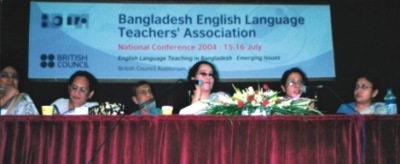
Forum
on ELT and Teaching Development: (from left) Dr Mobasherra
Khanum, Dr Arifa Rahman, Karim of Karim International, Razia
Sultana Khan (Moderator), Suraiya Huda and Kishwar Kamal
I
listened to the discussants and the presenter on the podium
but part of me was busy drinking in the atmosphere of the
conference. Admittedly the auditorium was not as full as one
would have expected but what it lacked in physical strength
was more than made up by the excitement.
During
the morning tea break I placed myself strategically near the
doors of the auditorium. I wasn't disappointed. Screams of
"Razia!" "Apa!" "Madam!" and
warm hugs, depending on whether the person was a friend, a
junior colleague or an ex-student. Others came up to me and
reminded me of the BELTA conference the first time around.
There was no way I could forget that. It was the early 80s
and I was out teaching for the first time. Still not certain
whether I wanted to take up teaching as a profession, I had
let myself be seduced, more by vacant teaching posts than
any strong commitment. BELTA was in its heyday and the then
executive members, Abdus Selim and Hamidur Rahman had wanted
me to take a more active part. New to the profession and very
insecure, I had shied away with the easy promise of "the
next time." I had however listened attentively to all
the papers presented and it had been my first exposure to
a conference.
Twenty
years later from the vantage point of experience and countless
conferences under my belt, I looked around at the young eager
faces, and felt their excitement. It wasn't just BELTA I was
revisiting, it was part of my youth.
I realised
how far I had come when, at the absence of a speaker, I needed
little persuasion to face a session and give an extempore
presentation on "Preparing an Effective Lesson Plan."
The strategies learned in the last 20 years came to my aid
and feeling a rush of adrenaline, I was able to provide my
bit to keep the wheels of the conference turning. Teachers
need to be improvisers and be ready for all eventualities.
Who has not faced at least one of the following situations?
You're ready with wonderfully detailed Over-Head Transparencies
and find out you there is a power outage. You have a great
handout and the photocopier breaks down. Or you prepare group
work for a particular class and then find yourself in a room
where the desks have all been nailed down. Did I mention that
the class had 250 students?
Two forums
were held the first day. One on employers' perspectives of
needs and standards of English and the other on ELT Issues
at primary, secondary and tertiary levels. Speakers as diverse
as an editor of a newspaper, a publisher, a lawyer, the CEOs
of a bank and of an advertising company as well as the managing
director of a tobacco company, looked at the standard of English
from the employers' point of view. The gist of the discussion
was the low language proficiency of prospective employees
and the need for better English.
The Second
forum dealt with ELT (English Language Teaching) issues at
primary, secondary and tertiary levels. The discussion was
a little more diverse here though the problem of recruiting
proficient teachers came up again. There was a suggestion
from one of the speakers, that more communicative books be
written and made available to students. This issue also took
me back, to 1995 this time, when together with three other
teachers we had been asked by NCTB (National Curriculum and
Textbook Board) to write a communicative English text book
for Class V. We set to the task with gusto, visualising the
change we would, in our own small way, be able to bring about
in English language teaching in the schools. With typical
Bangladeshi urgency we were asked to finish the book the day
before we had our first meeting. But one learns to work under
that sort of pressure and "if only we had more time,"
is the underlying cliché in almost all projects in
Bangladesh. Suffice it to say that we finished the book in
three months. The following year I was in my village in Chandpur
and on finding out that a young cousin of mine was in grade
V, I asked to see the book (perhaps hoping subconsciously
to rise in her esteem). She brought me a book which looked
totally alien, though the cover boldly proclaimed that it
was indeed "ENGLISH FOR TODAY" and in smaller letters
"For Class Five." On flipping through it I found
that 90 per cent of it was written in Bangla. Do not mistake
me, I love Bangla, but my concern was in seeing it in English
textbook, especially since the actual writers had refrained
from using any Bangla. A ghostwriter had taken the trouble
to translate all the communicative exercises and instructions
into Bangla (and not too accurately). The names of the teachers
had been lumped together as "written by three teachers."
(I must admit this totally punctured my pride). The government
books would have been distributed free of cost or at a very
nominal price, but now the students were expected to pay for
it. The real tragedy was that though the intention to improve
had been genuine enough, the link had fallen apart somewhere
along the line.
The third
and last forum held on the concluding day was on Teacher Development.
It was a real honour for me to be the moderator here, not
just for the fact that we had an august panel of teacher educators,
but because two of the discussants, Soreya Huda and Mobasherra
Khanum were old class-friends from Dhaka University.
The discussants
spoke of the lack of extensive programmes on the teaching
of English. They informed us that, even institutes which provide
teacher training, as well as in-service training for school
teachers, do not stress the teaching of the English language
and that one could become a teacher in Bangladesh with no
formal academic training. Though most of us knew that intuitively,
it was a shock to hear it from the podium. Another truth that
was voiced was that despite the call for and desire to make
classes more communicative, language classes were still lecture
rooms. "Most teachers do not like the communicative method,"
a couple of participants pointed out. And would we if we did
not have some knowledge of what it involved nor the communicative
ability ourselves to use it effectively in class? We also
have to ask ourselves, do we have the best teachers at the
primary and secondary levels? This is where minds are formed
and foundations forged. The tertiary level can only build
on that and chisel the forms into sharper focus. But we are
also aware of the direct ratio between salary and quality
and that is one area I do not wish to visit at this moment.
I noticed
a definite parting of ways between the presentations in the
initial stages of the conference and the concluding part.
On the first day the emphasis had been on the importance of
starting the teaching of English language at a very early
age but as the conference progressed, the focus moved to the
importance of quality education. For me this was déjà
vu: I'd been there. In a presentation, at exactly the same
spot, some ten years back on the standard of ELT in Bangladesh.
I had suggested, with relevant statistics supporting my argument,
that we start English from grade 3 , instead of grade 1. The
protest from a number of academics was quite violent. It is
sad that the same issue needs to be focused on and discussed
a decade later. Have we not moved at all? It's facile to say
we need English from day one. It may seem like "a good
thing." But what about the logistics? Where are the qualified
teachers we need to teach the millions of students? No one
in management or mid-management who has the difficult job
of headhunting can be unaware of the fact that the trained
English language teacher with proficiency in English is an
endangered species in Bangladesh. The focus needs to be on
teacher training. As groups of teachers become trained, they
can in turn disperse and train other teachers. This would
have a ripple effect and in a few years time our body of trained
teachers would expand. If the initiative had been taken a
decade back we would not be at the same crossroads again.
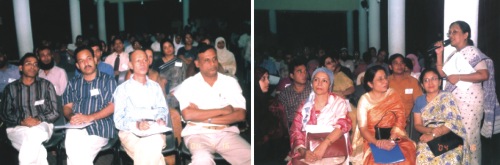
Arifa
Rahman, President of BELTA, addressing the audience in the
auditorium of The British Council
The
concluding speaker was Professor Sirajul Islam Chowdhury,
I listened to him entranced with the rest of the packed auditorium
as he lucidly brought language and literature together. Can
one teach language divorced of culture? Is language not a
vehicle of expression of the people and culture and is not
literature a picture to that culture? It was Friday and close
to Juma prayers, yet the audience sat spell bound.
It's noticeable
that quite a few members of the audience eagerly asked BELTA
to provide ongoing teacher education. This is missing the
point, teacher development is not dependent on outside factors.
It's a life-long process, and involves any activity aiming
to achieve personal and professional growth for teachers.
It can be something as mundane as observing colleagues' classes,
or as casual as reading academic journals and books, and as
formal as attending conferences. In my opinion BELTA had taken
the most important step: it had brought English language teachers
from all parts of Bangladesh together and given them a forum
to express themselves. To know that they are not alone, the
problems they have are not individual ones, and it's not true
that there is no solution.
Over lunch
we did the immediate post-conference discussion (this would
continue for the next few days). The good, the bad and the
"what should have been done," were minutely dealt
with. I over heard the remark: "But what did we get out
of it?" perhaps not too much in the way of the latest
teaching/learning methodology. But even in international conferences
like TESOL (Teaching of English to Speakers of Other Languages)
or AWP (Association of Writers and Publishers) one does not
necessarily come away, with pages of notes, or feel intellectually
more knowledgeable. What one gets is the ambeance of the conference,
the discussions in the corridors, the meetings with people
you know, the making of new friendships and a list of new
contacts. And BELTA 2004 more than satisfied my craving for
that. In my heart I thanked the people responsible for reviving
BELTA and giving me the opportunity to be a part of it.
Razia
Sultana Khan teaches at North South University and is presently
on leave doing her Ph.D. in Creative Writing at the University
of Nebraska at Lincoln, U.S.A.
Copyright
(R) thedailystar.net 2004
|
