Event
Memoirs of a Patriot
A. M. Amin
At a time when role models
in the political arena have become virtually extinct, the
best way to fill such a vacuum would perhaps be to look for
them further back in history. For it is by delving into the
past that we may find figures who have undauntedly stood for
all that we consider noble--truth, justice, democracy. Maulvi
Tamizuddin Khan, a name hardly recalled nowadays, was such
a character in history whose steadfast adherence to his principles,
political acumen combined with personal integrity, makes him
a perfect candidate for role 'modelship'. He is also an antithesis
of the present brand of self-aggran-dising, unscrupulous and
power-crazed politician. The launching of the second edition
of 'A Test of Time' My Life and Days, a book primarily
based on Khan's memoirs, on July 21, is therefore good news
for those who crave for information on political heroes.
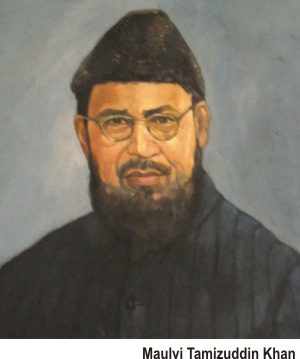 Khan's
political accomplishments alone are enough to warrant widespread
knowledge of him amongst the young generation that is so disillusioned
by the unsavoury politics of their times. Tamizuddin Khan
was twice in the Bengal Cabinet as Education, Food and Health
Minister. He gave up a lucrative legal practice to join the
non-cooperation movement led by Deshbondhu C. R. Das for which
Khan had to endure incarceration. After Partition, Khan was
elected Deputy President of Pakistan's Constituent assembly
when Mohammed Ali Jinnah was the President. Later, when Jinnah
died in 1948, Khan was unanimously elected President of the
Constituent Assembly. The assembly however, was unconstitutionally
dissolved in 1954 by Governor General Ghulam Mohammad. Tamizuddin
Khan, a lawyer by profession, challenged this illegal dissolution
in the Sind Court in the famous Tamizuddin Khan versus Federation
of Pakistan case -- and won. But the case was appealed and
Pakistan's Federal Court set aside the judgement on the basis
of a controversial doctrine. This decision was a blow to Pakistan's
democracy and a preamble to the decades of dictatorship and
military rule that were to follow. Khan's
political accomplishments alone are enough to warrant widespread
knowledge of him amongst the young generation that is so disillusioned
by the unsavoury politics of their times. Tamizuddin Khan
was twice in the Bengal Cabinet as Education, Food and Health
Minister. He gave up a lucrative legal practice to join the
non-cooperation movement led by Deshbondhu C. R. Das for which
Khan had to endure incarceration. After Partition, Khan was
elected Deputy President of Pakistan's Constituent assembly
when Mohammed Ali Jinnah was the President. Later, when Jinnah
died in 1948, Khan was unanimously elected President of the
Constituent Assembly. The assembly however, was unconstitutionally
dissolved in 1954 by Governor General Ghulam Mohammad. Tamizuddin
Khan, a lawyer by profession, challenged this illegal dissolution
in the Sind Court in the famous Tamizuddin Khan versus Federation
of Pakistan case -- and won. But the case was appealed and
Pakistan's Federal Court set aside the judgement on the basis
of a controversial doctrine. This decision was a blow to Pakistan's
democracy and a preamble to the decades of dictatorship and
military rule that were to follow.
These
significant political events are described in detail in A
Test of Time, along with Khan's farsighted analysis of
their socio-political context. This includes the growing divide
among the Hindus and Muslims and the continued repression
faced by the latter group, that would later lead to nationalistic
movements. The first four chapters are Khan's own writing
and covers a period from 1889 when he was born, to 1926 as
he could not finish his memoirs before his demise in 1963.
The rest of the book is a continuation of Khan's life based
on extensive notes left by him which have been reconstructed
by the book's editor Mirza Nurul Huda, Khan's son-in-law with
the help of other family members.
The book's
launching took place at the Bar Association's auditorium of
the Supreme Court. It was here that well known personalities,
including Dr. Kamal Hossain, the main speaker, talked about
the book and about the man who made history by standing up
to injustice no matter what the consequences. The other discussants
were economist Dr. Wahiduddin Mahmud, Dr. Razia Khan, writer
and former university teacher, and the author's youngest daughter,
Professor Begzadi Mahmuda Nasir, founder of Women's University,
Dr. Fakhruddin Ahmed, Professor Ahmed Kamal, historian and
history professor of DU, and former Chief Justice Mostafa
Kamal who chaired the session. The speakers spoke about Khan's
political accomplishments and also gave a glimpse of the type
of person he was -- principled, honest, self-effacing, full
of humility yet with a steely resolve to stand up for what
he believed in.
Khan's
childhood days are described in detail in the first chapters
of the book. Village life of the early 19th and 20th centuries
is recounted, which include delightful accounts of a child's
growing up -- playing pranks in school, being terrorised by
sadistic teachers or inspired by kind ones, the relationship
between Hindu and Muslim neighbours, fishing expeditions,
boat racing, kite flying and so on. But there is also an underlying
pathos in the writing, stemming from perpetual financial hardship
that Khan had to go through. The author, in his lucid and
direct style, describes how his own family became impoverished
after their homestead in Faridpur got washed away by a merciless
river Padma, how his father struggled to gather funds to get
his son educated, his days as a university student studying
English at Presidency College in Calcutta and then completing
his law and MA Degrees from the University of Calcutta. Khan's
life as depicted in the book, has been a great test of endurance.
Apart from financial troubles, Khan had to bear the pain of
losing many loved ones -- a supportive father, a brother,
a sister, a favourite aunt, a doting mother, children and
a loving wife. His days of incarceration are related with
poignancy. The sub-standard food and harsh conditions of the
jail when he joined the non-cooperation movement took a heavy
toll on Khan's health. While in jail, Khan continued to defy
his captors refusing to salute the Superintendent or other
officials risking flogging. Even after he was released he
preferred to take the hard way of fending for himself and
his family instead of using his political connections.
Dr. Kamal,
during his address, said that while reading the book he was
struck by its relevance in today's context. Referring to the
Tamizuddin Khan versus Federation of Pakistan case, Dr. Kamal
said that Khan used his excellent education to defend an unjust
position. Khan's involvement in the non-cooperation movement
at considerable personal sacrifice, his defiance of his jailers
-- all gave evidence to the inherent patriotism of Bangalis
and their desire to fight injustice. "Every young person
who protests against injustice should see Tamizuddin Khan
as a model", said Dr. Kamal.
The first
edition, published by University Press Limited (UPL) was sold
out and this second edition has been published by the Tamizuddin
Khan Trust. A Test of Time is valuable on several counts.
It recreates the socio-political ambience of a momentous period
in the history of the subcontinent. It also documents the
thoughts, emotions and insight of a man who moulded his life
and self to fight for the cause of justice and freedom. In
that Khan is a true patriot whose example, no doubt, will
remain timeless.
Copyright
(R) thedailystar.net 2004
|
