CityScape
Dhaka
under Deluge
Shamim
Ahsan
As
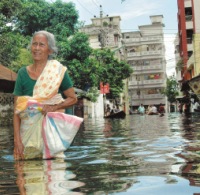
almost half of Dhaka stands drowned by the ever swelling flood
water the sufferings of the city dwellers, are dire straits
specially the eastern parts of Dhaka Gopibgh, Basabo, Madartek,
Mugda Kamalapur, Badda, Manda, Fakirapool, Paltan, Motijheel;
the older parts like Sadarghat, Kaltabazar, Banglabazar, posh
areas like Gulshan, Baridhara are among in the worst-hit areas.
 Flood
water gushing into Dhaka through different entry points are
growing thick with wastes and taking the shade of black, as
it advances deep inside the city. The terrible smell emanating
from the rotten flood water turns the air heavy making breathing
an excruciating task. Cars and scooters have long stopped
to poke their noses into these streets. Rickshaws have gone
obsolete, people now travel by vans sitting shoulder to shoulder
with their legs hanging loosely as the van inches forward
through water. The areas where the water level is higher,
newly-built boats have come into use; but the boatman and
passengers -- both unaccustomed to travelling by boat -- are
making boat journey potentially dangerous as they move along
tilting to one side now and the other side the next moment. Flood
water gushing into Dhaka through different entry points are
growing thick with wastes and taking the shade of black, as
it advances deep inside the city. The terrible smell emanating
from the rotten flood water turns the air heavy making breathing
an excruciating task. Cars and scooters have long stopped
to poke their noses into these streets. Rickshaws have gone
obsolete, people now travel by vans sitting shoulder to shoulder
with their legs hanging loosely as the van inches forward
through water. The areas where the water level is higher,
newly-built boats have come into use; but the boatman and
passengers -- both unaccustomed to travelling by boat -- are
making boat journey potentially dangerous as they move along
tilting to one side now and the other side the next moment.
Accidents
are taking place now and then. Often boats are being turned
upside down resulting in the forced bath of the passengers.
More serious incidents are also happening. In the last two
weeks 3 teenagers have met tragic death when the boat they
were travelling by sank.
As far
as travelling is concerned, office goers are among the worst
affected. Arif Ahsan, a resident of Gopibagh who works at
the main branch of Marcantile Bank in Motijheel, cannot hide
his bitterness as he narrates his plight. "These days
I am starting for office half an hour before than I used to
do before the flood, as I have to often wait for 10 to 15
minutes to get hold of an empty rickshaw. Sometimes, when
I don't have time to wait, I am forced to fold my pants just
above my knees and pack my shoes in a bag. The trouble is
greater when I return home. Since the rickshaw puller cannot
see the terrible condition of a particular road as it remains
under water, the danger of the rickshaw taking a dive into
a hole or one of its wheels slipping into the road-side drain
causing injury to the passenger is greater," Ahsan explains.
Things
are still worse with women. Farzana Karim, a young Lecturer
at a private university in Dhamandi, has stopped going to
university for a couple of days because of flood. Well, there
are rickshaws, but if you want to escape from the black, foul-smelling
and poisonous water you need to sit aaraari or sideways
along the seat as a man can do," Karima points out.
There
are other troubles too. 50-plus Bashiruddin who owns a four-storied
building in Fakirapul, is worried about his reserve tank.
"I have built a brick fence surrounding the reserve tank
to keep flood water from seeping into the tank. I don't know
how long it will work," he says.
People
living in the flood hit areas are living a prisoners' life.
Nurzahan Begum, a resident of Paltan, is extremely bored staying
indoors for days on end. "I used to do the everyday shopping,
but now I am forced to send the boy servant. I am also not
going out for morning walks," she says.
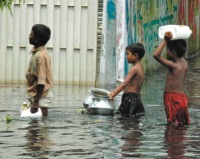 While
flood affects all and sundry, the sufferings of the poor people
living in the different slums are many times greater in comparison
with the middle-class people, who at least haven't had to
leave their homes. Since the flood hit the city a couple of
weeks back, these people have started to take shelter in different
government owned schools, colleges and other buildings. The
back side of Birsreshtha Sepahi Mohammad Mostafa Stadium in
Kamalapur is one such shelter. It is now home to several thousand
homeless people. Its large and spacious space on the 1st and
2nd floor has been divided into a good number of small makeshift
homes, each occupied by a family. Each of the homes has its
boundary, the numerous potla-putli (small belongings
in pouches) people have brought with them when they abandoned
their homes have been arranged in the shape of a rectangle.
Ropes tied like as done in wrestling stages are also used
to mark one's area distinctly. Amid all sorts of household
articles -- from plates to stove and badna to meatsafe
scattered all over the place -- lies a space exclusively devoted
for arranging beds. Beds are prepared of folded sacks and
a folded katha as the pillow. Half-clad and half-fed
children are everywhere -- walking around aimlessly and playing
with the new found pals. Somehow they don't look like as if
they are in any troubles. While
flood affects all and sundry, the sufferings of the poor people
living in the different slums are many times greater in comparison
with the middle-class people, who at least haven't had to
leave their homes. Since the flood hit the city a couple of
weeks back, these people have started to take shelter in different
government owned schools, colleges and other buildings. The
back side of Birsreshtha Sepahi Mohammad Mostafa Stadium in
Kamalapur is one such shelter. It is now home to several thousand
homeless people. Its large and spacious space on the 1st and
2nd floor has been divided into a good number of small makeshift
homes, each occupied by a family. Each of the homes has its
boundary, the numerous potla-putli (small belongings
in pouches) people have brought with them when they abandoned
their homes have been arranged in the shape of a rectangle.
Ropes tied like as done in wrestling stages are also used
to mark one's area distinctly. Amid all sorts of household
articles -- from plates to stove and badna to meatsafe
scattered all over the place -- lies a space exclusively devoted
for arranging beds. Beds are prepared of folded sacks and
a folded katha as the pillow. Half-clad and half-fed
children are everywhere -- walking around aimlessly and playing
with the new found pals. Somehow they don't look like as if
they are in any troubles.
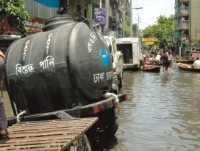 But
in reality life is hard, harder than what appears in the open
eyes. Acute crisis of drinking water is invariably the first
thing the inhabitants would speak of. "We have to buy
drinking water 1 taka per kalshi from the nearby
mosque," says Hosne Ara who is living here with her four
minor children since her home in Maniknagar went under water
last week. Farid Ali, a 40-plus construction worker who is
enjoying a forced leave as the site he was working at has
been swamped by flood water, also complains of the drinking
water crisis. But
in reality life is hard, harder than what appears in the open
eyes. Acute crisis of drinking water is invariably the first
thing the inhabitants would speak of. "We have to buy
drinking water 1 taka per kalshi from the nearby
mosque," says Hosne Ara who is living here with her four
minor children since her home in Maniknagar went under water
last week. Farid Ali, a 40-plus construction worker who is
enjoying a forced leave as the site he was working at has
been swamped by flood water, also complains of the drinking
water crisis.
"An
emergency water supply car from WASA came here yesterday for
just once in the whole week. The tank emptied long before
many of us staying on the 1st and 2nd floor reached there.
Besides, it is impossible for women to collect water forcing
her way through men who raise war to get water."
The absence
of any proper toilet arrangement is also adding misery to
the plight of these destitute people. Children can be seen
attending nature's call in the adjoining open places, helping
germs to spread all around, not to mention the terrible smell
in the air. Many of them are already down with diarrhoea,
while skin disease is spreading fast.
Unfortunately
there has been no help of any sort from anywhere. "We
are living with half of our stomach filled. Women are forced
to go to far away places for attending toilets. We also need
enough drinking water. Will you help us," 60 year-old
Sahera Begum asks expectantly. We should all extend our helping
hands to these suffering souls.
Copyright
(R) thedailystar.net 2004
| 