|
Special
Feature
Bogra dam-cut A-feud leads to a calamity
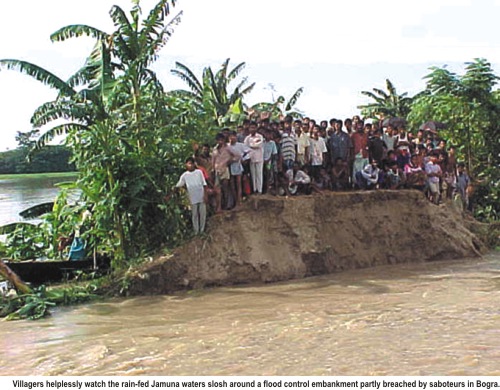
It
was at a quarter to three in the morning on July 14th that
a part of the dam near Shimulbari suddenly gave way. The villagers
were in deep sleep when the Shaharbari, Shimulbari, Chuniapara,
Gosaipara, and Godakhali villages were suddenly hit by floodwater.
The rushing water not only inundated a vast area but also
left many dead in its wake. Four thousand homes were washed
away in that sudden surge of water. The unexpected calamity
originated from a break at the dam that protects a vast area
and its people. The most shocking revelation is that it was
the work of the henchmen of a ruling party leader. According
to newspaper reports, a petty feud between two local Bangladesh
Nationalist Party leaders led one to cut a gash in the dam
letting the surging water to gush through it.
As the
current was strong, the villagers did not get much time to
save their belongings. Many stood by while they witnessed
their homes being taken away by the sudden deluge. Even while
reading the newspaper reports, the aftermath of this human-induced
calamity seemed like an apocalyptic vision. Whether the perpetrators
sensed that their act could have the potential to take such
a devastating turn is not the point here. For any human it
is nerve racking even to think that a dispute could lead to
deluge of such catastrophic proportions. Being the leaders
of the community, how could the people suspected of carrying
out the act of sabotage not think of the consequences? The
very act serves as an example of how politics has become an
abstract game on an imaginary chessboard just to get an upper
hand in every occasion for the people at the helm. Although
there were denials from the BNP bastion regarding their leaders
having a hand in the dam-cut incident, the circumstantial
evidence points to sabotage.
Call it
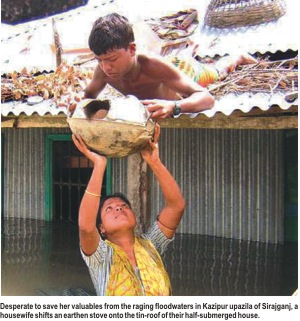
sabotage or 'fate' of the villagers, the calamity cost dearly
both in terms of lives and property. Over 3,000 people lost
their homes. While around 60 villagers remained missing, death
counts, two days after the dam-cut, stood at six. The local
leaders claimed the dam at Shimulbari of Dhunat Thana needed
fixing, although the observation of the engineers belonging
to the Water Development Board (WDB) refuted this. They denied
having seen any volatile point in the dam, especially in that
area near Shimulbari. The water level in the Jamuna river
was flowing not only over the danger level, but also in fierce
velocity and the cut had made the water to rush in and level
off the part of the dam resulting in the immediate flooding.
A Daily Star report said it was a 500 metre swathe
that caused the devastating flood. The report also blamed
the alleged saboteurs with links to two pro-BNP groups contractors
for cutting the dam open.
 Pitiably,
while 3,000 people moved onto higher ground after having lost
everything they possessed, government response to the emergency
situation was lukewarm. One day after the incident, BBC Radio
reported that the army was called out to the flood-affected
areas. But the local administration and police could not confirm
it. In fact the Officer in Charge, Zulfiker Ali, bluntly said
to a reporter on the night of July 15 that he had not hear
about such a decision. Pitiably,
while 3,000 people moved onto higher ground after having lost
everything they possessed, government response to the emergency
situation was lukewarm. One day after the incident, BBC Radio
reported that the army was called out to the flood-affected
areas. But the local administration and police could not confirm
it. In fact the Officer in Charge, Zulfiker Ali, bluntly said
to a reporter on the night of July 15 that he had not hear
about such a decision.
It was
not until July 17 that the reports could catch up to the scale
of devastation resulting from the embankment breach. A Daily
Star report put the figure of marooned people to 5.5
lakh. Three days went by without retrieval of the six bodies
that had washed away on that fateful night. Another 60 people
who went missing remained so as no search drive was conducted.
While
BNP and the local authorities were trying their best to prove
that it was not an act of sabotage, the reports in most dailies
confirmed that it was. A Prothom Alo report said
that the conflict between Belal Hossain Babu and Jahurul Islam
Nannu, the two BNP leaders, caused this breach in the dam
that took a heavy toll on lives and property. Rashedul Islam,
an ASO of the Water Development Board (WDB) filed a case with
the Dhunat thana. In the FIR he clearly stated the reason
to be an act of sabotage. As for the two BNP leaders, they
were as usual pointing to each other and were also trying
to raise an accusing finger to the WDB officials. Many villagers
were of the opinion that it is to frame Nannu, Babu, the Chairman,
has made his men do this. This was the local scenario; on
the national level the Deputy Minister for Disaster Management
and Relief Asadul Habib Dulu asked the WDB officials to retract
their comment.
While
talking to journalists at Bogra Circuit House on July 15,
the deputy minister confirmed that "the embankment wrecked
in a natural process". But this did not deter the WDB
officials from repeating the fact that a vested quarter had
cut the dam open, which clearly was an act of sabotage. Dhunat
Sub-Division Engineer Mosharraf Hossain told newsmen that
the point in question was not so weak that it would break
down naturally. The WDB board officials said that there were
30 vulnerable points on the embankment that stretches 262
kilometres from the northern district of Kurigram to Pabna,
"but none of them broke".
The local
lawmaker Golam Mohammad Siraj put a different twist to the
whole affair. His contradictory statement cleared the cloud
that many were set to create. He first said that the feud
did not lead to the sabotage but delayed the repair and then
he went on to add, "The sabotage would not have taken
place if the WDB had allowed Babu to do the (repair) work."
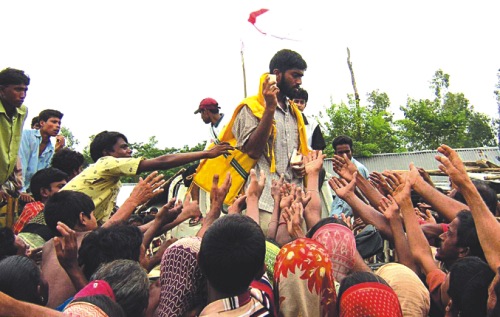
Hungry
villagers in Bogra scramble for relief that has long eluded
them
Imagine
a small feud over the contract of repair work leading to a
huge disaster; this can happen only in Bangladesh. Moreover,
the dreadful reality is that, persons who are willing to doggedly
pursue their personal and petty interest by endangering lives
of a huge population ride power year after year without having
to account for their misdeeds.
Copyright
(R) thedailystar.net 2004
| 