|
Time
Out
A game of mistakes only?
Chess
Is chess
a game of mistakes only? For the beginner or the average player,
that may be true. They usually wait for their opponents to
make some horrible blunder and win without having to do anything.
That's chess at the wood-pushers' level.
There
are many types of mistakes, usually depending on the strength
of the players. A wood-pusher hopes for a checkmate overlooked
by the opponent. He is happy with the win since he knows that
chess is a game of mistakes only. Move a little ahead, and
you meet players who do not rely on gross oversights. They
miss combinations of three or for moves, but not a knight
fork or a mate in one. Moving further along the line, you
find the masters who do not usually miss tactical threats.
They commit positional mistakes which can be exploited only
through patient manoeuvring. Then there is the super-master
level where the mistakes are too subtle for lesser mortals
like us to understand anything. The inanimate objects called
chessmen come to life in the hands of a master. In fact, chess
is played at so many levels that at times you may wonder whether
they are playing the same game!
But even
grandmasters do believe that mistakes, even elementary ones,
influence the outcome of a game. I think it was Dr. S Tartakower
(1887-1956) who said that the winner of a game is the player
who makes the second last mistake. "Mistakes are there,
just waiting to be made", was another of his many interesting
observations. Try to work out the point of this one -- "
Some players don't consider a move strong enough if it is
not audible in the next room"!
Tartakower
was a poet and linguist and, above all, a very witty man.
He never quite rose to the very top, but was a leading player
in the 1920's. He was not orthodox (no poet can ever be!).
Nevertheless, his new ideas enriched the game in many ways.
Here is a game in which the Ukrainian master gives up a rook
like a real gambler and then recovers his money with interest!
White-Geza
Maroczy
Black-Saviely Tartakower [A85]
Teplitz-Schoenau 1922
1.d4 e6 2.c4 f5 3.Nc3 Nf6 4.a3 Be7 5.e3 00 6.Bd3 d5 7.Nf3
c6 8.00 Ne4 9.Qc2 Bd6 10.b3 Nd7 11.Bb2 Rf6 12.Rfe1 Rh6 13.g3
Qf6 14.Bf1 g5 15.Rad1 g4 16.Nxe4 fxe4 17.Nd2 Rxh2 18.Kxh2
Qxf2+ 19.Kh1 Nf6 20.Re2 Qxg3 21.Nb1 Nh5 22.Qd2 Bd7 23.Rf2
Qh4+ 24.Kg1 Bg3 25.Bc3 Bxf2+ 26.Qxf2 g3 27.Qg2 Rf8 28.Be1
Rxf1+ 29.Kxf1 e5 30.Kg1 Bg4 31.Bxg3 Nxg3 32.Re1 Nf5 33.Qf2
Qg5 34.dxe5 Bf3+ 35.Kf1 Ng3+ 0-1.
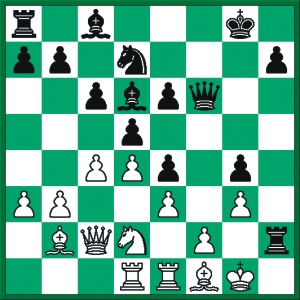
Position
after 17...Rh2
-PATZER
Copyright (R)
thedailystar.net 2004
| 