|
Music
Taking
the Led
Out
Farjad
Ahmed
 Spearheaded
by The Beatles, The Rolling Stones, and The Who in the 60's,
the British rock n roll invasion ( and subsequent unequivocal
domination) across the Atlantic to the US lasted well into
the '80s without any serious threats from American bands.
After the deluge of the '60s, the '70s saw the following three
bands: Led Zeppelin, Genesis and Pink Floyd taking over the
helms of rock music. Representing three very different forms
of rock music, they were the quintessential bands of the time
and at the vanguard of rock music of the '70s decade--the
post Woodstock, post Vietnam era that introduced the word
"inflation" to the common person. Spearheaded
by The Beatles, The Rolling Stones, and The Who in the 60's,
the British rock n roll invasion ( and subsequent unequivocal
domination) across the Atlantic to the US lasted well into
the '80s without any serious threats from American bands.
After the deluge of the '60s, the '70s saw the following three
bands: Led Zeppelin, Genesis and Pink Floyd taking over the
helms of rock music. Representing three very different forms
of rock music, they were the quintessential bands of the time
and at the vanguard of rock music of the '70s decade--the
post Woodstock, post Vietnam era that introduced the word
"inflation" to the common person.
To begin
with, Led Zeppelin sold more albums than any of their rivals
(Uriah Heep, Deep Purple, Black Sabbath, Rainbow, Whitesnake)
and broke concert attendance records throughout the '70s (their
attendance record at the Madison Square Garden in 1976/77
remained unbroken for many years). Though heavily influenced
by blues music, Led Zeppelin had seminal influence on the
genre of music known as heavy metal or hard rock.
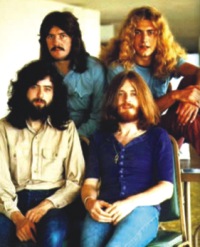
As a band,
Jimmy Page, Robert Plant, John Paul Jones, and John Bonham--were
all brilliant musicians; as a unit, Led Zep was synergy par
excellence. Jimmy Page, in particular, was the lead guitarist,
co- songwriter, co-composer and most amazingly, the producer
of ALL the Led Zeppelin albums. From their debut album in
1968, Led Zep stoked the heavy metal fire that became an inferno.
To be fair, Led Zeppelin did not single handedly "create"
or "invent" heavy metal/hard rock music, but was
undoubtedly an intrinsic part during its embryonic stage.
Led Zeppelin's
music had depth and diversity-- from the highly rhythmic "Whole
Lotta Love", the raw guitars of "Black Dog",
the haunting nine minute "Kashmir", and lest we
forget the classic ballad "Stairway To Heaven",
LZ greatly enriched rock music. Their first album, the eponymous
Led Zeppelin I (one) became one of the top 5 selling albums
of the year in the US. This is no easy feat considering the
stellar competition at that time: The Beatles, Jimi Hendrix,
The Who, Bob Dylan, The Rolling Stones, Doors, Crosby Stills-Nash-Young
etc.
In the
late '60s, Jimmy Page, already a veteran guitarist who had
made his mark with The Yardbirds (Yardbirds alumni also included
Eric Clapton, and Jeff Beck two great guitarists), and bassist
John Paul Jones, set out to form a new band. As the story
goes, Jimmy Page saw Robert Plant singing for a local band
at a club, and when approached, Robert Plant insisted on bringing
his hitherto unknown drummer John Bonham on board. Up until
that point, Ginger Baker (who went to join Eric Clapton and
Jack Bruce to form Cream) was tipped to be the drummer of
this new band. Reluctantly, Page agreed to take John Bonham
and the four thus formed The New Yardbirds. Then when the
late Keith Moon (legendary Who drummer) commented that this
band " will go up like a lead balloon" the name
was changed to Led Zeppelin. LZ's second album (simply titled
Led Zeppelin II) was also a top 5 seller. Their third album
received lukewarm reviews but then in 1971 they came up with
Led Zeppelin IV (also known as "four symbols") containing
such tunes as "Black Dog", "Rock'n'roll",
Battle Of Evermore, and the timeless classic ballad "Stairway
To Heaven", etc. This was to be their milestone and the
album remained in the charts for more than 5 years! Led Zeppelin
had come of age and they were ready to rock the world. They
remained a dominant force throughout the '70s-- becoming one
of Atlantic Records' money-spinners while receiving innumerous
accolades from the leading rock critics and magazines (Creem,
Kerang, Rolling Stones etc.). Unbeknownst to many, Led Zeppelins'
vast portfolio of fans also included such luminaries like
the late great Ananda Shankar (nephew of sitar maestro Ravi
Shankar).
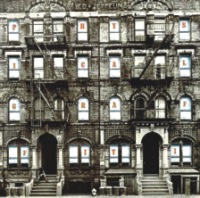
Another
striking feature of the band was their album covers. Done
by the legendary Hypnosis (of Pink Floyd, Yes fame), LZ's
album covers were works of art. An example of Hypnosis' famed
creations can be seen in Led Zeppelins 1975 classic double
album Physical Graffiti - one of the most expensive album
covers in the history of music. Notwithstanding the great
music, one could easily spend hours just toying with the album
cover. Incidentally, Physical Graffiti debuted in #1 in the
album charts of UK and became one of the fastest selling albums
of all time.
 Tragedy
struck the band with the premature death of drummer John Bonham
in 1980. Eleven years and 9 albums later, Led Zeppelin disbanded
in 1981. However, the band's music still reverberates across
the radio airwaves, for any self respecting rock n roll station
worth its name will regularly play Led Zeppelin tunes while
leading rock clubs from London to New York are always paying
tribute to them. At one time, some critics even labeled some
bands (notably Whitesnake) as "Zeppelin clones"
- disparaging perhaps, but true, nevertheless. Tragedy
struck the band with the premature death of drummer John Bonham
in 1980. Eleven years and 9 albums later, Led Zeppelin disbanded
in 1981. However, the band's music still reverberates across
the radio airwaves, for any self respecting rock n roll station
worth its name will regularly play Led Zeppelin tunes while
leading rock clubs from London to New York are always paying
tribute to them. At one time, some critics even labeled some
bands (notably Whitesnake) as "Zeppelin clones"
- disparaging perhaps, but true, nevertheless.
As for
the heavy metal/hard rock aficionados, there were a number
of US bands who, perhaps not as forceful as their UK counterparts,
did contribute significantly towards the development of heavy
metal/hard rock music. Bands like Blue Oyster Cult, Aerosmith,
Steppenwolf, Grand Funk Railroad, Lynyrd Skynynrd, Ted Nugent,
Iron Butterfly, Van Halen did have their outbursts of creativity
in this realm of music in the '70s.
I grew
up to the sounds of these bands and their music still invokes
sweet memories from my bygone days. I am not ashamed to admit,
that a quarter century later, I still get goosebumps and feel
the adrenalin rush every time I hear Led Zeppelin's crashing
intro of the track Rock'n'Roll.
It has,
in the words of Led Zeppelin, "Been a long time since
I Rock'n'Roll..."
[Farjad
Ahmed is an audiophile and works for Delta Brac Housing Fin.
Co. (DBH)]
Copyright
(R) thedailystar.net 2004
|
